
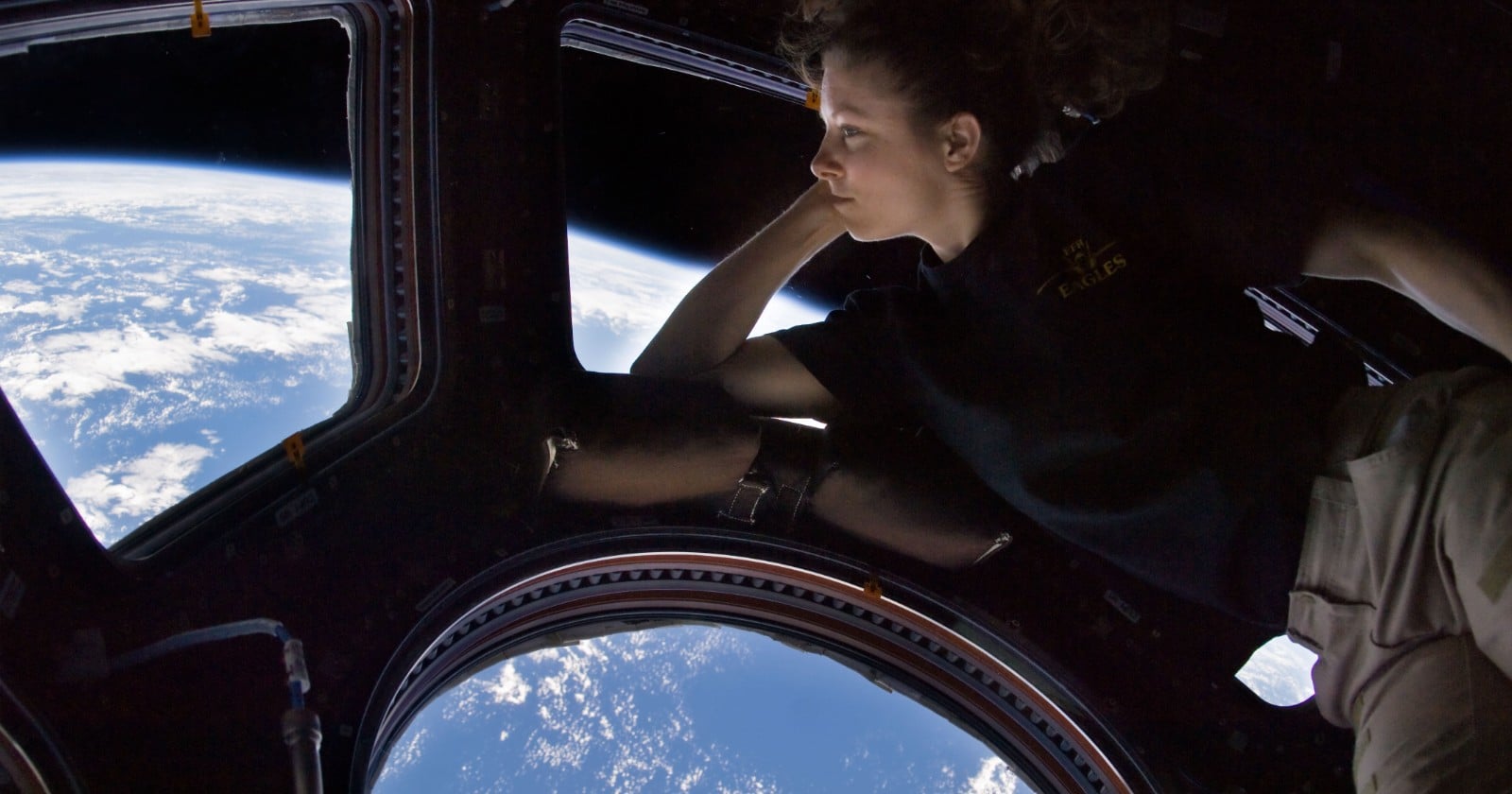
Astronauts have a habit of coming home slightly rearranged. Not injured, not ill, but changed in a way they struggle to name: a loosened sense of where the body ends, a flattening of old priorities, sometimes a feeling that the boundary between themselves and everything around them has gone soft. A new Perspective paper in Frontiers in Psychology takes those reports seriously and offers a provocative explanation. The cause, the authors suggest, is something more elementary than any of those: the disappearance of gravity itself.
Annahita Nezami and Elisa Raffaella Ferre of Birkbeck, University of London argue that Earth’s steady pull functions as what they call a 1G super-prior: a background assumption so constant, so lifelong, that the brain has built much of its model of reality on top of it. Remove that assumption in orbit, they propose, and the mind is forced into a wholesale recalibration that reaches all the way up into conscious experience. Their most eye-catching move is a comparison: at the level of computation, they write, weightlessness may loosen the mind in a way that echoes what happens under psychedelics. It is worth saying clearly at the outset that this is a proposal built on other people’s data, not a new finding of their own.
Gravity as the mind’s steadiest assumption
To follow the argument you need one idea from modern neuroscience: the brain is a prediction machine. On this view, associated with the neuroscientist Karl Friston, perception is not a passive recording of the world but a constant negotiation between the brain’s prior expectations and the sensory evidence streaming in. The more reliable a signal has been over a lifetime, the more weight the brain gives it.
By that standard, gravity is the most reliable signal there is. It has pointed the same direction, with the same strength, every second of every human life. The inner ear’s balance organs report it continuously; it underwrites our sense of up and down, of body position, of which way to reach. Nezami and Ferre’s claim is that this makes gravity not just one input among many but a kind of foundational scaffold, an expectation so entrenched the brain rarely bothers to question it. One psychologist they cite, Jean Ayres, went so far as to call a child’s bond with gravity even more primal than its bond with its mother.
Take that scaffold away and, in their telling, the brain faces a flood of prediction errors it cannot easily resolve. The balance organs still fire, but their signals no longer match anything. The model has to be rebuilt on the fly.
Inside a brain with nothing to fall toward
Here the paper stands on firmer ground, because these physical changes have actually been measured. Spaceflight measurably changes the brain’s structure: imaging of cosmonauts before and after long missions shows the fluid-filled ventricles at the brain’s center enlarging, a change still measurable months after they came home. Researchers link it to the way body fluids drift headward once gravity stops pulling them down.
The authors gather more of this evidence to make their case. One cosmonaut, scanned after 169 days in orbit, showed vestibular regions pulling back from the rest of the brain’s communication network. Group studies report shifting connectivity across areas that handle body sense and self-location. Resting-state recordings show a drop in a particular band of brain activity tied to the mind-wandering “default mode” network, a reduction that in some measures lingered for up to twenty days after landing.
Crucially, the researchers treat these adaptations as recalibration: the brain rebuilding its model for a world with no reliable down. That reframing is the hinge of the whole piece. In their telling, the strangeness astronauts report is what a mind looks like while it relearns its most basic assumptions.
The comparison to a psychedelic trip
The psychedelic parallel is the part most likely to travel, and the part most easily mangled. Nezami and Ferre point out that psilocybin and LSD, in neuroimaging studies, tend to do a recognizable set of things: they boost communication between brain regions that normally keep to themselves, weaken the usual top-down hierarchies, and lower the confidence the brain places in its high-level expectations. The reported result is the loosening of self-boundaries that users describe as ego dissolution.
Weightlessness, the authors argue, may drive the brain toward a computationally similar place, relaxing those same high-level priors and letting lower-level sensory information flow more freely. That, in their framework, is why the sense of self can feel unusually porous in orbit.
But the paper is emphatic about a line that headlines will be tempted to erase. The similarity they claim is purely computational, a matter of how information flows through the brain. The causes could hardly be more different: a drug floods serotonin receptors, while microgravity simply removes a sensory anchor. These are different roads, they suggest, reaching a partly similar destination. The authors explicitly warn that the parallel “should not be taken to imply mechanistic equivalence.” Space is not a drug, and they do not claim it is.
This is an argument, not an experiment
Described plainly, this paper is a synthesis with a thesis attached. It is a Perspective, a format for advancing an idea, and it contains no new experiment, no astronaut interviews, no brain scans of its own. Every concrete measurement in it was made by someone else and is being enlisted in service of a larger interpretation. The measured brain changes are real. The claim that they add up to a loosening of consciousness comparable to a psychedelic state is the authors’ reading of that evidence, and other researchers could read the same scans as ordinary sensorimotor adaptation with no deep implication for the nature of awareness.
Some of the human reports doing work here are soft by design. The Overview Effect, the awe-struck shift in perspective astronauts describe on seeing Earth whole, rests largely on an analysis of a small number of self-reported astronaut accounts, powerful testimony but not the kind of controlled data that pins down a cause. The sense that gravity anchors the self is an interpretation laid over that testimony; the testimony itself measures nothing so precise.
A reader might also note that the work was funded by the BIAL Foundation, which backs research into consciousness and the mind, and that both authors sat on the journal’s editorial board. Funding and editorial ties do not make an argument wrong, but they are part of why a bold and unproven idea deserves a cautious reading.
The experiment nobody has run yet
The appeal of the paper is that it turns a fuzzy, almost mystical set of astronaut reports into something a scientist could, in principle, test. If weightlessness really relaxes the brain’s high-level priors, that predicts specific, measurable signatures in perception and neural activity, the kind of thing a well-designed study on the next long-duration crew could confirm or quietly kill.
Until then, the deeper question stays open. When an astronaut comes home describing a self with softer edges, no one can yet say how much of that is the missing pull of the planet, how much is the overwhelming sight of it from above, and how much is simply a tired brain that spent six months learning to live without a floor. This paper offers a clean story about which of those it is. It has not yet earned the right to be believed, only to be checked.