
The first deep images from the James Webb Space Telescope contained a population that astronomers had not expected to see. Scattered among distant galaxies were compact red points, abundant in the early universe and bright enough to imply extraordinary masses if their light came mainly from stars.
The nickname “little red dots” described their appearance without pretending to explain them. Some seemed to contain implausibly dense concentrations of old stars. Others carried broad hydrogen emission lines normally associated with gas moving rapidly near an actively feeding black hole, yet lacked the strong X-ray and radio emission expected from a conventional active galactic nucleus.
A new interpretation is bringing those contradictions together. In the “black hole star” model, a rapidly growing black hole sits inside a thick cocoon of hot, dense gas. Energy released as matter falls towards the black hole is absorbed, scattered and re-emitted by the envelope. The result can resemble the smooth glow of a cool stellar atmosphere even though nuclear fusion is not powering it. A June 2026 Webb analysis of one especially well-observed dot now provides the strongest single-object evidence for this picture.
Why the dots first looked impossible
Webb began returning science data in 2022, using its infrared instruments to study light stretched to longer wavelengths by the expansion of the universe. The little red dots appeared unresolved or barely resolved, and many existed when the universe was less than two billion years old. Their light often rose steeply at visible wavelengths in their own rest frame, a feature that could be read as evidence for mature stellar populations.
That reading created a serious accounting problem. Packing enough stars into such small objects would require stellar densities far beyond those in ordinary galaxies. Estimates of their stellar masses could also make early galaxy growth seem uncomfortably fast. These objects were sometimes called “universe breakers”, although that phrase ran ahead of the evidence. The more immediate possibility was that astronomers had assigned the light to the wrong source.
Spectroscopy strengthened that suspicion. Broad Balmer lines, especially hydrogen alpha, suggested powerful central engines. At the same time, typical signatures of unobscured quasars were weak or absent. Little red dots were generally faint in X-rays, radio waves and the mid-infrared. The objects seemed to behave partly like dense galaxies and partly like active black holes, but not quite like either familiar class.
What a black hole star would be
Despite the name, a black hole star is not a star with a black hole substituted for its core in the ordinary sense. It is a proposed phase of rapid black hole growth. Gas falling inward releases gravitational energy near the black hole, but the surrounding material is so thick that much of this radiation cannot escape directly.
Instead, photons interact repeatedly with the gas before emerging from a larger effective surface, or photosphere. The envelope reshapes the radiation into a smooth thermal continuum at temperatures comparable to those of cool stellar atmospheres. Calculations of black hole envelopes show how a dense extended structure can confine outflows and reprocess the central engine’s energy into this star-like spectrum.
This model also changes mass estimates. If astronomers assume that most of the red light comes from stars, they can infer a galaxy containing an enormous stellar population. If much of it instead comes from an accreting black hole hidden inside a reprocessing envelope, the host galaxy can be less massive and less mature. The apparent challenge to the standard history of galaxy formation becomes less severe.
A magnified dot yields more than 40 clues
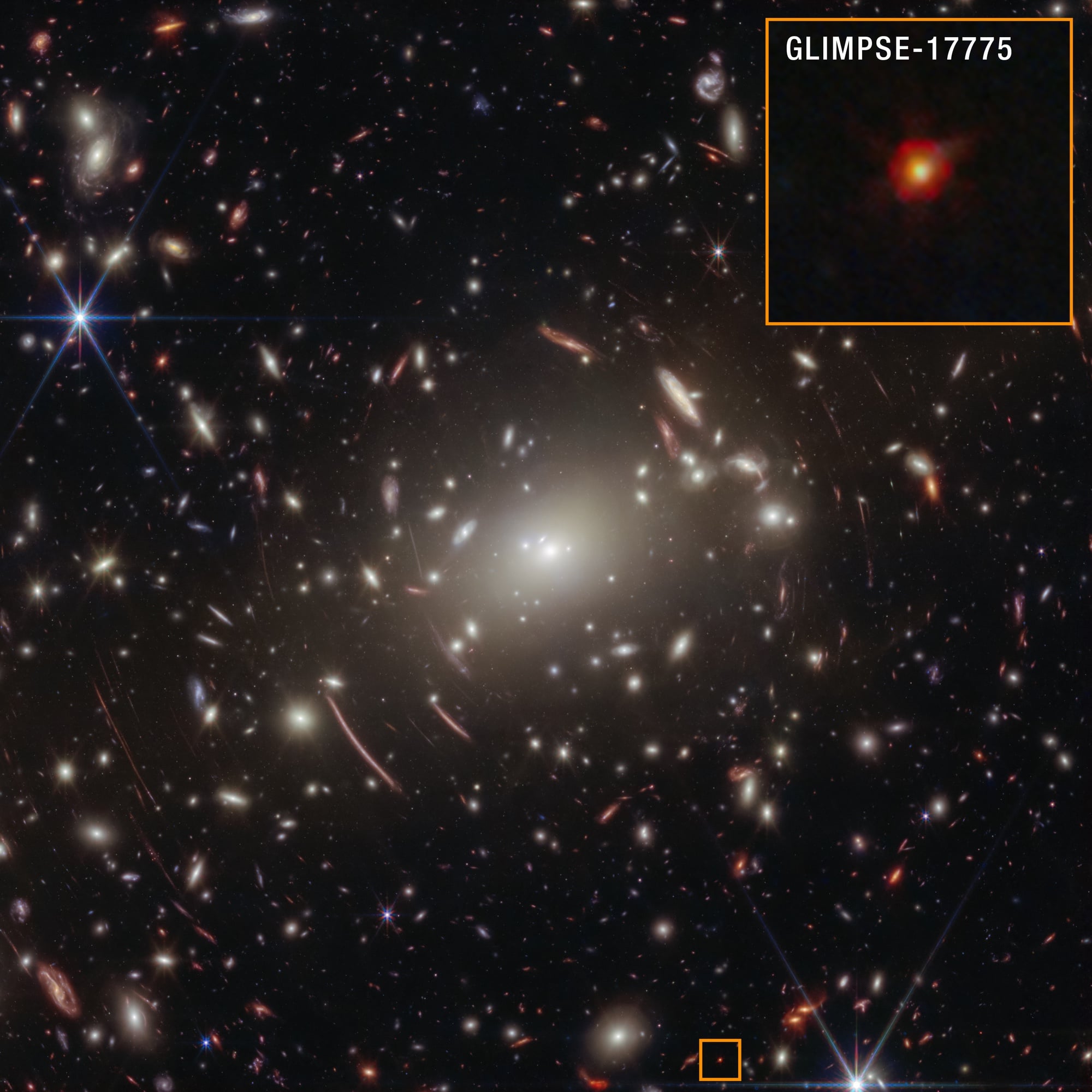
The most detailed test so far comes from GLIMPSE-17775, a little red dot behind the massive galaxy cluster Abell S1063. The cluster’s gravity magnifies the more distant object through gravitational lensing. Webb observed it for 30 hours, but the natural magnification produced a spectrum comparable to roughly 80 hours of telescope time. The object has a redshift of 3.5 and is seen as it was about 1.8 billion years after the Big Bang.
Webb’s NIRSpec instrument separated its light into more than 40 emission and absorption features. The resulting Astrophysical Journal study found several independent signs of a powerful source buried in dense, partially ionised gas.
Hydrogen, oxygen and helium lines did not fit a simple model in which their width came only from gas orbiting at high speed. A model including electron scattering through a dense layered envelope fit better. The spectrum also contained 16 iron lines, described by the researchers as an “iron forest”, whose relative strengths require a strong source of high-energy radiation. Helium fluorescence and absorption offered further evidence that thick gas surrounds that source.
No single feature proves the complete model. Their value lies in appearing together. Electron scattering points to high gas density, the iron requires an energetic engine, and the helium features indicate an enveloping medium. The same cocoon would absorb much of the X-ray emission close to the black hole, explaining one of the longstanding absences in typical little red dots.
Chandra may have caught a cocoon opening
A separate object adds a possible evolutionary link. Astronomers compared Webb observations with years of data from NASA’s Chandra X-ray Observatory and found 3DHST-AEGIS-12014, an object with most of the visual characteristics of a little red dot but detectable X-ray emission.
The team proposed that it could be a black hole star in transition. As the black hole consumes or expels its surrounding gas, openings may form in the cocoon and allow X-rays to escape. Eventually the object could resemble a more conventional active galactic nucleus. NASA’s account of the Chandra and Webb result notes that an unusual dusty active black hole remains an alternative explanation, so the interpretation is suggestive rather than settled.
That transitional idea has received support from another direction. Two little red dots reported in Nature Astronomy show stronger X-ray, radio and mid-infrared emission than the wider population. Their hybrid properties are consistent with dense envelopes dispersing as the objects develop towards ordinary quasars.
A population, not necessarily one answer
The phrase “little red dot” is an observational label, not a guarantee that every member has the same internal structure. Selection methods vary, and an object can meet the colour and compactness criteria for more than one physical reason. Some dots may contain heavily obscured active nuclei, some may have unusually dense stellar populations, and stars in their host galaxies can contribute blue or ultraviolet light.
GLIMPSE-17775 itself illustrates that complexity. Webb and Hubble data reveal a substantial surrounding host galaxy, while the compact red component carries the black hole star signatures. The central source and the galaxy are not mutually exclusive. The question is which one supplies most of the light at each wavelength.
Researchers are now moving from broad resemblance to tests that distinguish models: the shapes and ratios of spectral lines, the temperature of the apparent photosphere, X-ray leakage, variability and the relationship between the compact source and its host. A larger Webb spectroscopic analysis of little red dots finds that their optical continua can often be described by modified blackbody emission and that their line properties are consistent with very dense gas, but it also documents substantial diversity across the sample.
Black hole stars therefore offer a physically coherent answer to several puzzles at once. They can produce compact red light without an impossible concentration of mature stars, hide the X-rays expected from rapid accretion, and provide a short-lived phase in which early black holes gain mass quickly. The latest spectrum makes that explanation much harder to dismiss. It does not yet make every little red dot the same object.