

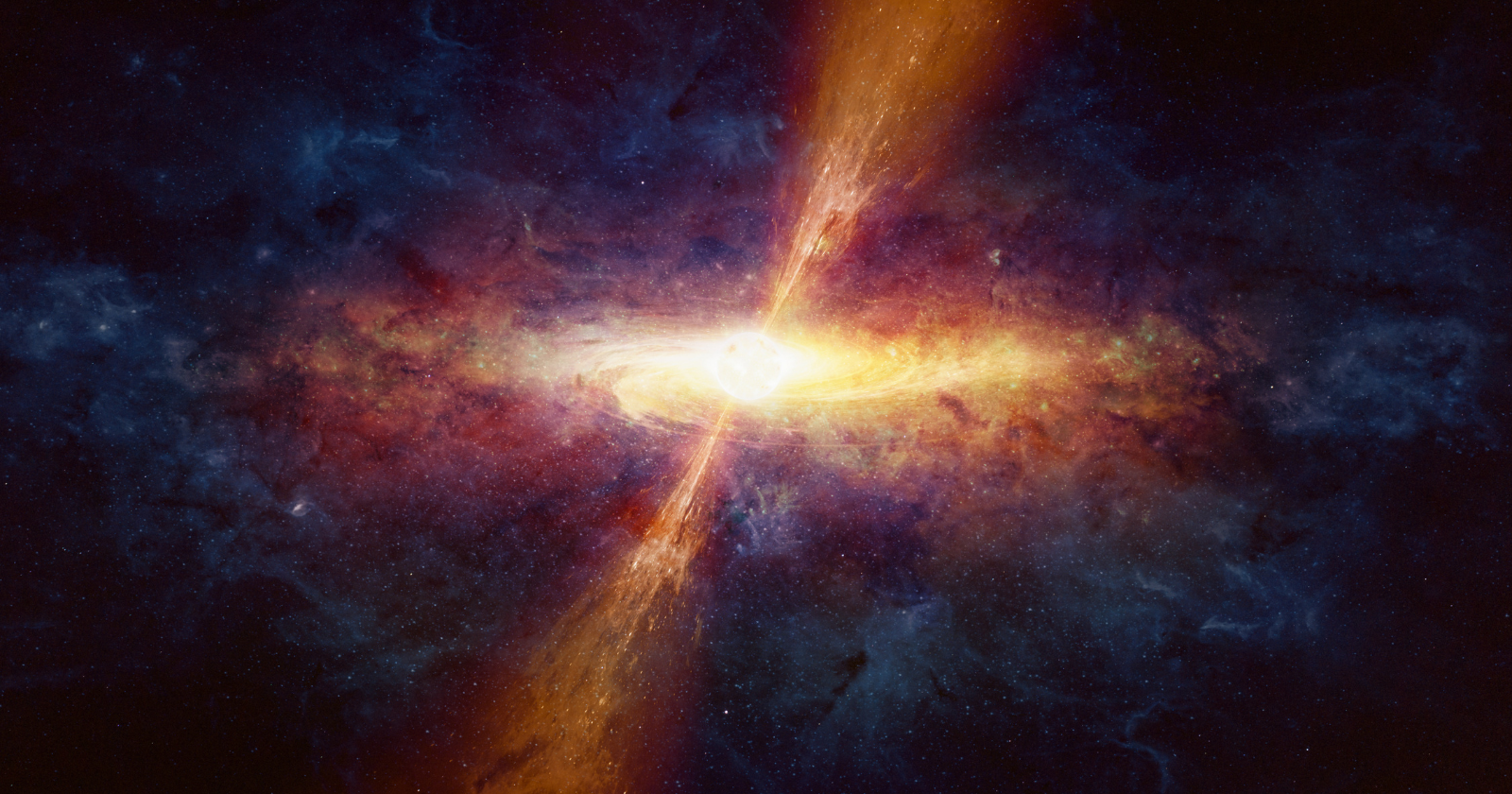
Europe’s Euclid telescope has found 31 of the oldest known quasars in one go, and the haul roughly doubles the number known from that early stretch of the universe.
A quasar is the blazing heart of an early galaxy, lit by a giant black hole pulling in gas so hard that the core outshines the whole galaxy around it. The European Space Agency announced the find on 6 July 2026 and he results were published in Astronomy & Astrophysics as “Euclid: Discovery of 31 new quasars at 6.6<z<7.8“.
What 31 quasars actually means
Finding quasars from this early era has been slow, painstaking work for years. Antonio La Marca, an ESA Research Fellow on the Euclid team, said the result “more than doubles the number of quasars we know of that are so ancient.” He called it the first real survey of these objects. The team, in his words, “has taken a true ‘census’ of quasars at the dawn of the Universe for the first time.”
It took astronomers more than a decade to find the first ten or so of the very oldest quasars, those from the deepest slice of cosmic time. Euclid gathered more than that in about a year.
Astronomers measure how far back they are looking with a number called redshift: the higher the number, the older and more distant the object. Of the 31, 12 sit at redshift 7 or higher, placing them in the universe’s first 770 million years.
The two record-holders
Two objects stand at the front. They carry redshifts of 7.77 and 7.69, making them the earliest quasars yet observed. The previous record-holder, found in 2021, sat at 7.64. The numbers look close, but at this frontier a small step in redshift is a large step further back in time.
Each of these cores shone with the light of roughly a trillion Suns, when the universe was about 670 million years old, only around 5 percent of its current age of some 13.8 billion years. The light Euclid caught set out more than 13 billion years ago and has only just arrived.
Valeria Pettorino, ESA’s Euclid Project Scientist, put the appeal plainly: “Ancient quasars are rare discoveries. They’re interesting in themselves, but also time machines that enable us to explore the early Universe and understand how the first generation of galaxies came to be.”
The puzzle they deepen
The black hole powering each of the 31 weighs around a billion times the mass of the Sun, and that is the problem. Building something that heavy takes time, and the early universe had very little of it. The two record-holders were already fully grown when the cosmos was younger than a billion years, which is a tight window in which to accumulate a billion Suns’ worth of mass.
Study co-author Joseph Hennawi named the discomfort directly. In a statement, he called them “monsters — weighing billions of times the mass of our sun” that “somehow already existed when the universe was in its infancy,” adding, “We don’t yet have a good understanding of how they grew so massive, so fast.” Every new record makes the gap harder to close. As Hennawi put it, “Every step further back in time makes the puzzle more perplexing.”
Daming Yang, the paper’s lead author, said these systems “date back to the Universe’s infancy,” and that studying them helps researchers “understand how these enormous systems formed and grew so quickly,” which he called “one of the greatest mysteries in astrophysics.”
Why Euclid, of all telescopes, found them
Euclid was not built for this. Its main job is mapping dark matter and dark energy across more than one-third of the sky. The mission launched in July 2023 and began routine science operations on 14 February 2024.
Yang explained the shift: “Before, we could only find a handful of the very brightest ancient quasars, but Euclid lets us search far more efficiently across huge areas of sky to capture much fainter light.”
The catch is that these objects are extremely rare in the data. Daniel Mortlock, a professor of astrophysics and statistics at Imperial College London, called it “the ultimate ‘needle in a haystack’ problem.”
This is only a slice of Euclid’s planned six-year survey, and researchers expect it to turn up many more distant quasars, possibly older still. The question astronomers now carry is specific, and likely to sharpen rather than ease: how the black holes lighting these quasars gathered a billion Suns’ worth of mass before the universe was old enough to make that easy.