

Somewhere in a small museum in Montreal, on a shelf funded entirely by community donations, a piece of rock had been holding onto the tube feet of a sea creature that died before dinosaurs, before trees, before anything with a spine had crawled onto land. It sat there, catalogued and unremarkable, until a student at the University of Oklahoma looked at it and said the arms had things on them that shouldn’t be there.
Those little things, roughly the size of a pinhead, turned out to be the second known example of soft tissue ever preserved in a crinoid fossil, and the oldest. The specimen is Dendrocrinus simcoensis, and it is about 450 million years old.
What was actually preserved
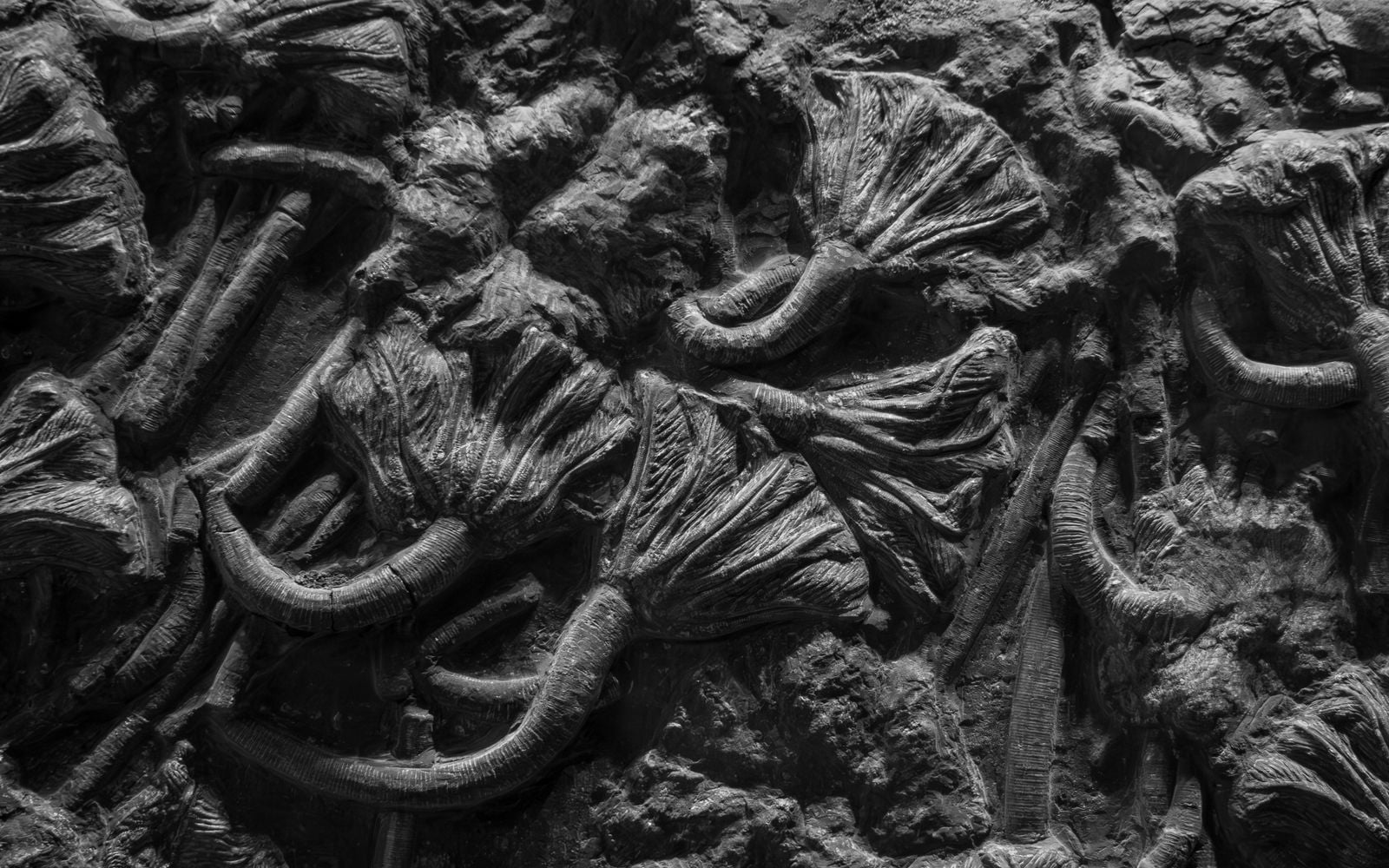
Crinoids look like flowers on stalks. They are not flowers. They are echinoderms, in the same broad family as starfish and sea urchins, and they have been in the oceans since the early Palaeozoic. Their fossils turn up by the millions in limestone quarries, riverbeds and roadcuts around the world — usually as segmented columns and calcite plates that once formed the animal’s skeleton.
What almost never turns up is the soft part.
After an animal dies, skin, guts, muscle and eyes decay first. Bones, shells and skeletal plates can last for hundreds of millions of years. Everything else vanishes within days or weeks unless something odd happens to the body — burial in fine, oxygen-starved mud, quick coating by minerals, chemistry that stops bacteria before they finish their work.
On this specimen, that odd thing happened. The tube feet — small, tentacle-like appendages the animal used to catch food particles drifting past in the current — were mineralised in place along the arms. Lena Cole, the OU paleontologist who led the study, described the preservation to Gizmodo as “one-in-a-million,” and the numbers back the phrase up: millions of crinoid fossils exist, and this is the second time anyone has found the soft bits still attached.
Tube feet are how a crinoid makes a living. They line the arms in rows, catching plankton and organic scraps, then passing the food down to the mouth at the centre of the body. Their size, spacing and geometry are tuned to the currents the animal lives in and the food it eats.
Co-author David Wright, also at OU’s Sam Noble Museum, put it in a statement released through EurekAlert as roughly analogous to teeth in a mammal — the shape tells you what the animal ate and where it lived. A wolf’s molars and a horse’s molars are not the same for a reason. Tube feet carry the same kind of information for filter feeders.
The catch is that tube feet, being soft, almost never fossilise. Palaeontologists have spent more than a century inferring how extinct crinoids fed by comparing their skeletons to living relatives and hoping the analogy holds. On this specimen it does not hold cleanly. Cole told Gizmodo that the ancient animal appears to have “fed and behaved very differently” from its modern cousins, which means a chunk of what textbooks say about early crinoid ecology is built on a guess that this fossil is beginning to challenge.
How old is 450 million years, really
The number is easy to say and hard to feel. Some scale helps.
The oldest known dinosaur skeletons are around 230 million years old. This crinoid predates them by more than 200 million years. When it was alive, the continents were arranged into unfamiliar shapes, most of what is now North America sat south of the equator, and land plants had barely begun to appear as low, moss-like mats along wet ground. Nothing with a backbone had yet walked on land. Insects had not evolved. The reefs the animal lived in were built not by corals as they exist today but by sponges and other early reef-builders, with crinoids swaying above them in dense meadows.
The rock the fossil came from formed during the Ordovician, an interval that ended in one of the five great mass extinctions.
The tube feet in the Montreal specimen were already ancient by the time the first fish grew jaws.
How the fossil was found — and how it was almost missed
The specimen had been sitting in Montréal’s Musée de paléontologie et de l’évolution, a small institution kept running entirely by community donations. Cole and Wright were visiting the collection as crinoid specialists, working through drawers of Ordovician material. According to an interview Cole gave to The Transcript, it was a student who first flagged the specimen — pointing out that there were small structures projecting from the arms that shouldn’t be there on a standard crinoid.
Cole looked, and thought immediately that the small structures looked like preserved soft tissue.
They are, as she described them, roughly the size of a pin. Easy to overlook. Easy to catalogue as noise on the surface of the slab and never look at again. The fossil had been in the museum for years before anyone recognised what it was.
Wright, in the OU release, made a point that runs through the whole story: “There are simply too many fossils to study over one person’s career. There’s more than a lifetime’s worth of discoveries waiting to be found.”
Popular imagination puts palaeontology in the field — a tent in the Gobi, a pick and a brush, the moment the skull comes free of the matrix. Plenty of important fossils do come out of the ground that way. Many others come out of a drawer.
The invertebrate palaeontology collections Cole and Wright curate at the Sam Noble Museum in Norman, Oklahoma hold more than a million specimens. Multiply that across the world’s natural history institutions — the Smithsonian, the Natural History Museum in London, the Muséum national d’Histoire naturelle in Paris, hundreds of smaller regional collections like the one in Montreal — and the number climbs into the tens of millions of catalogued items, most of them never examined in detail by more than one or two people.
Each generation of researchers arrives with new tools. CT scanners that can image internal structure without breaking the rock. Chemistry that can identify preserved pigments. Fresh questions that make yesterday’s overlooked detail suddenly important. The Montreal specimen was not new in any physical sense. What was new was the pair of eyes that recognised the pinhead structures for what they were.
This is a pattern that has come up repeatedly in Life Signs. A recent piece looked at Germany’s national insect survey, where four billion DNA fragments were sequenced from 75 traps and the resulting catalogue still hasn’t caught up to what’s actually there. The same shape shows up here in fossil work: the sampling has already been done. The interpretation is the slow part.
What the study actually shows, and what it does not
The paper describing the specimen was published in Royal Society Open Science. The core claims, per the summaries from the university and independent reports, are these: the specimen is Dendrocrinus simcoensis; it comes from Ordovician-age rock; the projecting structures along the arms are mineralised tube feet; the arrangement suggests a feeding style that differs from modern crinoids.
What the paper does not do is rewrite the family tree. One specimen from one location tells you what one animal looked like. It does not tell you the range of variation across the species, or across the broader group of Ordovician crinoids. Cole and Wright are careful in the reporting to describe the find as a window rather than a survey — a rare data point that constrains previous guesses without settling every open question.
The other known crinoid with preserved soft tissue is younger. This one pushes the record back. But “the oldest example known” is a statement about the fossil record as it currently stands, not a claim that no older examples exist somewhere in a drawer that no one has opened yet.
Why soft tissue almost never lasts
The chemistry involved is unforgiving. Most seafloor sediment is oxygenated enough to support the bacteria that break down organic matter, and those bacteria work fast. A body that lands on a normal patch of ocean bottom will be reduced to skeletal material within weeks, sometimes days.
Exceptional preservation — the technical term is Konservat-Lagerstätten, a German word palaeontologists have kept in their working vocabulary — needs a stack of unlikely conditions. Rapid burial in fine sediment, so the body is sealed off from scavengers. Low oxygen, so aerobic decay slows or stops. The right water chemistry, so dissolved minerals can precipitate onto the soft parts before they finish decomposing, effectively casting them in stone at high resolution.
The famous soft-tissue sites — the Burgess Shale in British Columbia, Chengjiang in southern China, the Solnhofen limestone in Germany that gave up Archaeopteryx — are famous because those conditions were sustained across a whole environment for long enough to preserve entire faunas. The Montreal specimen is a solo act: a single crinoid that happened to die in exactly the right kind of mud on exactly the right kind of day.
What the animal looked like, best guess
Reconstructing a living Dendrocrinus simcoensis from the fossil and its relatives gives you something like a small, feathery lily on a stem. The stem anchored the animal to the seafloor. The calyx — a cup at the top of the stem — held the body’s soft parts. From the calyx radiated arms lined with tube feet, held up into the current to catch drifting food.
The animal did not chase anything. It stood in the flow and let the flow bring it dinner. Whole meadows of crinoids would have swayed together on Ordovician reefs the way kelp forests do today, filtering water that was warmer, shallower and considerably less oxygenated than modern equivalents.
Most of the roughly 600 species of crinoid alive today are unstalked feather stars that swim or crawl. The stalked, sessile forms that dominated Palaeozoic reefs now live mostly in the deep sea, out of easy reach. Watching a modern stalked crinoid on video from a submersible is the closest anyone gets to seeing what a reef 450 million years ago actually looked like in motion.
The Montreal specimen is one fossil. The value of finding it is partly the data it carries and partly the reminder it gives — that the next one might already be sitting in a drawer somewhere, waiting for someone to notice the pinhead-sized things on the arms.
Cole told The Transcript that new discoveries “can come from things that have actually already been collected, as opposed to things that might be new finds from someone working in the field.” It is not a glamorous framing. It does not involve helicopters or badlands. It involves someone with the training to know what they are looking at, pulling open a drawer in a small museum in Quebec, and slowing down long enough to see what has been there the whole time.
The tube feet held their position for 450 million years. They can wait a little longer for the rest of the drawers to be opened.