

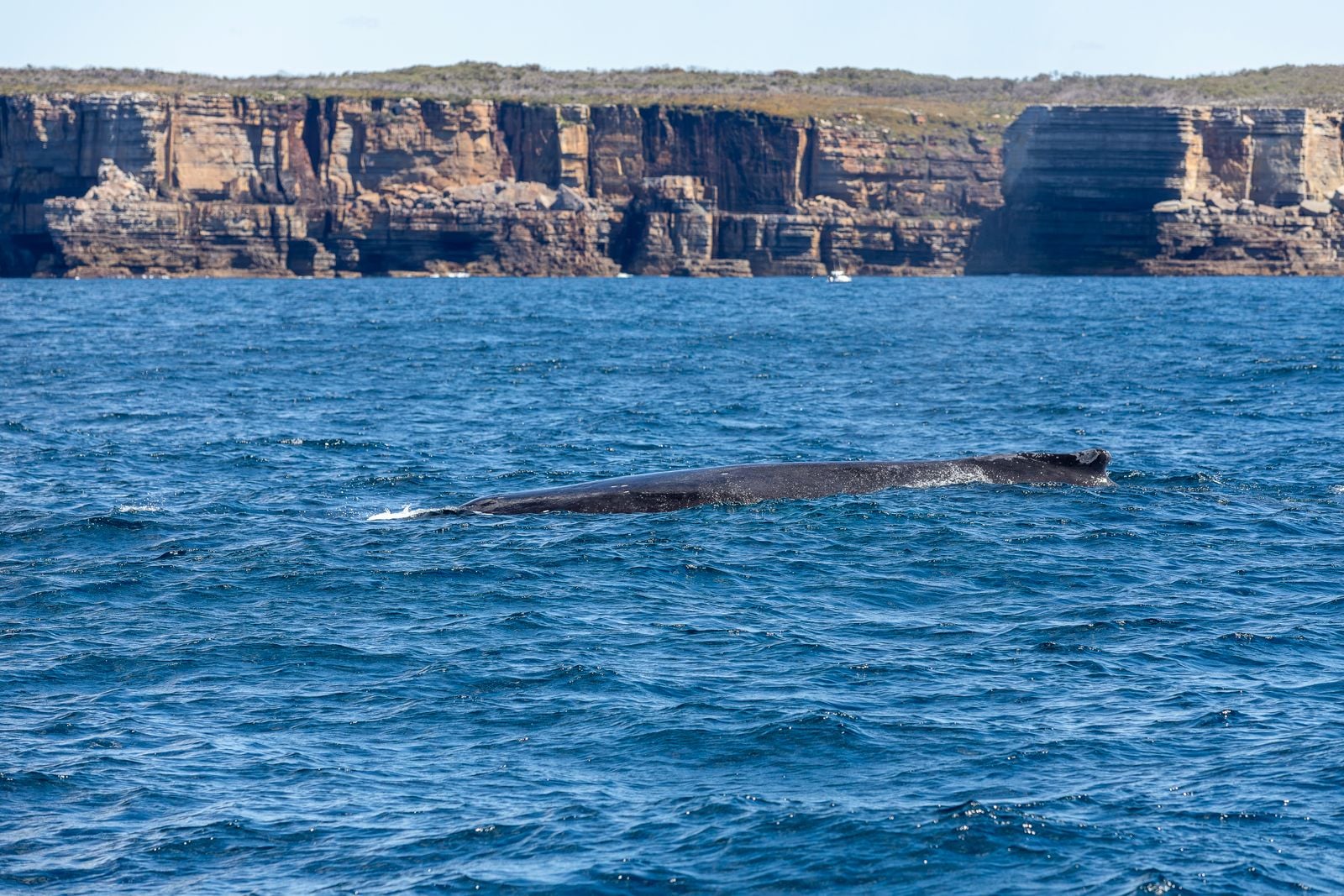
A blue whale’s heart weighs about 400 pounds — roughly a small piano — and when the animal drops into a foraging dive, that heart can slow to two beats a minute. Thirty seconds of silence. Then one contraction, pushing something like 60 gallons of blood into an aorta about nine inches across. It is the largest heart known to have existed on this planet, and almost everything about how it works violates the intuitions built from studying smaller mammals.
The 400-pound figure comes from a specific heart. In March 2014, nine blue whales from the endangered Northwest Atlantic population died after becoming trapped in thick sea ice off western Newfoundland. Months later, two of the carcasses drifted ashore near Gros Morne National Park, at Trout River and Rocky Harbour. The Royal Ontario Museum sent a team to recover skeletons and, from the Rocky Harbour animal, a heart.
Getting it out took four staff plus Miller, pushing the organ through a window cut in the ribs and into a dumpster bag. It was frozen, trucked to Research Casting International in Trenton, Ontario, and thawed over five days. Then the team sealed every vessel and cavity they could find, improvising with buckets, bottles and toilet plungers, before pumping in roughly 2,800 litres of formaldehyde.
Two veterinary anatomists from Lincoln Memorial University’s College of Veterinary Medicine, Robert Henry and Paul Nader, flew in to run the fixation. The heart then went to Guben, Brandenburg, where Gunther von Hagens’ company Gubener Plastinate GmbH plastinated it — no facility in North America was large enough. It arrived back at Toronto Pearson on 15 May 2017 and was installed three days later.
The number that turned out to be wrong
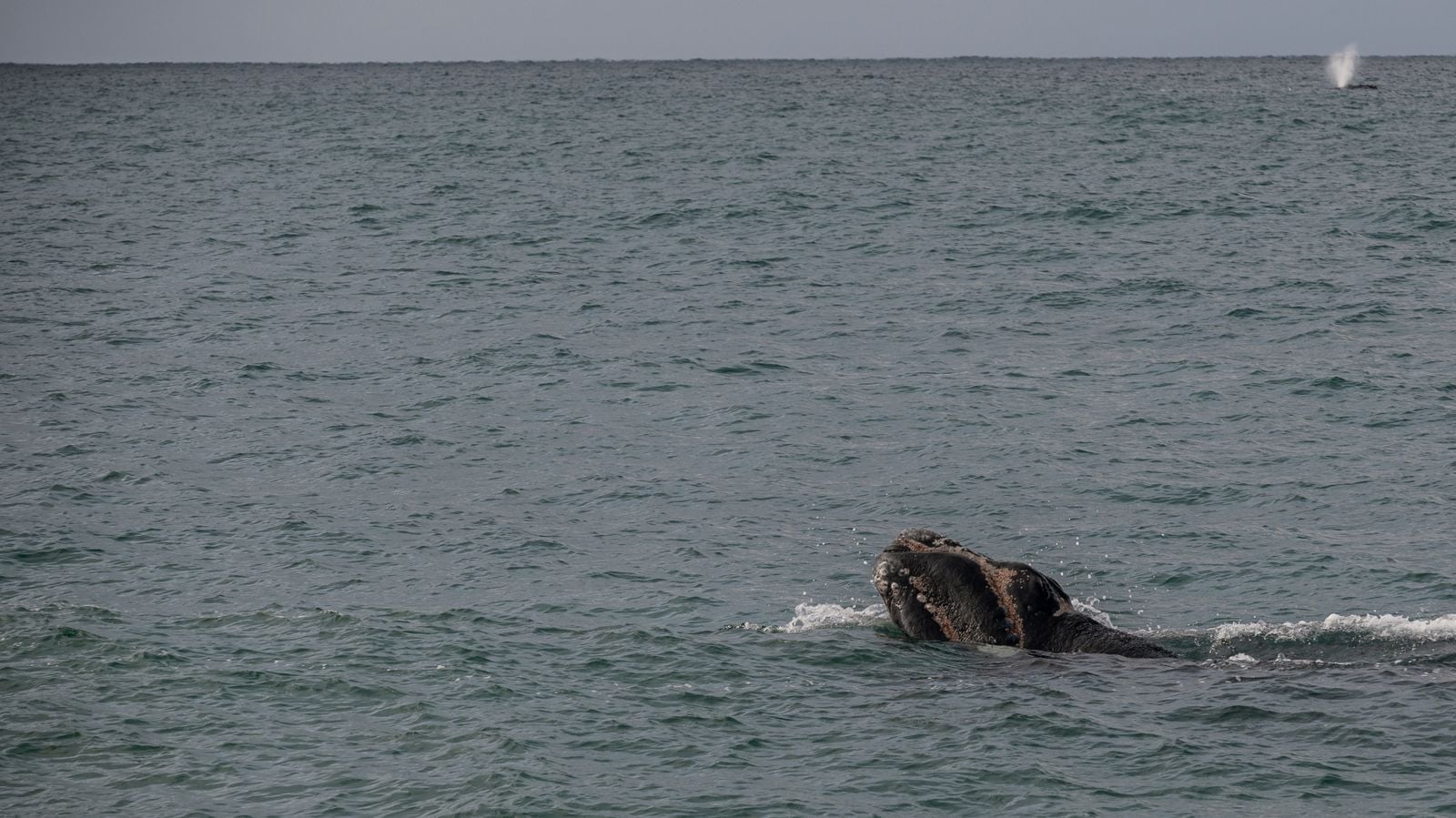
For most of the twentieth century, popular science writing described a blue whale’s heart as roughly the size of a small car — a Volkswagen Beetle, in the version that circulated longest. The comparison survived because nobody had weighed one intact. Blue whales sink when they die at sea. The ones that beach are usually decomposed, scavenged, or too damaged to dissect cleanly.
Miller had expected to pull out something the size of a sedan. What emerged was closer to a small golf cart: about five feet by four, and a great deal less impressive than a Beetle. She has said since that it was considerably smaller than the team anticipated.
The measurements were published in 2017 in the Journal of Plastination by Miller, Henry, Nader, ROM’s Mark Engstrom and colleagues. Fresh mass: 175 kilograms, or 386 pounds. The finished plastinate came out at 106.2 centimetres long and 96.3 wide. Popular accounts round the weight to 400 pounds, and the ROM’s own figure sits there too.
What surprised the team more was the shape.
Not a point, but a fork
A human heart tapers to a single sharp apex at the bottom, where the left ventricle narrows. This one didn’t. The blue whale heart was flattened front-to-back and ended in a bifid apex — split into two points, with both ventricles reaching the tip.
That turns out not to be a blue whale peculiarity. A bifid apex has been described in beluga, sperm whale and killer whale hearts, in harp and ringed seals, and in manatees and dugongs. Surgeons note it as a rare congenital finding in humans precisely because it is standard equipment in marine mammals.
Elephants have one too, which is unusual among land mammals and tempting to read as a scaling effect — something that kicks in above a certain body mass regardless of habitat. The simpler explanation is genealogy. Elephants’ closest living relatives include the manatees and dugongs. Nobody has demonstrated that size alone drives the trait, and the article you are reading should not pretend otherwise.
Two beats a minute
The size is what people remember. The rhythm is what makes physiologists lean forward.
In 2019, a team led by Jeremy Goldbogen at Stanford’s Hopkins Marine Station, working with Cascadia Research Collective and Scripps Institution of Oceanography, attached a suction-cup electrocardiogram tag to a 22-metre blue whale in Monterey Bay. They placed it just behind the left flipper as the animal surfaced, and it held for about nine hours. It was the first heart-rate record ever obtained from the species. The results ran in the Proceedings of the National Academy of Sciences.
The whale dived as deep as 184 metres and stayed down as long as 16.5 minutes. During those dives its heart rate ran typically between four and eight beats per minute, dropping to two. On surfacing it climbed to between 25 and 37.
Two beats a minute is one every thirty seconds. A resting human runs 60 to 100. A hibernating ground squirrel drops to around three. The blue whale — awake, swimming, actively hunting krill — was beating slower than a hibernating rodent.
The mechanism is the dive response, familiar in outline from every diving mammal: bradycardia paired with constriction of peripheral vessels, which shunts oxygen toward the brain and the swimming muscles. What was not familiar was the magnitude. The blue whale pushes the response further than the scaling models had predicted.
There is a complication built into the animal’s feeding. Lunge feeding — accelerating into a krill patch and opening the jaws around a volume of water that can exceed the whale’s own body volume — was described by Paul Brodie in 1993 as the largest biomechanical event on Earth. It arrives in the middle of a dive, at precisely the moment the heart is supposed to be idling. The 2019 tag caught what happens: heart rate rose about two and a half times above the diving minimum during the powered ascent of each lunge, then decayed through the long glide as the engulfed water filtered out through the baleen.
The dataset has hard limits. One whale, one location, one feeding season, nine hours. Blue whales in the Southern Ocean feed differently from the ones off California, and no comparable record exists for a mother-and-calf pair, for an animal on migration, or for a whale startled by an approaching ship.
The plumbing that makes it possible
To move blood through an animal that can reach thirty metres, the vessels have to be enormous. The aorta near the heart measures roughly 23 centimetres across — nine inches, about the width of a dinner plate. That is the source of the widely repeated claim that a person, or at least a child, could crawl through it.
Miller, who had her hands inside this one, drew the line at a human head. Not a body. Nine inches will not admit a set of shoulders or hips, the vessel collapses without internal pressure, and the lumen narrows fast as it branches. The legend was one of the specific things the ROM dissection was undertaken to test, and it did not survive the test.
What the aorta does instead is more interesting than the myth. Each ventricular contraction ejects a very large volume into a vessel whose wall stretches and then rebounds, smoothing the pulse the way a shock absorber smooths a pothole. In smaller mammals this elastic recoil is a marginal contribution. The 2019 team argued that in rorquals the highly compliant, elastic aortic arch is doing something structural: accommodating the ejected blood and maintaining flow across the long and variable pauses between beats. At two beats a minute, most of the circulating is happening between contractions. The vessel is not a pipe. It is a second, slower pump.
Why a heart this large has to stay small
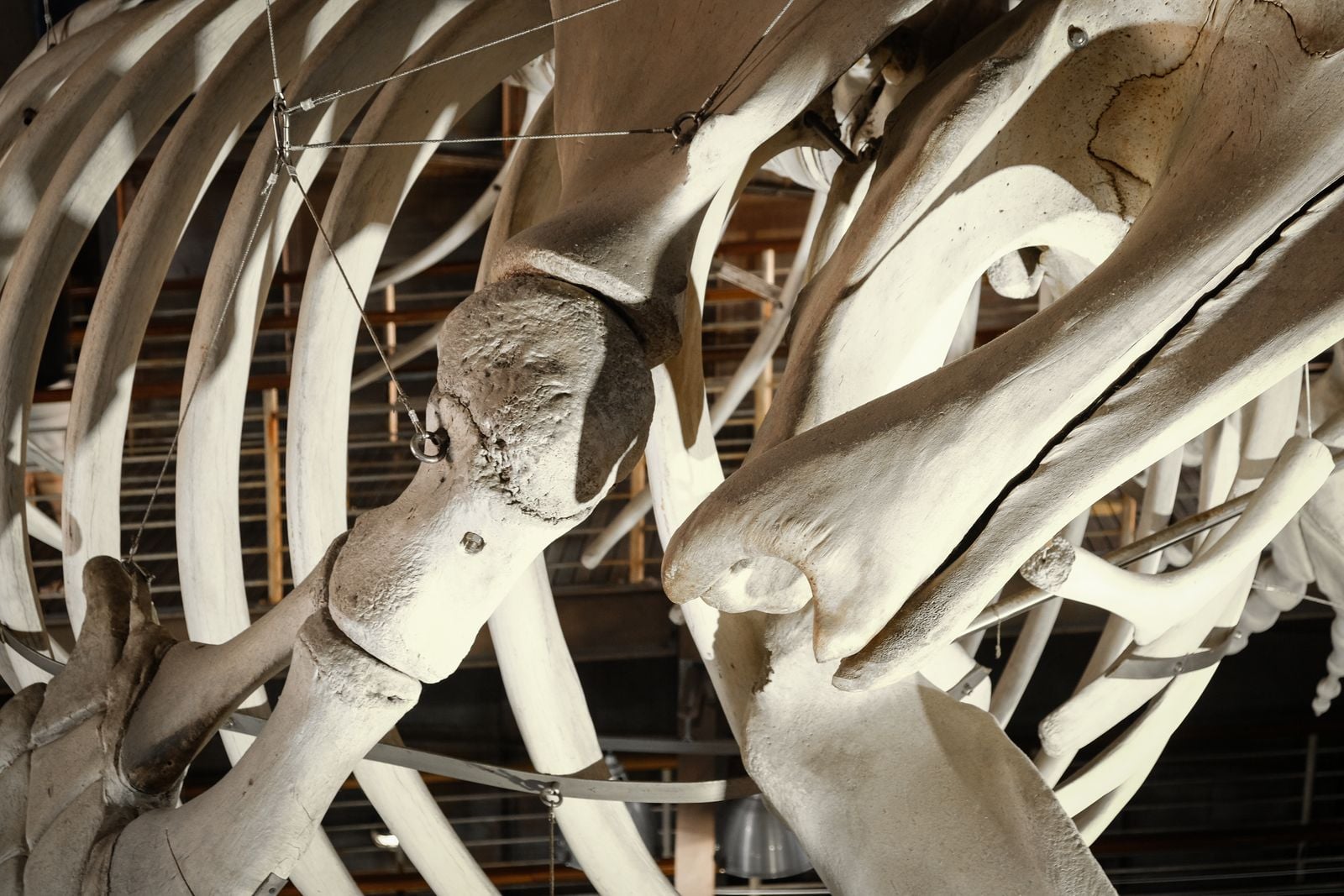
Bigger animals need bigger hearts. But the scaling does not run the way intuition suggests. Set 175 to 200 kilograms of heart against a body somewhere between 70 and 150 tonnes and the organ comes out at roughly one-tenth to one-quarter of one percent of body mass. Published estimates vary across that range and higher, mostly because blue whales are so rarely weighed directly. Mammals including humans typically run nearer half a percent. Whatever the exact figure, the largest heart on Earth is proportionally modest.
There is a ceiling, and the 2019 measurements ran into it. Working from the recorded QT interval, the team calculated that a single heartbeat in a 70-tonne blue whale takes about 1.8 seconds, implying an upper limit near 33 beats per minute. The surface rates they measured, 25 to 37, sit at or above that estimate. The heart is already running flat out when it is working hardest. The authors suggested this is part of why nothing has ever grown bigger: at greater mass, the pump could not keep up with the body.
That record was briefly contested. In 2023 a team led by Giovanni Bianucci described Perucetus colossus, a roughly 39-million-year-old early whale from Peru whose extraordinarily dense, thickened bones yielded mass estimates of 85 to 340 tonnes — enough, they argued, to rival or exceed a blue whale. In February 2024, Ryosuke Motani at UC Davis and Nicholas Pyenson at the Smithsonian reworked the calculation in PeerJ and put Perucetus at 60 to 70 tonnes at 17 metres, perhaps 98 to 114 at 20 metres, against roughly 270 tonnes for the largest blue whales on record. The original estimates, they noted, would have made the animal so dense it could barely have reached the surface. The blue whale keeps the title.
The organ, at rest
The plastinated heart is dry, non-toxic and needs no preservation fluid, which is part of why it works as a museum object. It belongs to the ROM’s research collection and travelled with the exhibition built around the Newfoundland whales. It is the colour of preserved tissue, somewhere between amber and dark rust, and it is about a metre across in every direction. You can walk around it. You can put a hand on the wall of the left ventricle, which is thick and dense and does not give. The aorta, cut open, exposes a channel you can look down — not crawl through, but look down.
Somewhere off California, another one is beating twice a minute, 180 metres down, in the dark. Thirty seconds of nothing. Then one contraction, a bathtub of blood, and the long elastic recoil of a vessel doing the rest of the work — keeping an animal that may live eighty or ninety years alive on a single held breath.