

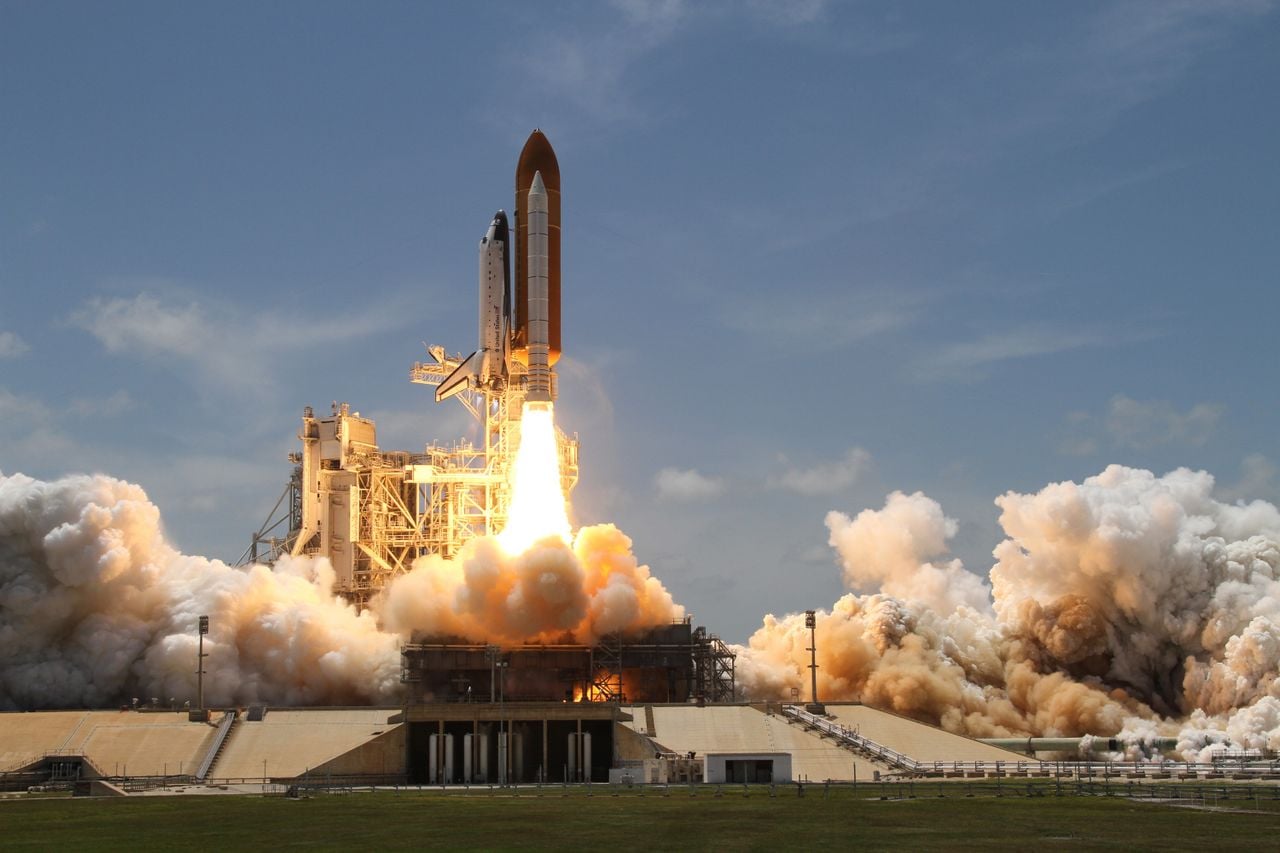
On July 22, 1962, an Atlas-Agena rocket lifted off from Cape Canaveral carrying a spacecraft bound for Venus. Two hundred and ninety-three seconds later, a range safety officer sent the destruct command. The rocket, and the probe strapped to its nose, broke apart over the Atlantic. The cause, once investigators pieced it together, came down to a single mark of punctuation missing from a line of guidance code — a symbol so small that Arthur C. Clarke, writing six years later in his book The Promise of Space, would call it the most expensive hyphen in history.
Mariner 1 was supposed to be America’s first interplanetary success. It became, instead, the most famous typo in the history of spaceflight.
What the rocket was doing when it died
Mariner 1 was NASA’s opening move in the planetary race with the Soviet Union. The Venera program had already tried and failed to reach Venus in 1961. Both superpowers were now aiming instruments at the second planet from the Sun, hoping to answer a simple question: was the surface hot, cold, oceanic, or something stranger. The Mariner series had been designed by the Jet Propulsion Laboratory in Pasadena to find out.
The launch vehicle was an Atlas booster with an Agena upper stage. Guidance during the Atlas phase relied on a ground-based radar system that tracked the rocket’s position and velocity and fed corrections back up through a radio link. The computer running those calculations was on the ground in Florida. The code it executed had been hand-transcribed from equations written by engineers at JPL.
Somewhere in that transcription, a symbol was lost.
The overbar that wasn’t there
The equations governing the rocket’s smoothed velocity contained a variable — usually written as R with a bar drawn over the top. That overbar was mathematical shorthand. It told the computer to use a time-averaged value of R, smoothing out the small, jittery fluctuations that come from any real-world radar signal. Without the bar, the code told the rocket to react to the raw, unsmoothed data instead.
The result was a guidance system that treated every tiny wobble in the tracking signal as a real course deviation and tried to correct for it. As NASA’s own mission page acknowledges, the omission of the overbar for the symbol R (radius) in an equation caused the program to not respond as planned. The rocket started swinging its nose to fight phantom deviations that existed only in the mathematics.
Some later retellings describe the missing mark as a hyphen. Others describe it as an overbar. The distinction matters to programmers and typesetters, but the effect was identical. A single symbol, roughly the width of a printed dash, was absent from a line of code. The rocket did what the code told it to do.
Debate over the exact nature of the error has persisted for six decades. Early NASA post-mortems and press coverage described the missing character as a hyphen in the source equations; later technical accounts pinned it as an overbar denoting a smoothing function. A hyphen is punctuation. An overbar is a mathematical operator. But the historical outcome doesn’t turn on which it was. What matters is that one small piece of notation, present in the original mathematics, was absent from the code the computer actually executed.
293 seconds
The Atlas cleared the pad cleanly. For the first several minutes, telemetry looked nominal. Then, as the guidance system began issuing spurious corrections, the vehicle started drifting off its planned trajectory. Ground controllers watched the track wander toward a heading that could have brought debris down over shipping lanes in the North Atlantic, or, in a worst-case scenario, over inhabited land.
The range safety officer had a decision to make and roughly no time to make it. At 293 seconds after liftoff, he pressed the destruct button — six seconds before the Agena upper stage was scheduled to separate, after which the vehicle could no longer have been destroyed. The Atlas exploded. Mariner 1 fell into the ocean.
The spacecraft that was supposed to become the first human machine to fly past another planet had lasted just under five minutes.
The price and the phrase
The Mariner 1 mission cost $18.5 million in 1962 dollars — roughly $190 million in today’s currency. A symbol smaller than a grain of rice erased a nine-figure investment.
Arthur C. Clarke, writing about the incident in The Promise of Space in 1968, gave it the phrase that would follow it forever. As Reader’s Digest’s roundup of the most expensive typos in the world notes, the science fiction author dubbed the missing punctuation “the most expensive hyphen in history.” The line stuck because it was true in spirit even where it was slightly wrong in technical detail.
Clarke’s exact wording has been quoted, misquoted, and slightly restructured in dozens of retellings. The common thread — that a single piece of punctuation destroyed a mission worth tens of millions of dollars — has proven durable because it condenses something true about the era into a sentence. The phrase survives partly because the number is astonishing and partly because the culprit is so small.
Every generation of software engineers hears about Mariner 1 in some form. The reason is not schadenfreude. The reason is that the failure exposes something that stays true no matter how sophisticated the tooling gets: the gap between a mathematical equation and its executable translation is a place where entire missions can vanish.
An overbar in a physicist’s notebook is a request for smoothing. In a stack of punched cards, or a line of hand-transcribed machine code, that overbar has to be represented by some specific character or convention. If the transcriber and the compiler don’t share the same idea of what that character means, or if it simply gets left out, the mathematics on paper and the mathematics being executed become different mathematics. Nothing warns you. The rocket just flies wrong.
Later investigators would identify at least two contributing errors — the missing overbar in the smoothing function, and a separate hardware fault in the Atlas that caused the guidance antenna to lose its radar lock in the first place. The hardware fault would have been recoverable if the smoothing code had been correct. The smoothing code would have been irrelevant if the hardware fault hadn’t occurred. It took both to kill the mission. Multiple accounts, including Mental Floss’s rundown of major computer bugs, describe this compound failure — a hardware glitch that a properly written line of code would have absorbed without incident.
The direct legacy of the failure was procedural. NASA and its contractors began treating code review and equation-to-code translation with a rigor that would have seemed excessive in 1962. Independent verification of hand-transcribed mathematics became standard. The idea that a single engineer’s typing could sink a mission was no longer a hypothetical. Longer term, the incident became a teaching case in software engineering programs, cited in lectures on requirements engineering, formal verification, and the risks of manual translation between representations.
Mariner 2 and the second chance
NASA had a backup. This was standard practice in the early planetary program — you built two spacecraft, launched them separately, and hoped at least one would survive. Mariner 2, essentially identical to its lost twin, launched five weeks later on August 27, 1962.
It worked. Mariner 2 flew past Venus and became the first spacecraft to successfully return data from another planet. Its microwave radiometer confirmed that the Venusian surface was staggeringly hot, killing the last serious hopes that Venus might be a warm, wet twin of Earth beneath its clouds. As WIRED’s account of the Mariner 2 encounter describes, the mission rewrote human understanding of the inner solar system in a single flyby.
The Mariner 1 hardware, minus a few pounds of debris on the Atlantic seafloor, effectively completed its mission through its sibling. But the story of the missing mark had already entered the folklore of computing.
The residue
Somewhere at the bottom of the Atlantic, several hundred miles east of Cape Canaveral, are the fragments of a spacecraft that flew for less than five minutes. The Agena stage, the Atlas booster, the aluminum structure of Mariner 1 itself — all of it went down in July 1962 and has been sitting there ever since. Nobody has ever tried to recover it. There would be no point.
The mission it was supposed to fly was flown by another spacecraft five months later. The data it was supposed to return has been returned many times over by other probes — Venera, Pioneer Venus, Magellan, Akatsuki. The scientific loss was, in the end, small. Venus was patient. Venus is still there.
What survived was the phrase. The most expensive hyphen in history. A sentence short enough to remember, precise enough to sting, and true enough — even in its slight technical imprecision — to keep being repeated in classrooms and code reviews sixty-four years after a rocket veered off course over the Atlantic on a summer morning in 1962.