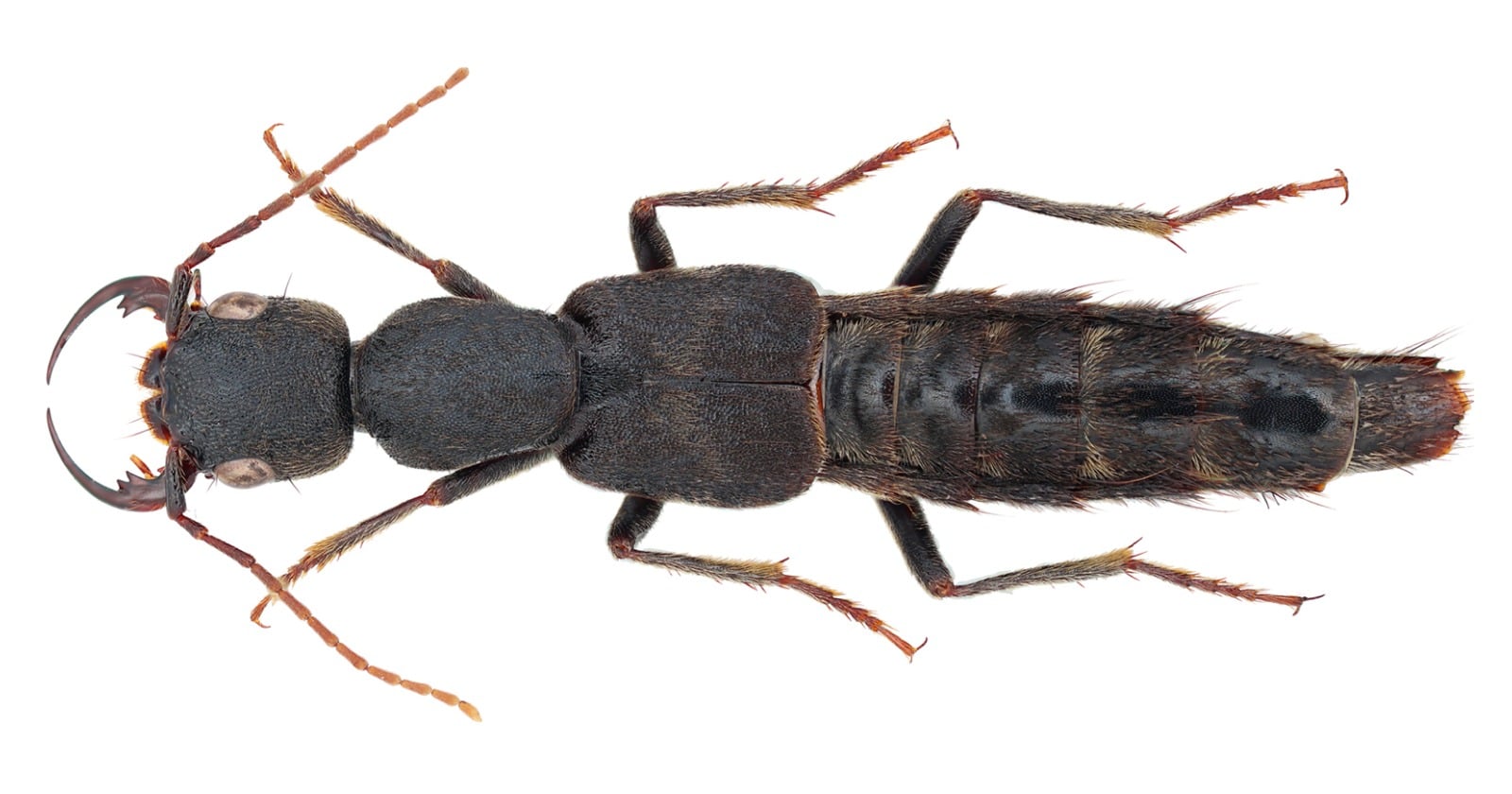
A new genus of rove beetle has been named Luffy, after the rubber-limbed pirate at the centre of the manga One Piece, and the reason given is anatomical: the paper points to the elongated antennae, palps and mandibles of the new genus.
The genus was erected by Fang-Shuo Hu and Alexey Solodovnikov in the open-access journal ZooKeys on 5 June 2026, along with two new species: Luffy schillhammeri from Yunnan in southwestern China, and Luffy nika from northern Laos.
Nothing about the jaws or antennae extends. The elongation is fixed, and the resemblance the authors are reaching for is to a drawing.
A name about proportions
The authors wrote the reason into the paper’s etymology section, in one sentence: “The generic name Luffy is the given name of the main character of the famous manga ‘One Piece’, Monkey D. Luffy, who has the ability to extend his body parts.” What it refers to, they add immediately, is “the elongated antennae, palps, and mandibles of the new genus.”
In the genus description the antennae are “very long,” with every antennomere, the individual segments that make up an antenna, longer than it is wide. The mandibles are “very long and slender.” The maxillary palps and the labial palps, the small sensory appendages flanking the mouth, are both described as long.
One of those traits also carries the genus diagnosis, alongside a character that has nothing to do with length. Hu and Solodovnikov define Luffy on all antennomeres being longer than wide and on narrow, unexpanded front tarsi in both sexes, and they call both traits unique synapomorphies within Staphylinina, the subtribe of large rove beetles the genus belongs to. Neither feature, they say, is known from any other member of that group.
Staphylinina are not obscure garden insects being dressed up for attention. They are among the largest rove beetles, predators that hunt other invertebrates across a wide range of land habitats, and the particular lineage this genus sits closest to contains species that live in trees and flowers and take prey by ambush. Long jaws and long antennae on an animal like that are equipment, even if nobody has yet watched Luffy use them.
Elongation of this kind is a fixed shape. A beetle’s mandibles and antennae are hardened cuticle, and they do not lengthen on demand.
That distinction gets lost quickly. ScienceDaily’s headline on 2 August called the beetles stretchy, and the July coverage before it described their proportions as stretched, which invites readers to picture an animal doing something the paper never describes.
Two drawers hold the whole genus
The genus rests on four beetles.
Luffy schillhammeri is known from a male holotype taken in a flight-intercept trap at Manzhang in Mengla County, Yunnan, on 27 March 2018 at about 650 metres, and a single female paratype taken at a light trap at Manfeng in the same county on 12 May 2016 at about 750 metres. Both came from primary and secondary broadleaf forest, and both are held at the Taiwan Agricultural Research Institute in Taichung.
Luffy nika is known from two males, a holotype and a paratype, collected on 11 May 2004 about 36 kilometres northwest of Louang Namtha in northwestern Laos, at roughly 1,050 metres. They are held at the National Museum of Nature and Science in Tsukuba, Japan. Twenty-two years passed between the day they were collected and the day they acquired a name.
Body length runs to roughly 16 to 20.5 millimetres, going by the whole-body measurements the paper prints for individual specimens. The genus description labels that same range with the abbreviation its own methods section reserves for temporal length, which these same specimens measure at 1.0 to 1.1 mm, so the per-specimen measurements in the species descriptions are the figures to go by.
Four specimens is a thin sample for a genus in a subtribe that Hu and Solodovnikov put at 47 genera and more than 900 species. No female of Luffy nika is known. For that species the paper states plainly that nothing is known about its habitat or the circumstances of its collection, which means the animal has a name, a description and a place in a classification before anyone has recorded it alive.
There is also a character the authors declined to use. In both Laos specimens the last segment of the maxillary and labial palps carries a protruding membranous structure, less obvious in one of the two. They could not tell whether that is a real species character or an artefact of specimen preparation, so they left it out of the diagnosis, naming the artefact as the alternative they could not exclude.
The argument turns on the upper lip
The paper’s case for where Luffy belongs on the rove beetle tree runs longer than its etymology, and it turns on a plate of cuticle above the mandibles called the labrum.
Rove beetles in the Eucibdelus lineage, a mostly Oriental group, have been defined in part by a labrum that is fully hardened, with no soft margin at all. Luffy’s labrum is heavily hardened too, but it keeps a clearly soft lateral edge, which is what the rest of the Ocypus-group has.
At the same time, Luffy carries a tooth on the dorsal ridge of the left mandible. Hu and Solodovnikov propose that tooth as a new shared derived character for the Eucibdelus lineage, after examining specimens from every genus in the Ocypus-group and from three genera whose placement is unresolved.
The mandibular tooth is one of three characters pulling the genus inside the lineage; the labrum pushes it outside. The authors resolve that by placing Luffy as the lineage’s sister rather than a member of it. They call the placement a hypothesis, and nothing in the paper takes it past that. This is a morphological comparison of pinned material: it runs no molecular phylogeny, though one of the Yunnan specimens is labelled as a DNA voucher for a wider revision of the Ocypus-group.
The paper also notes that the same mandibular tooth turns up in Staphylinus, a genus whose own position has been contested for years, and that its appearance in both places may be convergence rather than shared ancestry. Two of the traits that make Luffy diagnosable, meanwhile, are found nowhere else in the subtribe, which the authors read as a sign of some specialisation nobody has identified yet.
Schillhammeri honours a working taxonomist
The species names carry the paper’s other two references. Schillhammeri is named for Harald Schillhammer of Vienna, whose revisions of this exact lineage are cited throughout it. Nika comes from the Devil Fruit of the manga’s main character, and the authors tie it to something visible on the specimen: the pale hairs scattered across the beetle’s body, which they liken to the form in which the character’s hair and clothing turn white.
A genus description is a claim other people can go and check, and this one names the characters they would check it against: a tooth on one mandible, a soft edge on one plate, a set of ratios between antennal segments. It is also, since 5 June, a name on the public nomenclatural record. The anime name is the part that travels, and it costs the paper nothing to give.
What it is attached to is four black beetles on pins, two in a drawer in Taichung and two in a drawer in Tsukuba, and a proposal that other taxonomists will now test against their own material.