

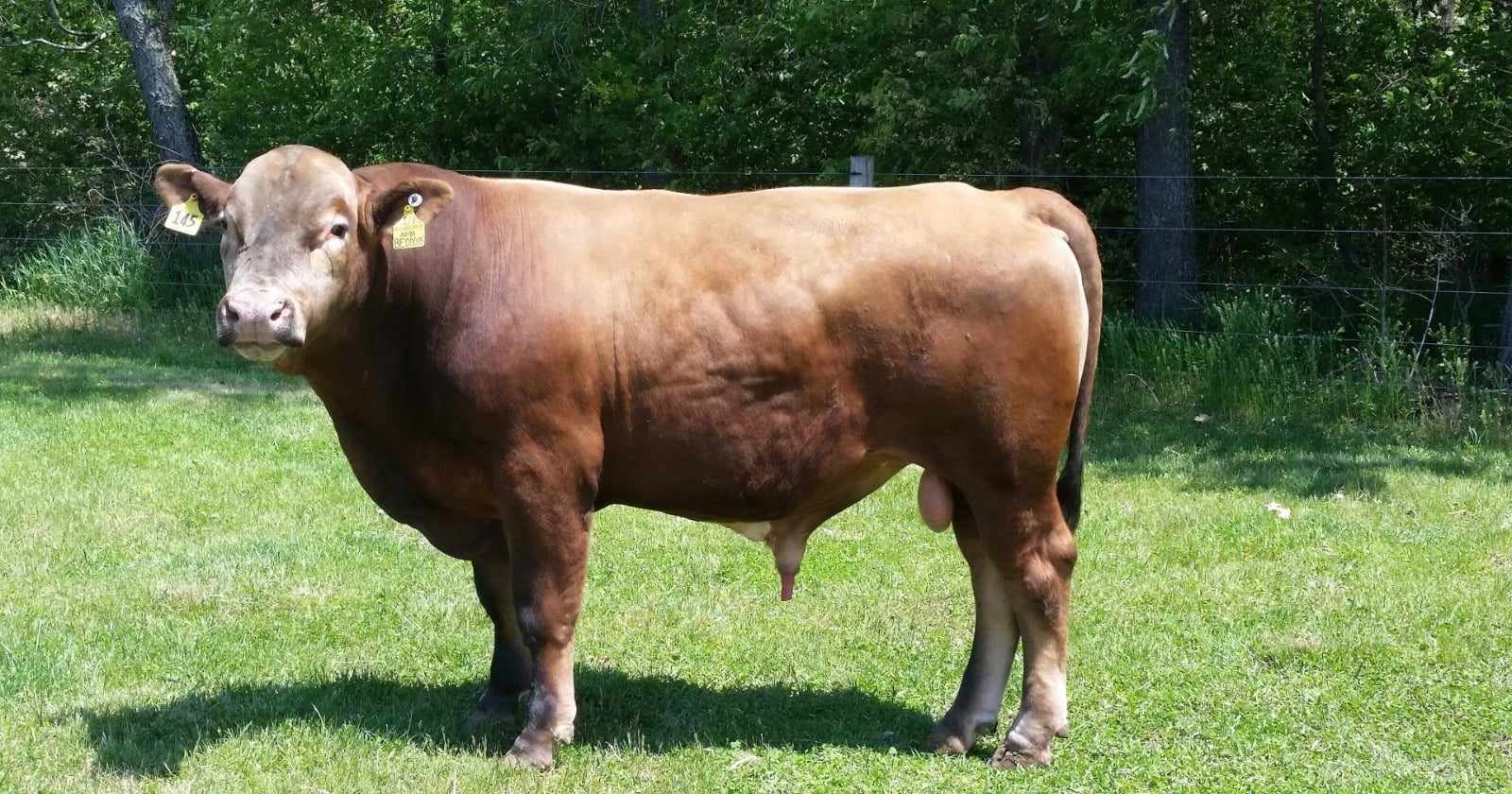
A bull called Joe’s Pride changed hands in 1975 for $2.5 million. His recorded pedigree put him at more than a third American bison. His breeder, D.C. “Bud” Basolo, had established the Beefalo breed a few years earlier by what was described as complex interbreeding of bison and domestic cattle, a feat both surprising and celebrated at the time, and he did not reveal the pedigree that produced his original animals.
A genome-wide survey has now looked. Working from preserved semen in a federal germplasm collection, a team led by Beth Shapiro sequenced 47 registered Beefalo, including animals from Basolo’s own foundation herds, and reports in a reviewed preprint at eLife that 39 of them carry no detectable bison ancestry. The eight that do are estimated to derive between 2 and 18 percent of their genomes from bison, all of them short of the breed standard.
Joe’s Pride is among the 39.
Basolo did not reveal the pedigree
That absence left the question open for fifty years. The American Beefalo Association’s standard specifies five-eighths cattle and three-eighths bison, and an earlier analysis showed two breeding routes that could in principle deliver that ratio. Both require first-generation hybrid males to be fertile.
They generally are not. Artificial insemination of taurine cows with bison semen has been reported to produce 77 percent calf mortality and sterile male calves. Research the paper describes as Canadian government work reported that no functional male carrying more than an eighth bison ancestry was ever observed. A breed built on repeated crosses at three-eighths would have had to walk through that wall.
The wall was not news. Breeders had been attempting bison-cattle crosses for commercial production since at least the early years of the twentieth century, and by 1942 the record showed that reproductive difficulties had stopped them from establishing a viable hybrid population. That history is why the breed’s establishment landed as it did. A stable three-eighths herd was not an incremental result. It was the thing that had not worked.
Two earlier studies had already noticed something was off, using the tools of their day. Karyotyping in 1978 found that all twelve Beefalo bulls examined carried cattle Y chromosomes rather than bison ones. Blood typing in 1986 found that of 148 Beefalo from the Basolo herds, exactly one carried alleles predominantly associated with bison, though the same authors noted that some later animals outside the founding herds did show bison-associated markers. Blood typing, as the paper puts it, gives limited insight into ancestry proportions, which is what a genome can do.
Straws of semen frozen since the 1970s
The material came from the United States Department of Agriculture’s National Animal Germplasm Program collection at Fort Collins, Colorado. Most of the Beefalo samples were taken during the 1970s and 1980s, held by breeders, and donated to the federal biobank around 2007. The team also sequenced three animals reported as majority-bison hybrids and ten bison from commercial herds, and drew on published genomes of cattle, bison, yak, gaur, banteng and water buffalo for comparison.
Sequencing was mostly shallow, a median of 2.7 times coverage across the fifty Beefalo and hybrid samples, with seven prominent animals taken above thirty. Rather than call full genotypes from thin data, the analysis used a single randomly chosen read at variant positions identified in gaur, an outgroup to both cattle and bison, 5,291,534 positions in all, which limits the bias that uneven coverage otherwise introduces.
Four approaches were then applied: a principal component analysis, an admixture model run both blind and with labelled source populations, allele-sharing statistics, and a method that maps ancestry along each chromosome. All four pointed the same way. The controls behaved: a known first-generation bison-cattle hybrid named Buzz came back as half bison, and in the chromosome-mapping check Brangus cattle, a recognised taurine-zebu cross, came back with both cattle ancestries in the expected amounts.
The sample is thin in one dimension: time. These are the Beefalo held in one federal biobank, and the team chose to focus largely on founding-era animals, and says so: present-day sources of Beefalo were not sampled exhaustively. The authors argue the choice is the right one, since Beefalo herds are generally founded by breeding with full-blood Beefalo rather than by fresh backcrosses to bison, which in the paper’s words makes surveying the founders an effective way of documenting bison ancestry across the breed. A wider sample of current producers is still the obvious next thing to do.
One more piece of context belongs here rather than in a footnote. This is an eLife reviewed preprint: it has been through peer review and carries a public assessment, but it is not a final version of record, and the sequencing data are deposited under a public accession for anyone who wants to check the calls.
The headline count deserves an audit, and the paper supplies the material for one. Its figure is 39 animals of 47 with no detectable bison ancestry, stated three separate times in the results and matching the discussion’s “only eight of the 47”. The passage describing chromosome-by-chromosome ancestry mapping instead refers to 37 animals lacking such evidence, a figure the paper does not reconcile with its other counts, since 37 and 8 do not add to 47. The discrepancy is in a prose count, and the paper describes the estimates themselves as similar across all the methods. The 39 is used here.
Zebu ancestry sits where bison ancestry was supposed to be
What most of these Beefalo do carry is zebu. The chromosome-mapping method assigns zebu ancestry to 38 of the animals, ranging from 2 to 38 percent, with all but two falling between 2 and 18 percent. The allele-sharing test finds significant excess zebu allele sharing in 18 animals. Joe’s Pride, whose recorded pedigree lists Hereford, Charolais and bison and no zebu breed at all, was estimated at about 10.5 percent zebu. The paper gives his reported bison share two ways, 37.5 percent in its discussion of the pedigree and 40.6 percent in a figure legend, which is why this piece says only that the pedigree put him above a third.
The authors suggest a reason. Zebu cattle tolerate heat and drought, have lower nutritional demands than taurine cattle, and carry a shoulder hump, so they share several commercially relevant traits with bison. The paper’s reading is that zebu crossing may have been used to manipulate the Beefalo phenotype. The breed standard does not require the cattle side to be taurine, so nothing about that breaks a rule. It simply does not appear in the pedigrees, and the paper puts that conditionally: if early breeders incorporated zebu ancestry deliberately, they left the detail out.
The bison came in through the bulls
The sex chromosomes point to how the small amount of real bison ancestry got in. The paper reports that all the Beefalo carry Y chromosomes associated with taurine cattle, while the majority-bison hybrids carry bison Y chromosomes, and the eight Beefalo with bison ancestry carry less of it on the X than on the autosomes. That pattern is what results when bison bulls are bred to cattle cows and the offspring are bred back to cattle, generation after generation. In every one of those eight animals the bison ancestry appears on only one of the two chromosome copies wherever it occurs, which the authors say provides evidence of backcrossing to a parent species rather than of hybrids being bred to each other.
The shape of those blocks carries a rough ordering. Bison ancestry in the eight animals that have it sits in long contiguous stretches, often tens of millions of base pairs, which is what recent admixture looks like before recombination has had generations to break it up. The zebu ancestry is also blocky but more broken, with many smaller segments mixed in, which the authors read as an earlier date for that admixture. The ordering is the inference here, not a calendar: zebu first, bison after.
One sample resolved itself in an unexpected way. An animal listed in the federal database as Beefalo with an eighth bison ancestry, and half Brahman, landed squarely inside the zebu cluster, and the American Brahman Breeders Association records the same animal as a purebred Brahman. The authors infer it was labelled wrong on the way in.
The animals are real and the meat is what it is. The USDA granted Beefalo a voluntary federal inspection stamp in 1984, and the analysis confirms that bison and cattle can hybridise in some circumstances, since three majority-bison hybrids and eight Beefalo in this sample carry bison ancestry that got there somehow. A stable population fixed at three-eighths bison is the thing that was never established.
A pedigree is a document, and a document is a record of what somebody wrote down. For half a century the Beefalo pedigree was the main account of what these animals were made of, and for most of that time nothing existed that could audit its proportions. Blood groups got partway there in 1986. A genome sampled at more than five million positions can finally say which parts of a written claim the animal itself supports.