

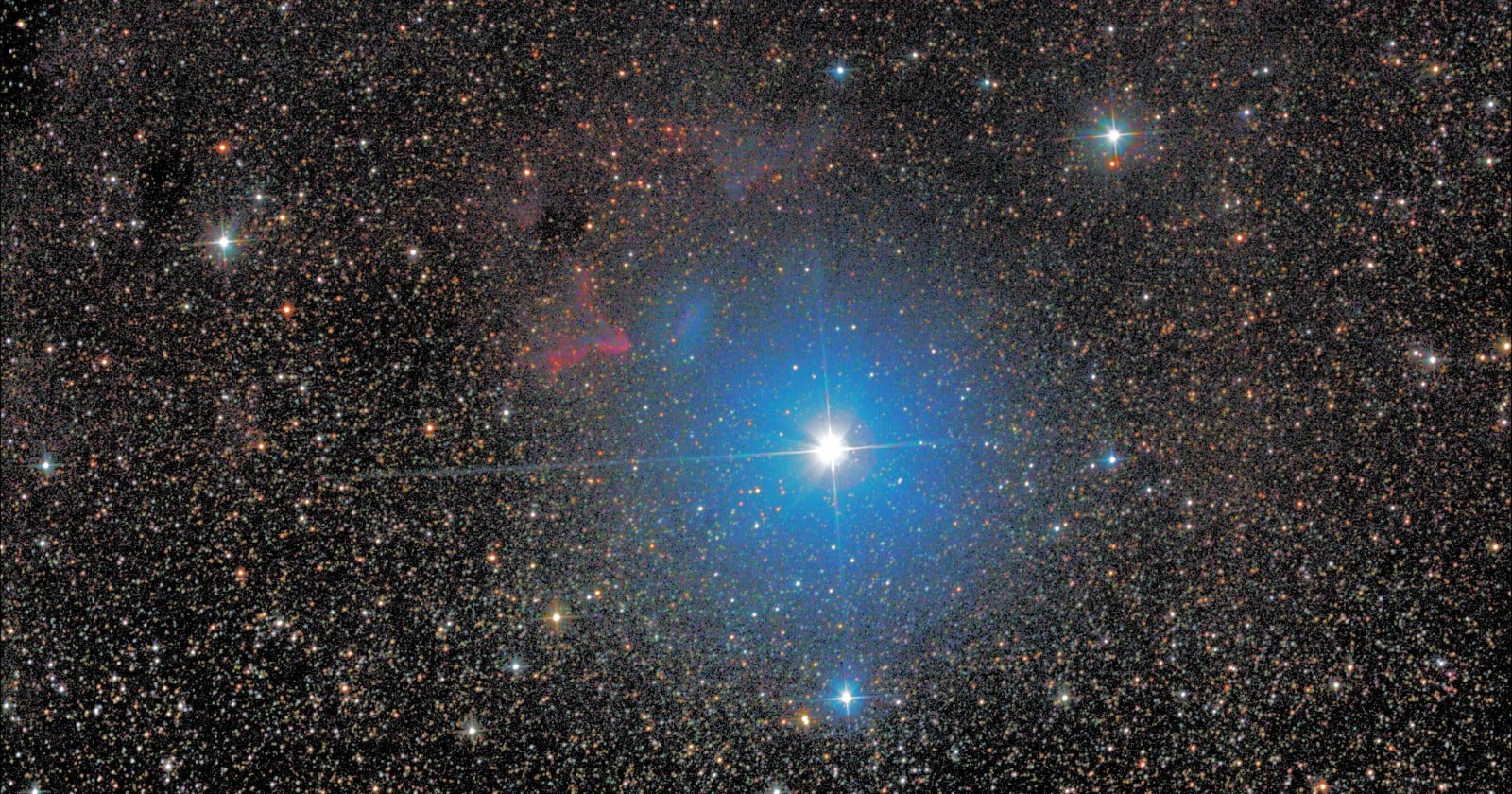
In 1866 the Italian astronomer Angelo Secchi looked at the light of the middle star of the W of Cassiopeia and found something backwards. Hydrogen, which in stars like the Sun prints itself as a dark line, was printing itself bright. The star, gamma Cassiopeiae, became the first object identified as what astronomers now call a Be star, a fast-spinning hot star wrapped in a disc of its own shed material.
A hundred and nine years later it broke the rules again. Until 1975 gamma Cas was treated as an ordinary member of the class it had founded; that year an X-ray observation found it glowing at high energies in a way no massive star should. Half a century of argument followed about where those X-rays were made. A new set of observations, published in Astronomy & Astrophysics by a team led by Yaël Nazé of the University of Liège, answers the question by measuring the X-rays themselves in motion.
The trouble with the X-rays
Massive stars do emit X-rays. Shocks buried in their fast winds heat gas to around five million degrees, which is enough to show up and not much more. Gamma Cas is roughly 40 times more X-ray luminous than a star of its kind is expected to be, and earlier work put the plasma responsible at something like 150 million degrees.
At that temperature iron is stripped almost bare, and the spectrum fills with lines from highly ionised iron at 6.7 and 7 kiloelectronvolts. Flanking them is a third feature at 6.4 keV, a fluorescence line produced when X-rays are absorbed and re-emitted by cooler material close by. That fluorescence feature is, in the paper’s words, “unique amongst massive stars”. So is the flickering: the X-ray output changes by a factor of a few over intervals as short as a few seconds, where a normal hot star holds steady. Similar behaviour has since been found in about two dozen early-type Be stars, now called gamma Cas analogues after the original.
The last explanations standing
The field had narrowed to a pair. In the first, the X-rays come from the Be star itself, produced by magnetic reconnection where small loops of field at the stellar surface meet the toroidal field of the surrounding disc. Current spectropolarimetric surveys rule out large-scale magnetic fields in Be stars. Small ones could be generated below the surface and would stay undetectable, which leaves the idea, in the authors’ phrase, “theoretically plausible” and very hard to close off.
In the second, the X-rays come from a companion. Gamma Cas has one: a low-mass object in a circular 203-day orbit, inferred from the star’s own motion and never seen directly. A stripped helium star was considered and appears inconsistent with what is known about stripped stars, colliding winds and the X-rays that Be and stripped-star pairs actually produce. A neutron star could manage this behaviour only during a brief and rare phase of accretion, which the authors call unlikely and set aside. That leaves an accreting white dwarf, an idea the authors trace back to 1986. Before this campaign, they write, the observational evidence “remains inconclusive as to whether the high-energy emission in γ Cas analogues arises from the Be star itself or from its companion”.
Three pointings across the full orbital swing
The instrument that settled it is Resolve, the microcalorimeter aboard the X-Ray Imaging and Spectroscopy Mission, a JAXA-led observatory launched on 7 September 2023 and working from an orbit 570 kilometres up. Resolve measures the energy of each arriving photon by registering the temperature rise it causes, about a thousandth of a degree. That is fine enough to resolve the structure inside the iron complex for the first time.
The team observed gamma Cas three times: on 29 December 2024 for 34.4 kiloseconds, on 15 February 2025 for 59.3, and on 16 June 2025 for 46.5. The dates were chosen for where they sit in the orbit. They fall at phases 0.28, 0.52 and 0.11, which puts the December pointing near conjunction and the February and June pointings near opposite quadratures, spanning the full swing of the orbit. The paper’s observation table and its observations section date the conjunction pointing to December 2024; one passage in its results section calls it February, and this account follows the table. Optical monitoring confirmed the Be star’s disc was well developed at all three epochs.
The iron followed the wrong star
Between the two quadrature observations, in June and February, the fluorescence complex at 6.4 keV shifted by 148 kilometres per second, with an uncertainty of 28. The highly ionised iron lines shifted, less securely, by 87 kilometres per second with an uncertainty of 30. Both shifts run in the same direction, negative, and the authors call them consistent in direction and amplitude.
Over that same span of phases, the Be star’s own radial velocity, taken from the most recent optical orbital solution, changes by seven kilometres per second, and it changes the other way.
The companion is a different matter. Its motion cannot be observed, but it can be predicted from the Be star’s mass function, an assumed Be star mass of 13 to 16 solar masses and a system inclination of 42 degrees. That calculation gives an expected swing of about minus 100 kilometres per second over the same two phases. The measured X-ray shifts bracket it, one slightly under and one slightly over, which the authors say is what measurement scatter looks like. The iron in the X-rays is moving with the invisible object, while the star that makes the visible light barely moves at all.
That is the result the whole campaign was built to get.
The white dwarf itself was not weighed here
The abstract’s parenthetical that the companion was “previously shown to be a white dwarf” rests on a chain of earlier papers the introduction summarises rather than re-tests, going back to 1986. The body’s own language is weaker: the absence of any detected optical signature of a companion in gamma Cas and some of its analogues, it says, “favours a white dwarf interpretation” over a brighter stripped star. The label is a conclusion by elimination, and this campaign inherits it.
What the campaign does add is a second measurement. The team took the strength of the lines as well as their positions: equivalent widths of 92 electronvolts for the Fe XXV complex, 56 for Fe XXVI and 43 for the fluorescence feature. Those values, with the plasma temperature, place gamma Cas between two known classes of accreting white dwarf, intermediate polars and quiescent dwarf novae.
So the kinematics point hard at the companion, and the line strengths put that companion in white dwarf company. Neither weighs it.
There is also a configuration the authors say outright they cannot rule out: a non-magnetic white dwarf caught in a quiescent state, of the kind seen in dwarf novae. The narrow lines do not kill it, because the geometry near a quiescent white dwarf differs, with accretion running direct and the fluorescence coming off the surface. What is left against it is what has never been seen. That scenario predicts outbursts, even if infrequent, and no outburst has been detected so far for gamma Cas or any of its analogues.
Every velocity the team measured also came out positive, which is not what an orbit alone would give. They attribute the offset partly to gravitational redshift of about 60 kilometres per second at a white dwarf surface, and partly to not knowing which ionisation stage of iron the fluorescence comes from. Measured against neutral iron, emission from Fe VIII would look redshifted by up to 140 to 200 kilometres per second on its own. The paper’s orbital argument therefore rests on how much the velocity changed between observations, with the absolute figures set aside.
Lines too narrow for an inner disc
The width of the lines does its own work. If material were spiralling in through the inner region of an accretion disc, Keplerian speeds there would smear the fluorescence into a feature roughly 6,000 kilometres per second across for a white dwarf of about one solar mass. Resolve instead measured a Gaussian width of about 200 kilometres per second for the fluorescence, which stays several times narrower than the disc prediction even once the Gaussian width is turned into a full line width. The ionised lines came in at about 425.
That points the emission at a magnetic white dwarf, where the field truncates the disc and channels gas down onto the poles: shocks in the accretion column make the hard X-rays, and the fluorescence comes off the surface below.
One number in the same dataset does not sit neatly. The iron line ratio gives a plasma temperature of 100 million degrees, below the 125 to 150 million derived from broadband continuum fits in earlier work. That is an ion temperature against an electron temperature, and the authors suggest a plasma out of thermal equilibrium as one possibility, with Compton scattering or gas at a range of temperatures as alternatives.
About one early Be star in ten
Population models put the fraction of Be binaries carrying a white dwarf somewhere between 50 and 70 per cent, and yet the systems have stubbornly refused to be identified, while neutron star companions turn up in numbers and around a dozen stripped helium companions have been caught by their ultraviolet signatures.
The gamma Cas result appears to close that gap and immediately opens a smaller, more awkward one. The models expect white dwarf companions mostly around Be stars below ten solar masses. The gamma Cas analogues are all earlier than B3, and roughly half of them earlier than B1.5, which puts that half above ten. In a distance-limited sample the phenomenon shows up in only about 10 per cent of early-type Be stars, a pattern the authors say contrasts with what the models expect.
What the authors call for next is both more observation and a kind of modelling that does not yet exist: hydrodynamical simulations built specifically for Be and white dwarf pairs, including radiative transfer. Until those arrive, gamma Cas keeps at least one trick the authors say still needs explaining, its habit of maintaining the X-rays even when the disc feeding the white dwarf has largely dissipated. The white dwarf’s rotation period, magnetic field and accretion rate remain to be measured.
So the answer to a fifty-year question arrives attached to a demographic problem, and the authors concede the discrepancy may not be fully reconciled. That is close to the ordinary shape of a solved problem in astrophysics. The mysterious thing becomes a system with named parts, and the naming turns up a count that will not add up. Gamma Cas has stopped being an anomaly and become a population.