

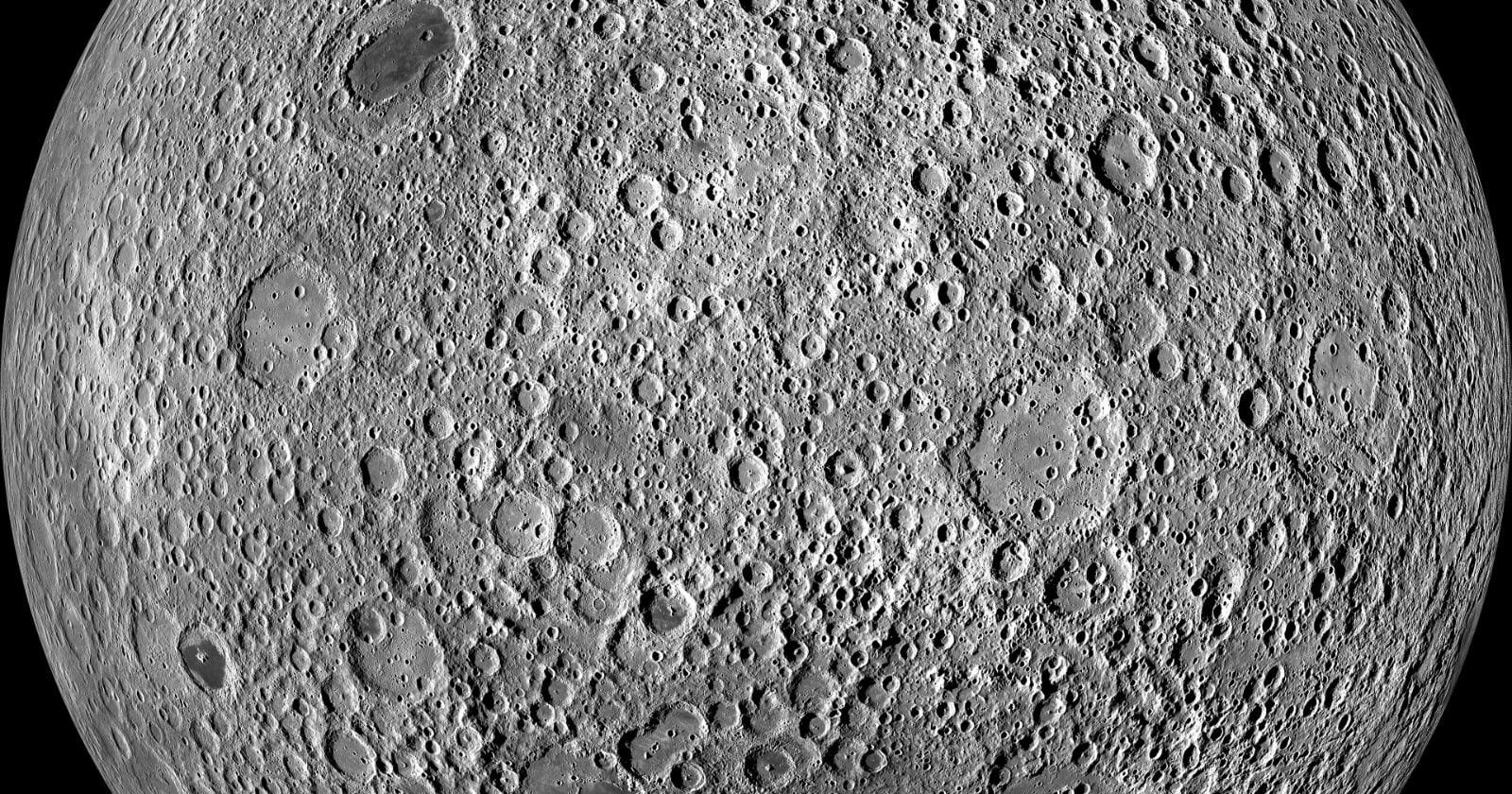
Solar-wind krypton and xenon in the lunar soil Chang’e-6 brought back from the far side of the Moon held on through the low-temperature steps of a laser heating run, and most of the xenon came off at the high end. In soil collected on the near side by Chang’e-5, the equivalent xenon release seems to be bimodal, in the paper’s own hedged phrasing, with a larger share coming off early. A team led from the Institute of Geology and Geophysics at the Chinese Academy of Sciences reports in Nature Geoscience that the difference reads as a depth signature: on the far side, solar wind ions sit further inside the grains.
The explanation the authors offer is that the two hemispheres are not hit by the same solar wind. Earth’s magnetosphere carries a buffer region around it, the magnetosheath, and the Moon passes through that region twice in each orbit. Plasma inside the magnetosheath moves considerably more slowly than the undisturbed wind outside it, and slower ions stop nearer the surface of whatever they hit. By the paper’s geometry, the near-side sampling site is exposed to that slowed plasma during those crossings and the far-side site is blocked from it.
Why heating a grain in steps measures depth
Gas held near the surface of a mineral grain is easier to drive out than gas buried inside it, so a release curve read across rising temperature steps carries information about where the gas was sitting. That is the premise the whole result rests on, and it only works for gases that stay put. Previous studies have shown no significant diffusion losses of krypton and xenon in lunar soil, which is why those two carry the argument, in contrast to hydrogen and helium, which the paper describes as readily disturbed by surface processes on the Moon.
A laser takes the sample apart in stages
The China National Space Administration allocated a far-side regolith sample of about 1,000 milligrams, catalogued as CE6C0300YJFM001, out of the 1,935 grams Chang’e-6 returned from the South Pole-Aitken basin. Seven aliquots were taken from the original sample container, each weighed on a microbalance to a precision better than a microgram. Three were heated to complete fusion in a single shot; four were taken up in steps, with a carbon dioxide laser raising the power gradually so that gas released at each temperature could be measured on its own. One of those four supplied the stepwise helium, neon and argon data. The other three supplied the krypton and xenon on which the central result rests.
Each aliquot went into its own copper holder, sized to match the three-millimetre laser spot so the heating would be even, and the chamber was pumped down and baked before anything was fired. The released gas was cleaned over getters and separated cryogenically, then measured on a noble gas mass spectrometer at the institute in Beijing.
The average abundances came out unremarkable against the Apollo and Luna yardstick. Average helium, neon, argon, krypton and xenon concentrations in the Chang’e-6 soil all fell inside the ranges already measured in Apollo and Luna soils. The finding is carried by the shape of the release curve, not by how much gas is there.
Helium sits noticeably below the near-side figure, and the authors point to mineralogy. Helium in the far-side soil runs about 2.5 times lower than in the Chang’e-5 material, and the ilmenite content runs about 2.8 times lower alongside it. The authors take that matched ratio to suggest both a similarity between near-side and far-side samples in these two respects and a crucial role for ilmenite content in how much helium a lunar soil holds.
The depth signature in a release pattern
Comparing one stepwise far-side aliquot against a near-side aliquot run under matched laser power, duration and beam size, and comparable sample mass, the authors found that the proportion of solar-wind components released in the first two, coolest steps was markedly lower in the far-side material. Across all three far-side aliquots run stepwise for xenon, most of the solar-wind-derived xenon came out at the higher steps.
The near-side sample, the paper says, seems to show a bimodal release of solar-wind xenon, while the far side shows a single peak. The two aliquots share a peak at the same step, which the authors take to mean both experienced implantation with similar properties, probably corresponding to normal solar wind. The near side has something extra: the early release. Read as depth, that says the near side received a second population of ions that stopped shallower.
The team checked an alternative reading and set it aside. If the far side’s early steps looked thin because extra meteoritic and cometary material had accumulated on the grain surfaces, the bulk 84Kr/132Xe ratio of the far-side soil should come out lower than the near-side value, because the cometary and meteoritic ratios are lower. It does not: the two averages, 8.29 plus or minus 0.25 and 8.33 plus or minus 0.36, are consistent.
Apollo soils sit outside this particular comparison. The paper sets them aside in the deeper-implantation comparison because of substantial terrestrial atmospheric contamination.
Earth’s magnetosphere slows what reaches the near side
Working from the geometry of the bow shock and the magnetopause under present-day average solar wind conditions, the authors calculated how much of each landing site’s exposure happens while the Moon is inside the magnetosheath. For the Chang’e-5 site on the near side, the affected share of total solar wind irradiation time works out at roughly 25 percent. The Chang’e-6 site is blocked from that slower plasma during both crossings, so its share is zero.
To put a number on the slower component, the team ran ion-stopping simulations and asked what arrival speed would bury krypton and xenon at a depth corresponding to the vapour-deposited coating found on near-side glass samples, whose maximum reported thickness is about 16.3 nanometres. The answer that matched was around 200 kilometres per second, which is also what spacecraft measure for plasma inside the magnetosheath.
Two other things about the two sites make the comparison unusually clean. The landing sites sit at nearly mirrored latitudes, 43.058 degrees north for Chang’e-5 and 41.6383 degrees south for Chang’e-6, which the authors say effectively mitigates the potential influence of surface temperature. Both soils also register as young by the argon antiquity indicator, meaning the trapped wind in each mainly represents recent solar activity rather than a record of the early Sun.
What the velocity figure rests on, and what one sample set cannot settle
The speed figure is a simulation output. It follows from assuming that the median implantation depth of the slower wind equals the thickest vapour-deposited layer reported in Chang’e-5 glasses, then reading the corresponding velocity off a stopping-range model. The authors’ own verb for that assumption is speculate. The result agrees with independent magnetosheath observations, which is real corroboration, but it is an estimate consistent with the data and should be held as one.
The 25 percent is modelled too, though by a different route: a geometric calculation rather than an observed exposure log. It fixes the magnetosheath’s angular width from average present-day solar wind conditions, which are not necessarily the conditions under which the gas was implanted.
The raw measurements carry their own caveats, and the paper states them. Blank contributions were under 0.1 percent for most measurements. For xenon in the first two steps of two aliquots they reached as high as 10 percent, and in one of those aliquots two xenon isotope results were discarded outright, with blanks running about 30 to 70 percent. Neither discarded isotope is one the depth argument uses, and the head-to-head low-temperature comparison the argument rests on runs on a different far-side aliquot, but the affected steps are at the cool end of the range, which is where the argument does its work. The authors also note that temperature during laser stepwise extraction carries uncertainties, and that minor variations in release patterns may arise from heating procedures, mineral heterogeneity and sputtering.
One number the paper reports about these grains, a cosmic ray exposure age of 670 million years give or take 117 million, is explicitly a lower limit, calculated by assuming the grains sat at the surface with no shielding, and it should not be read as a date. And the whole comparison rests on one far-side sample set measured against one near-side sample set, which is what exists rather than what a statistician would ask for.
The neon that no single model explains
The far-side soil also produced a 20Ne/22Ne ratio that the authors could not account for. Its average value of 11.34 sits close to the strongly fractionated solar wind endmember of 11.2, and the paper says that ratio has never been found in near-side lunar soils. A lower ratio means proportionally more of the heavy isotope, and the paper reads it as a more substantial presence of heavier neon in this material.
None of the standard explanations survives contact with it. Preferential sputtering predicts a steady-state value near 12.73, well above what was measured. Single-stage diffusion would require losing about 99 percent of the neon, and erosion about 95 percent, yet the far-side soil’s median neon concentration is if anything slightly higher than the near side’s. The matched latitudes, the paper says, provide no support for diffusion-driven fractionation caused by differences in surface temperature, and a long-term change in the Sun is called unlikely given the soil’s young antiquity age.
The authors do not resolve it. They suggest the ratio reflects some combination of mechanisms, or the addition of a neon component with a ratio lower still than the fractionated endmember, and leave it to future work on the differences between the two sides. The krypton and xenon depth result stands on its own release curves; the neon anomaly is a separate and still-open observation.
The paper’s own framing of the wider question is modest. Differences in volatiles between the near and far sides, it says, are not well understood, and the possibility has not been confirmed, for the plain reason that nobody had far-side samples until this mission. This work supplies a release-pattern comparison on returned material, read as depth, with a modelled speed attached to it.
So the whole argument comes back to the release curve. Gas that arrived from the Sun, at a site blocked from the slowed plasma during both of the Moon’s monthly passes through the magnetosheath, came off the laser late. Late means deep, and deep is the result.