

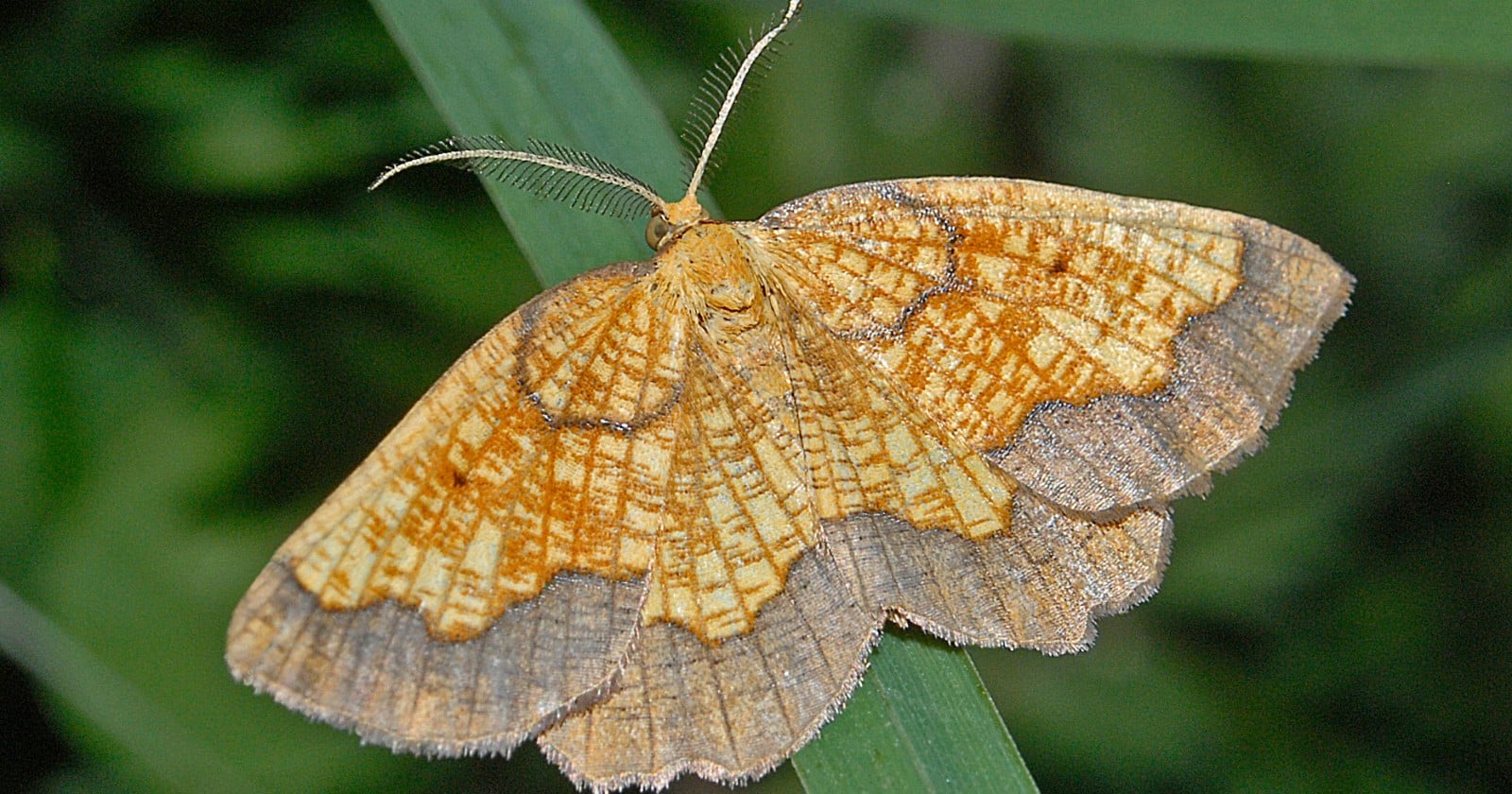
“It only took 10 minutes to find the first one, then we all started picking them up quite regularly.”
That is Dr Dave Wainwright, Head of Conservation in England at Butterfly Conservation, describing what happened on 16 July when he walked onto the National Trust’s Wallington estate in Northumberland with project officer Charlotte Rankin and a group of National Trust rangers. The moth they were picking up was the Dark Bordered Beauty, which, according to Butterfly Conservation’s account of the visit, published on 14 August, “was found at the site previously but had not been seen there since 1952.” Wainwright had been looking for a second English colony of it since 2004. He had walked that same estate in 2004 and found none.
England now has two known populations instead of one. The second one turned up in ground that did not match what the search had been built around.
The moth, and the numbers at Strensall
It is a day-flying moth with, in the charity’s description, “lemon yellow wings with a deep chestnut border,” and it is a specialist. Butterfly Conservation says its caterpillars “will only eat two plants,” aspen and creeping willow, though the Ministry of Defence, writing in 2024 about Strensall, calls creeping willow the moth’s “sole foodplant” there. The charity calls that dependency one of the main challenges in conserving the species. The species “was once widespread across northern England and Scotland,” and habitat loss had, until this July, pushed it back to “two small areas on Deeside and Speyside,” both in Scotland, “and Strensall Common” in Yorkshire.
Strensall is why a second English site was worth every year of looking since 2004. A Ministry of Defence press release from August 2024 states the position without softening it: the moth “exists at one last known site in England,” which the same release identifies as a military training area near York. Strensall Common is 570 hectares of open heathland east of the North Yorkshire village of Strensall, in the Vale of York, designated a Site of Special Scientific Interest. The Ministry of Defence owns most of it and it is used for military training, with, in the ministry’s words, “some areas managed by Yorkshire Wildlife Trust and Forestry England.” The charity’s account names Yorkshire Wildlife Trust and the Ministry of Defence.
The ministry’s release is where the numbers are. The Dark Bordered Beauty is a priority species in the UK Biodiversity Action Plan. The release says numbers “have declined by over 90% since recording first began at Strensall Common,” and “as little as 50 to 100” were believed to remain at the site. The release separately records the moth’s presence on the common since 1894, which is the earliest date it gives, although it does not actually say that is when recording began. It does quote Dr Peter Mayhew of the University of York calling Strensall “the population where the moth was first discovered in the UK,” which makes 1894 the likelier start of the record rather than a coincidence. It also dates a steep decline to the start of systematic monitoring in 2007, which is a different claim from the 90 per cent and rests on a different baseline.
Butterfly Conservation’s account two years later is bleaker, though it is counting a different thing: hundreds of moths recorded there twenty years ago, against a recorded count last year that “barely reached double figures.” A wildfire tore through “a huge portion of the nature reserve” last May.
Why did the same estate come up empty in 2004?
Wainwright’s answer is about grazing pressure. “I looked at that site in 2004 and it was quite heavily grazed and wasn’t in the right condition for Dark Bordered Beauty,” he told the charity. “This time the site looked a hell of a lot better,” he said, describing “really lush vegetation with lots of wildflowers.”
The mechanism behind that change is a farm tenancy. For several years the National Trust has been working with Fiona Goodfellow, the tenant farmer who manages the site, on what the charity calls nature-friendly farming, which here includes “reducing livestock grazing in key areas and restoring peatland.” The stated effect is that the moth’s food plants have been allowed to thrive. It sits inside a wider project across the 20 square mile estate called Wilder Wallington.
Grazing cuts both ways, and the ministry’s release is the document that says so. At Strensall, grazing by cattle and sheep “is essential to prevent the growth of trees and shrubs” and to hold the lowland heath open. It has also “caused the loss of creeping willow plants,” which is why the Defence Infrastructure Organisation “provided funding and materials through its Conservation Stewardship Fund” to build fenced enclosures around low-growing creeping willow across the training area, with additional funding from Yorventure. The same tool that maintains the habitat removes the food plant. What changed at Wallington was where the livestock were allowed to be.
What the record actually shows
The only search for this species that either document records at the estate between 1952 and this July is Wainwright’s single 2004 visit, which found nothing. The estate has been watched for moths more generally, and the charity says ranger Emily Johnson “has been monitoring moth populations on the estate over the years,” but neither document reports that monitoring picking the species up.
Butterfly Conservation writes that the team “discovered a habitat where the moths have managed to quietly hold on for 70 years.” That framing is an inference, not a measurement. A population present and missed, and a population absent and later re-established from elsewhere, leave the same record here, and the announcement does not claim to separate them. The charity’s own reading is continuous survival. Wainwright’s account of 2004, that the site “was quite heavily grazed and wasn’t in the right condition for Dark Bordered Beauty,” explains why his visit found nothing; reading that forward into a colony sitting there unnoticed is a step the charity’s framing takes, not one his own account of 2004 takes. A single negative visit supports more than one reading.
Against that, what was observed is firm. Dark Bordered Beauty moths were present at Wallington on 16 July, in enough numbers that a small team kept finding them, recorded first-hand by Butterfly Conservation’s Head of Conservation in England, who has searched for the species since 2004.
There is no count. The charity’s account gives no figure for how many Dark Bordered Beauty were found at Wallington, no estimate of the colony’s size and no indication of its extent. Johnson is quoted calling Wallington “a stronghold for such a rare species,” and the only number she gives is 130 moth species recorded across the estate so far this year, which counts species and not Dark Bordered Beauty. No number in either document attaches to this moth at Wallington.
Two figures in the charity’s account also need reading with care. It says 70 years in its headline and again near the end, and 1952 to 2026 is seventy-four, so that figure is approximate. And the same release quotes Wainwright twice on the same moment, once saying the team found one within a few minutes and once giving ten, which makes the ten-minute figure his own longer account of it.
The two documents look as though they disagree about the diet, and reading each in full mostly dissolves it. The 2026 charity release says the caterpillars “will only eat two plants,” aspen and creeping willow. The 2024 ministry release says the moth “favours sheltered locations at the woodland’s edges where its sole foodplant, creeping willow, can be found growing,” which is a sentence about Strensall. Aspen appears nowhere in the ministry’s release, so it never addresses the two-plant question at all. What looked like a contradiction is a difference of scope.
A search template corrected in public
The most consequential thing in the announcement concerns what the moth was sitting in rather than the moth.
“This opens up a new front in our knowledge of the species in England: we have very fixed ideas of what good habitat looks like based on Strensall, but actually the habitat at this new site is different, so straight away two or three other sites come to mind that we wouldn’t have recognised as prime Dark Bordered Beauty habitat before,” Wainwright said.
That is a search template being corrected in public. For decades the model for suitable Dark Bordered Beauty ground in England was a single lowland heath on a military training area, because that was the only English ground the species was known to occupy. A survey designed around one site finds sites that resemble it and walks past the rest. Two or three candidate sites changed status the moment the Wallington moths were in hand, and none of them changed physically.
What Wallington changes, and what it does not
Wallington does nothing for the older colony. Butterfly Conservation is working with Yorkshire Wildlife Trust on the habitat at Strensall and “is planning to trial a captive breeding programme,” while stating in the same breath that “the moths are clearly struggling to survive at that site.” A second English population lowers the chance that one wildfire or one bad grazing year removes the species from England altogether. It raises no number at Strensall.
Wainwright called the find “one of the highlights of my career,” and in the same breath put the feeling more plainly: “overwhelmingly it was just a feeling of relief that we weren’t just fighting the fight at one site anymore.”
What happens next is checkable, and it is close. The two or three sites Wainwright can now name were reclassified by a change in what counts as suitable ground, so surveying them is the test of whether the Wallington habitat is a genuine second template or a single lucky field. He has said what kept him going all these years was that he “always felt there was a chance of finding Dark Bordered Beauty on the Northumberland/ Cumbria border.” The older question could in principle be settled rather than argued, since a population that held on unseen since 1952 and one that arrived recently could be distinguishable by genetic comparison between the two English sites, though neither document mentions such work. The next phase of the Wilder Wallington project runs along the Fallowlees Burn, funded by the Garfield Weston Foundation and Northumbrian Water and in partnership with Forestry England, and the team hopes to expand the moth’s potential habitat there, with guidance from Butterfly Conservation.