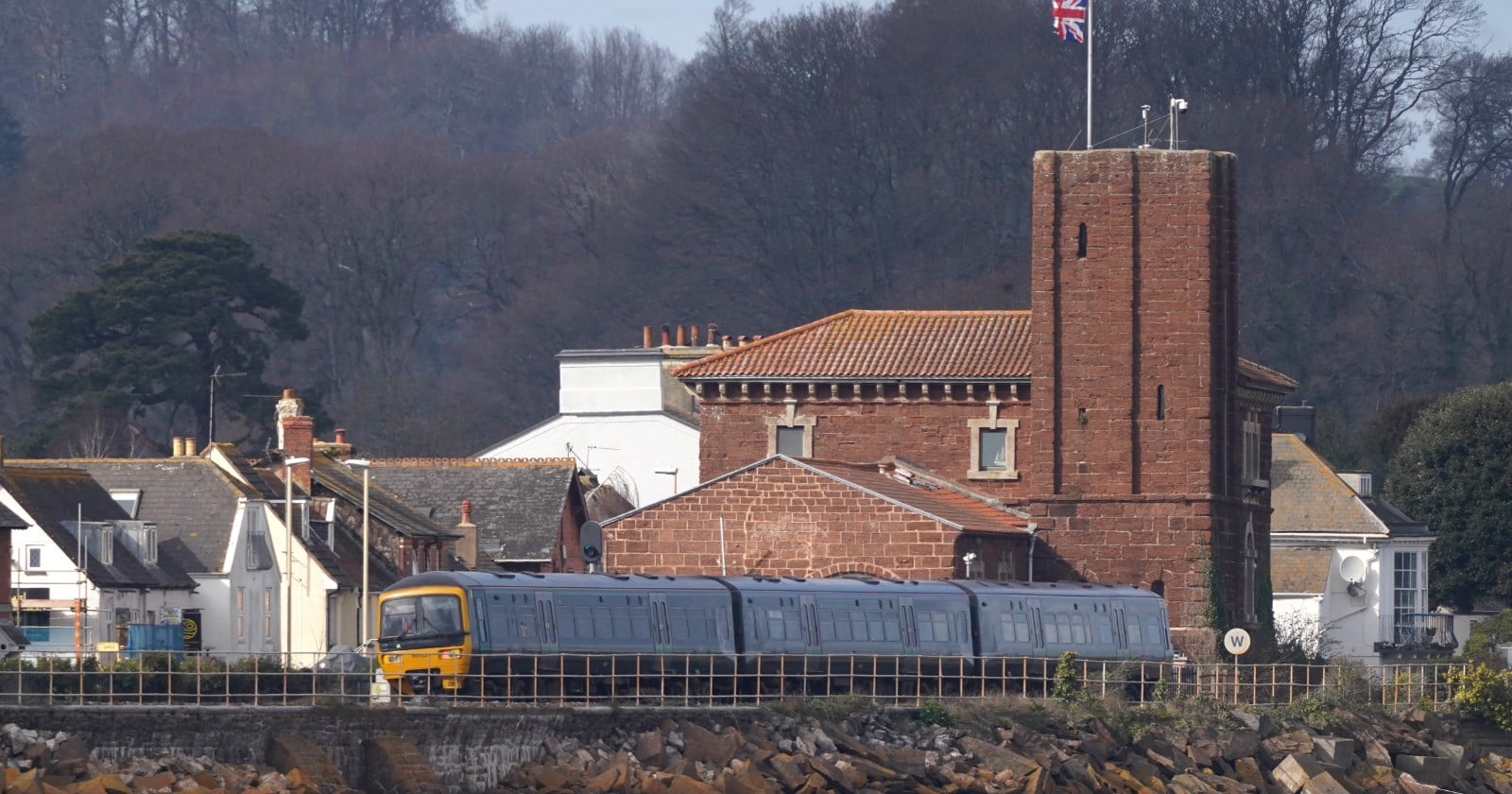
A paper published on 16 September in the journal Space Weather argues for moving one of the oldest incidents in the record of solar storms interfering with human technology forward by seven years. The reason is a railway line that had not been built.
The incident sits in an unsigned note in Nature of 5 October 1871. On 18 October 1841, the note says, a very intense magnetic disturbance was recorded, and the 10:05 p.m. express out of Exeter was detained sixteen minutes because nobody could establish whether the line was clear at Starcross. The equipment, as the paper describes it, was the needle telegraph signallers used to report whether a section of line was clear or occupied. The note carries one line that has kept the story alive.
“The superintendent at Exeter reported the next morning that some one was playing tricks with the instruments, and would not let them work.”
When William Cade III rediscovered the note in 2013, it seemed to push the first recorded collision between solar activity and human technology back to 1841. That would put it before the Carrington storm of 1859, which is usually cited as the first extreme space weather event of the scientific era, and before the 1847 telegraph disturbance the authors say is the earliest credible report of space weather reaching a technology.
The trouble is that on 18 October 1841 there was no railway between Exeter and Starcross for a train to be delayed on. Nothing in the English records that survive for that night points to a storm either.
The Act of 1844 and the opening dates
The route the account describes belonged to the South Devon Railway Company, whose line was broad gauge, seven feet and a quarter inch, and built to run on compressed air. The Act of Parliament authorising a line from Exeter to Plymouth did not receive Royal Assent until July 1844.
Construction went in stages. The first section, from Exeter to Teignmouth, taking in the station at Starcross about six kilometres south of the city, opened on 30 May 1846. The line reached Newton Abbot, which the paper gives as the express train’s destination, by December 1846.
Both dates come from contemporary issues of Trewman’s Exeter Flying Post. On the authors’ reckoning the railway opened almost five years after the events the 1871 note places on it, which means the report cannot be accurate as written.
Timetables in the local weekly press
The fix came from the least glamorous detail in the account. A 10:05 p.m. departure is a timetabled service, and timetables for the line were printed every week in the local papers.
Searching for an Exeter departure towards Starcross at that hour, the team identified a window between 11 March 1848 and 26 July 1849 in which the published timetable carried a 10:05 p.m. train. How far outside that window they looked is not stated.
The window narrowed the field, and one date inside it, 18 October 1848, carries the same day and month as the 1871 account. It also carries a magnetogram on which, in the paper’s words, powerful geomagnetic disturbances are apparent.
The record for 18 October 1848
Continuous magnetograms from the Greenwich magnetic observatory begin in 1846, which is itself part of why the 1841 claim is hard to test. For 18 October 1848 the scanned archive holds a trace, and the numbers pulled off it are large.
Reading the horizontal component, and applying scaling information that is not printed on the daily magnetogram itself, the authors put the largest change they can measure at roughly 310 nanotesla, across the stretch from about 22:00 to 22:20 UT that survives after a gap in the record. Across that stretch the authors give the rate of change as about 15 nanotesla a minute.
The declination swings about 1.3 degrees peak to peak over twenty-two minutes, from a point slightly off the page at 21:45 UT to 22:07 UT.
Changes that size would be enough to drive an induced electric field through the ground in southern England. Greenwich sits at 51.6 degrees north and Exeter at 50.5, about 250 kilometres apart, close enough in latitude that the authors are willing to assume the two places saw much the same disturbance.
Nothing comparable appears for 18 October 1841. The Greenwich observatory yearbook logs extraordinary magnetic observations back to 1840 and records none that night, and a later catalogue of European auroras seen below 55 degrees north, appended to Angot in 1897, lists none over England on that date, though it records sightings at Prague.
For the second half of October 1848 the sky is well attested. Auroral displays were observed widely across the UK in that period, with reports in newspapers from Cheshire, Lancashire and Norfolk among others. An Exeter weekly reprinted an account from an observer near Leeds, at Bolton-park, who saw the whole heavens vividly illuminated except for a few degrees of the south, with radii of light darting in all directions from a centre about five degrees south of the zenith. The writer dated it only to “Wednesday night”; from the time the report would have taken to reach print, the authors judge that Wednesday likely to have been 18 October 1848.
Temple Chevallier, a clergyman, astronomer and mathematician observing from Durham, sketched the solar disc at 10:25 a.m. on 19 October 1848 with a large sunspot group spanning the central meridian. The sheet is still held by the Royal Astronomical Society.
The limits of a circumstantial case
Two kinds of claim are doing the work here, and only one of them is documentary.
The railway dates are printed contemporary sources, and they settle that the 1871 account cannot describe 18 October 1841. That much is a refutation, and it is secure.
What replaces it is weaker. The paper matches no independent record of the delay itself, or of the superintendent’s complaint, to 18 October 1848. The authors reach that year by elimination and coincidence: a timetable window, a large magnetic disturbance on the same day and month, a solar active region, and aurora that a later catalogue logs over the UK on 18 October 1848 itself and on eight other dates that month, alongside a red display recorded from northwest Spain the same night. Their own phrase for it is compelling circumstantial evidence pointing to a typographical error, with 1848 mis-printed as 1841, and circumstantial is the operative word. The paper does say misdating is common to a few other accounts from this period, and traces one: a Matteucci event of 17 November 1848 that reached a 1998 list of storms affecting electrical systems as 27-28 October 1848, dates on which the paper finds no disturbance in the magnetic archive; Matteucci himself once published the event under the wrong year.
The paper is also inconsistent with itself on one point. Section 3 gives the timetable window as 11 March 1848 to 26 July 1849, a span of about sixteen and a half months, which is this article’s arithmetic because the paper states no span. The conclusions describe the search as narrowed instead to a four-month window in 1848. The Section 3 dates are the ones the paper works from, illustrated by a single reproduced timetable page from inside the window, while the four-month figure appears in the conclusions with no dates attached. They are the ones used here.
Two other cautions belong with that. The sixteen-minute delay is a figure from the 1871 report, the same report being corrected, and that report carries no citation that would let anyone check it. And the vivid line about the superintendent is the one the authors say hints that the account may have come from a contemporary newspaper report or the like: they could not find any report carrying that phrase or any language to that effect.
A period detail shows how casual the surrounding arithmetic could be. A resident whose letter ran in the Exeter and Plymouth Gazette on 21 October 1848 timed a sunspot group across his instrument on the 19th, assumed the Sun to be 800,000 miles across, and reported a dark patch nearly 31,000 miles long. It is his calculation on his assumption, not a measurement anyone would stand behind now, and it survives as evidence only that something large was on the solar disc that week. It is the same group Chevallier drew that same day; the paper links the two.
The name written on the page
The 1871 note carried no byline. Nature had only been publishing since November 1869, under its founding editor Norman Lockyer, and the authors of early reports were not always shown.
The authors’ enquiries indicate that neither the Nature archives nor the Lockyer archive at the University of Exeter holds the original source material. What does survive is the publisher’s own copy of the issue, annotated by hand on the page where the report begins and reproduced in the paper by permission of the Macmillan Archive, reading “N. ? Holmes” with a middle initial the authors read as most likely a J.
Their candidate is Nathaniel John Holmes, a Victorian electrical engineer active around 1870 in laying undersea telegraph cables across parts of the North Sea, including links to Denmark, Norway and the Northern Isles, which the authors suggest might have given him an incentive to care what magnetic storms did to cables and the rest of the era’s equipment. The 1871 census puts him at forty-seven and living in Hampstead, roughly a mile from Lockyer in West Hampstead. A newspaper report of 8 November 1870 has him lecturing to a public audience in Scotland on the chemical effects of the solar spectrum, and a letter of 1877 has him inviting Lockyer to visit.
None of that is a signature, and the authors do not claim it is one. What they say the missing manuscript and correspondence prevent them conclusively resolving is something else: why the 1871 report dates the event almost five years before the railway opened.
The title passes back to 1847
If the correction holds, the Exeter train loses its place at the front. Once the night moves to 1848 it no longer predates the event Barlow reported, presented to the Royal Society in May 1848, the “spontaneous electrical currents” that ran through Midland Railway telegraph equipment near Derby on the evening of 19 March 1847, when “a brilliant aurora was seen” over the British Isles. That account, on the authors’ reading, remains the earliest credible report on record, and the Exeter delay becomes one of the earliest instead.
William Cade III, whose 2013 paper put the 1841 report back into circulation, is a co-author of the study that now argues the date away from it.
Which leaves the superintendent. Sometime after ten o’clock on an October night, with his needles refusing to hold still and an express waiting to leave, he decided somebody was interfering with his instruments and said so the next morning. If the account is good, he was right that something was playing with them. He was about ninety-three million miles off on who.