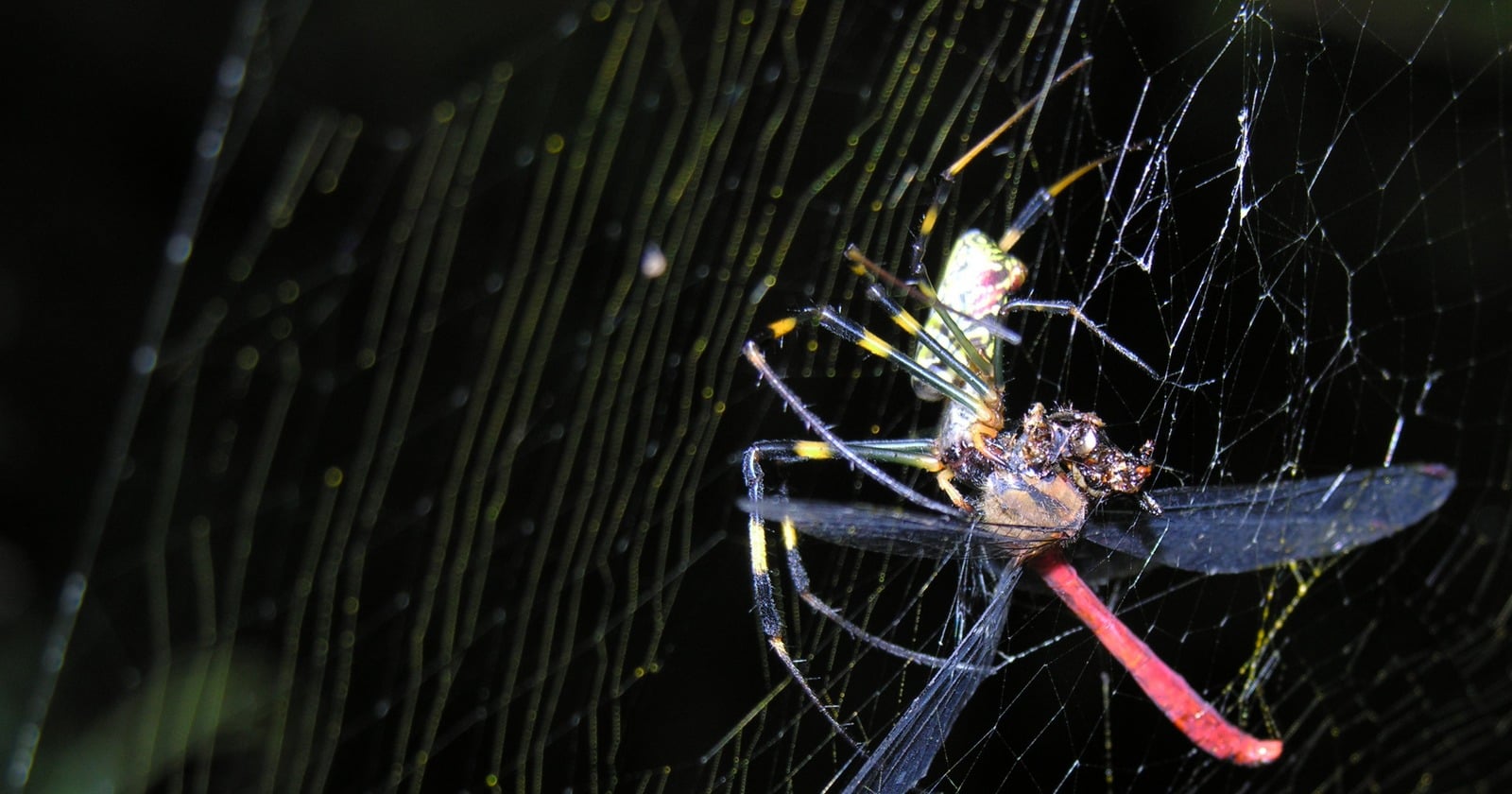
What does a large introduced spider do to the spiders already living around it? The answer usually offered for the Joro spider, as it has spread across the southeastern United States, is competition for food: several groups of researchers have suggested Joro spiders could limit native orb-weaver populations through overlapping diets.
Sequencing what was actually inside 356 female orb-weaving spiders puts numbers on that overlap, and they disagree with each other depending on how the data are scored. The Joro spider’s prey list came out statistically distinguishable in composition from those of three co-occurring native species, and 10 to 25 percent dissimilar to them on the families common enough to compare. At sites where Joro spiders were present, the native spiders’ gut contents were not distinguishable from gut contents at sites where Joros were absent. The work was published in PLOS ONE on 24 June 2026 by Erin Grabarczyk of Valdosta State University and Jason Schmidt of the University of Georgia at Tifton.
Collected in just over three weeks of one autumn
Between 2 October and 24 October 2021, the two researchers collected female orb weavers from 52 sites. Forty-nine were public parks chosen from iNaturalist reports of Joro spiders, plus parks just outside the confirmed Joro range. Three were private residences where Joro spiders had already been confirmed. Every site sat at least four kilometres from the next.
They took 213 female Joro spiders from 33 of those 52 sites, and native orb weavers from 41 of them. Only females were collected. The paper notes that male Joros are relatively easy to find in their own webs, but that the team found no males in or around the webs of the native species.
The native haul was smaller and more scattered: 47 spinybacked orb weavers, Gasteracantha cancriformis; 41 Neoscona crucifera; 26 marbled orb weavers, Araneus marmoreus; 17 Verrucosa arenata; eight Neoscona of undetermined species; and four Micrathena mitrata. Only species represented by at least 20 individuals went into the diet analysis, which left those first three to be compared against the Joro and set aside 29 spiders from the other groups.
Each spider’s intestinal tract was dissected out to cut down on the spider’s own DNA, then extracted and amplified with a primer pair designed to suppress spider sequences and favour insect ones. The products were sequenced on an Illumina NextSeq 2000. Because so many matches resolved only as far as family, every analysis was run at family level rather than at species level.
Even with the spider-exclusion primer, spider DNA still dominated the output, so the researchers discarded every read that came back as Araneae. That decision governs how much the rest of the numbers can carry. If a Joro spider had eaten a native orb weaver, the evidence went into the discard pile along with the spider’s own tissue, and the authors say directly that they did not attempt to separate the focal predator’s DNA from that of other spiders. Field observation, they write, will be needed to establish how often web takeovers and predation between spiders actually happen.
Prey richness was highest in the most-sampled spider
Across all four spider species, 164 prey families were detected, and most reads were flies.
The count of distinct families found in each species differed sharply. Observed prey richness was 156 families for the Joro spider, against 46 for the marbled orb weaver, 29 for Neoscona crucifera and 22 for the spinybacked. A rarefaction estimate put the Joro’s prey detection richness at 206 families, with a confidence interval running from 176 to 235.
That gap is not straightforwardly a fact about appetite, and the paper qualifies it in the same passage that reports it. The natives’ modest richness estimates are, in the authors’ words, “likely due to much smaller sample sizes”: 213 Joro spiders were collected against 47 spinybacked, 41 Neoscona crucifera and 26 marbled orb weavers. Rarefaction suggested the Joro sampling had captured roughly 97 percent of the prey families available to be found. Coverage for the natives ran far lower, and not in step with how many were caught: 46 percent for the marbled orb weaver, 22 percent for Neoscona crucifera and 29 percent for the spinybacked. The smallest native sample returned both the most prey families and the best coverage.
What each spider carried differed in kind as well as in breadth. The researchers report a high proportion of Diptera in the female Joro guts they sampled, and note that earlier work on the species found small flies, and non-biting midges in particular, to be its most commonly recorded prey. Neoscona crucifera went the other way, with a high proportion of Hemiptera, Coleoptera and Orthoptera; it fed on flies, but flies were not its main prey.
A test on the composition of the four diets separated them cleanly, at F(3,75) = 15.825 and P = 0.001. The size of that separation is the number worth carrying, and it is modest. That comparison runs on the 52 families common enough to appear in at least 5 percent of samples, 52 of the 164 detected. On those, the prey families in Joro guts were, in the paper’s words, “10-25% dissimilar, depending on analysis” to those of the three natives, which were at most 7 percent distinct from one another. Measured again with a Pianka index on simple presence or absence, overlap between each native and the Joro sat at roughly 0.6 on a scale where 1 is identical. Computed on read counts instead, the same pairings fell to between 0.24 and 0.40.
The abstract and the discussion both state that “Joro spider diets were distinct, with at least 26 unique prey taxa not detected in native spider diets.” That number is the output of an indicator species analysis, a test that identifies which categories are statistically associated with which group, and association is not the same thing as exclusivity. The paper’s own reporting of the result is also not internally consistent: the breakdown it gives for those 26 families, eleven Diptera, seven Hemiptera, three Coleoptera, two Psocoptera, one Lepidoptera and one Hymenoptera, adds up to 25. This article reports the 26 as the output of that test, not as a list of prey no native spider was found with.
Everything here is a DNA detection
A gut sequence is a trace, and the paper’s limitations passage is mostly a list of what a trace cannot distinguish.
Family-level identification blurs associations that would only show up at species level. Metabarcoding is sensitive enough to pick up secondary feeding, so a beetle sequence may have entered a spider inside something else the spider ate, and the design cannot tell the two apart. A presence-or-absence measure counts a single midge and a hundred midges the same way, and the overlap figure does move a long way when the same data are scored by read count instead.
The collection window is a caveat the paper does not raise. Everything here comes from just over three weeks of one autumn, which is when female Joro spiders are mature and their webs easiest to find, and the study does not discuss what a spring or summer sample might have shown.
There is also a small unresolved discrepancy between the paper and its supplement. The methods place the 52 sites in Georgia and South Carolina. The caption on the supplementary site map places the same 52 sites, on the same dates, in Georgia and North Carolina. Each state is named once and the two are never reconciled. This article follows the main text.
At the sites the Joros share
Diet breadth is interesting. The question underneath it is whether the natives are being squeezed, and that is a comparison between places rather than between species.
The test came back null. Native gut contents at Joro-occupied sites were not distinguishable from native gut contents at sites with no Joro spiders. A permutation test on group centroids gave F(1,52) = 2.42 with P = 0.14, and a PERMANOVA reported only in the supplementary material gave F(1,52) = 1.3 with P = 0.1. The paper’s phrase is that native diet composition “was not distinguishably different when Joro spiders were present.”
Two features of that null limit how far it travels. Sites were sorted by whether Joro spiders were there on the day of sampling, so there is no baseline and nothing about change over time. And the native sampling behind it covered between 22 and 46 percent of the prey families estimated to be findable, which by our reading is not much power to detect a difference with.
The authors are careful about what follows. Joro spiders are “unlikely to outcompete the focal native spiders based on diet overlap alone,” they write, and qualify it “at this time.” That last clause does real work. Competition for food is one of several ways an introduced spider could displace a resident one, and the paper lists the ones it did not test: competition for web sites, aggressive takeover of existing webs, and predation of one spider by another.
The floor this puts under the argument
The word “initial” appears eight times across the paper, and the conclusions end on the admission that too little is known about the native spiders themselves, including what their populations looked like before the Joro arrived, to judge whether they are being harmed.
Their diets were close to unmeasured while the argument about what the Joro spider was doing to them went on above their heads, which is the gap this paper starts to fill rather than close. The raw data are public.
What 327 analysed guts show is two kinds of spider reaching into overlapping sets of arthropods, the overlap substantial on the common families, the difference real. That is a claim about two prey lists. It is not yet a claim about whether the natives are losing.