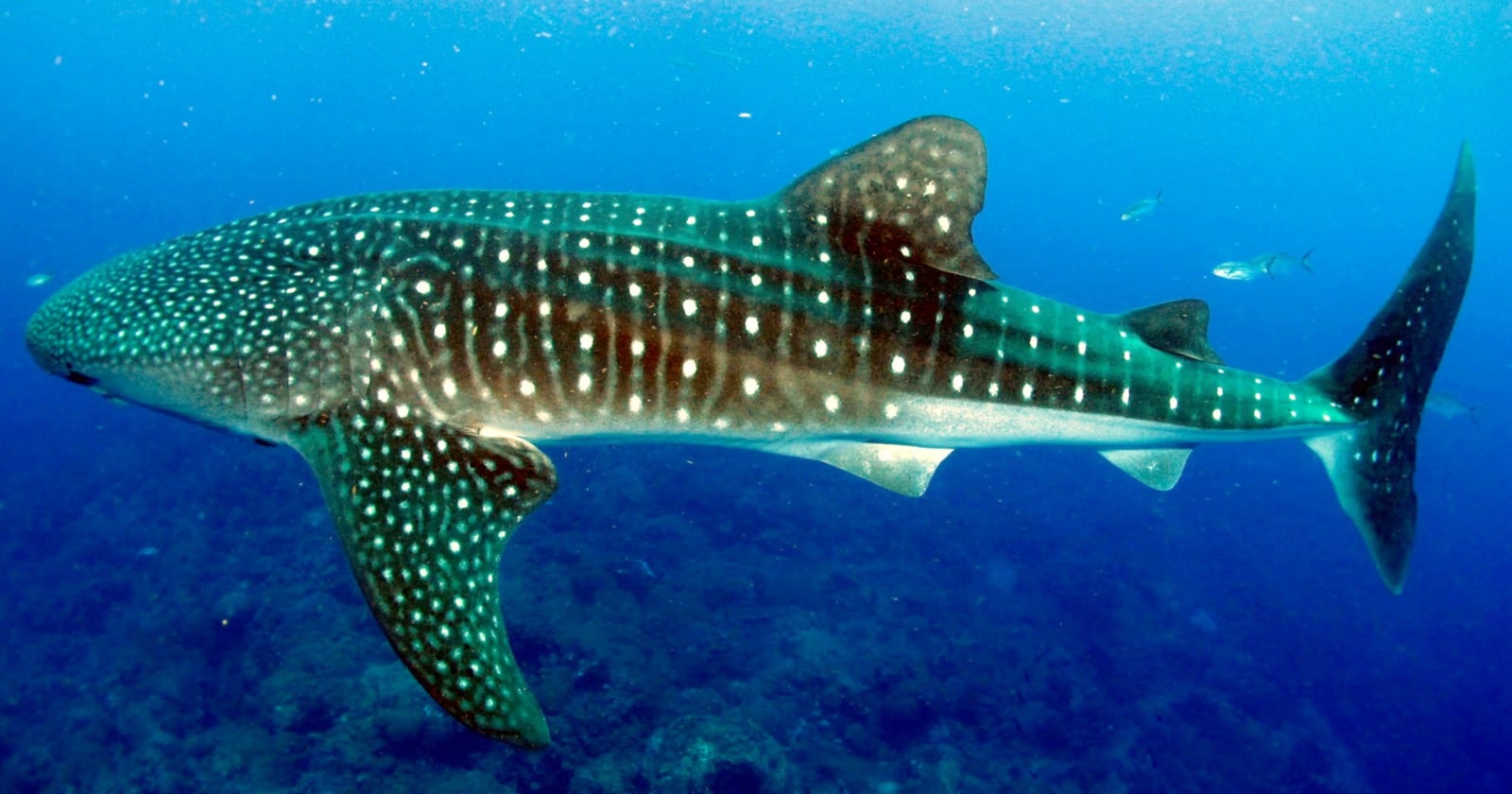
A whale shark tips nose down, holds its tail almost still, and sinks. The camera watching this is clamped to the leading edge of its dorsal fin, roughly 1.5 to 2 metres behind a mouth it cannot see. What the lens does catch is the gill slits, flared open on the way down.
Across the four sharks whose movement data could be used, that descent runs at a mean body pitch of about twelve degrees and a median sinking speed of just under a fifth of a metre per second. The researchers call the behaviour gliding slow feeding, and it is one of six feeding behaviours their paper describes as novel. Behaviour the team scored as feeding was filmed from the surface down to 68.8 metres.
The work is an ethogram for the whale shark, published open access in Marine Biology on 21 July 2026 by Christine Barry of Murdoch University and the Australian Institute of Marine Science, with six co-authors. An ethogram is a catalogue: a standard list of an animal’s discrete behaviours, written so different research teams can score the same thing the same way. The paper is typed on publication as “Review, concept, and synthesis”, and 30 of its 36 entries come from other people’s published work.
A fin clamp, a spotter plane and a galvanic link
A spotter plane found the sharks in Norwegian Bay, at Ningaloo Reef in Western Australia, during May of 2017 and 2018. Snorkellers went in from an 8.4 metre vessel and fixed a camera tag to the leading edge of the dorsal fin with a minimally invasive clamp.
Each tag carried a VHF transmitter, and a Fastloc GPS tag connected to the camera by a wire trace about 1.5 metres long. A galvanic link was configured to break and release the package after roughly 24 to 48 hours. The camera recorded a 30 minute interval every hour from dawn to dusk, about 06:00 to 18:00, while depth was logged continuously at ten readings a second.
Tags went onto ten whale sharks and five produced usable footage. The paper attributes the shortfall to unspecified technical issues, plus tags dislodging after deployment and debris accumulating on the lens. Depth and accelerometer data from one of the five surviving sharks were also excluded, so the kinematic figures rest on four animals and about eighteen hours.
What remained was 45 video intervals totalling 22 hours and 27 minutes, from two females and three males measuring 4.5 to 7 metres. Against that, the team ran a Google Scholar search in August 2025, screened the first 200 results for each of three search terms, and kept 106 articles out of 600. The criteria were narrow: a specific description of a behaviour directly observed or identified from kinematic data, in English, peer reviewed apart from one thesis due to be published, with behaviours inferred from two-dimensional dive profiles thrown out.
A dorsal fin sits two metres from a mouth
The camera’s position sets the limit on everything that follows, and the paper states the problem before it reports a result. Mounted on the dorsal fin, the camera could not directly film the mouth opening and closing below the snout. So the team read feeding off the gill slits instead, treating flared slits and open gill arches as a proxy for water and prey moving through an open mouth.
That proxy is not exclusive, by the paper’s own account. The ethogram entry for fluttered gills notes that the movement occurs during non-feeding as well as during both feeding modalities, and the paper concedes that gill movements in fishes are not uniquely diagnostic of feeding. The team assumed gill arch rotation reflected feeding rather than an effort to take on more oxygen, and says this cannot be determined definitively. It does offer support: the water at Ningaloo is well mixed and the observations sit shallower than 70 metres, where strong hypoxic influences are unlikely, and gill clearing events came with a visible particulate plume 44 times during feeding against twice during non-feeding.
No prey item was identifiable in any of the footage, because of the field of view, the camera quality, visibility and the speed of the animal.
The count of new behaviours is softer than a single number suggests. The abstract says six novel feeding behaviours. The results section reports thirteen behaviours on video, five of them previously not described in the literature. The discussion names seven novel behaviours, six feeding and one locomotory. Of the six the discussion calls novel feeding behaviours, three are credited in the ethogram table to this study alone. The other three list this study first alongside a prior source. One concedes the behaviour is likely the same as something another team already reported in 2020. One points to earlier surface dives. One holds only on the assumption that the sharks were not doing a different thing at the time. And sea floor scratching, also credited solely to this study, is not counted as novel anywhere in the paper.
Most of the footage is a shark eating gently
The paper sorts feeding into three categories borrowed from earlier work, renaming one of them. Feeding is active, stationary, or slow. Slow feeding is the category that took up more of the recorded time than any other.
Surface slow feeding was the most prevalent behaviour of all. Water column slow feeding came second, close behind. Cruising, which the ethogram does not count as feeding, was third, at an average of 16 per cent of the recorded time. Gliding slow feeding ran to a mean of 6 per cent of the recorded time, against 1.3 per cent for plain gliding, where the gills stay mostly closed.
Mean depths separate the behaviours even where individual events overlap. Benthic slow feeding, in which a shark swims along the seabed with a horizontal body and filters, averaged 46.4 metres. Water column slow feeding averaged 32.7 metres and reached 68.8. Gliding slow feeding averaged 31.6 metres. Surface slow feeding averaged 2.7 metres. The longest gliding descent recorded fed from 5.2 metres down to 64.7, and the longest ascent fed from 65.2 metres back up to 1.7.
Two limits travel with those figures. The cameras ran in daylight only, roughly 06:00 to 18:00, so nothing here speaks to what these sharks do after dark. And the animals were 4.5 to 7 metres long, against a species maximum the paper elsewhere gives as 18 metres, with no method stated for how length or sex was determined and no maturity class assigned.
The mechanical argument the paper builds on the footage is about cost. Earlier studies have measured whale shark gape varying from 50 to 85 per cent open depending on the behaviour, and the paper argues that a variable gape means variable drag, so a shark can scale the price of a mouthful to the prey actually available. Ram-filtering whales such as the bowhead and the North Atlantic right whale feed with the mouth either open or shut, and published figures put their drag penalty at sixfold and at two to five times. Every one of those numbers is quoted from earlier work. This study’s camera could not see a mouth at all.
Basking sharks managed one feeding behaviour in 123 hours
The comparison the paper returns to is with another giant filter feeder. In 123 hours of towed camera video from six basking sharks, a 2021 study recorded feeding of a single kind, all of it within a metre of the surface, and three of the six were never seen feeding at all. Eight feeding behaviours turned up in 22.5 hours here.
The paper explains the gap two ways, and anatomy comes first. Whale sharks are orectolobiforms whose relatives use suction; basking sharks are lamniforms, with less jaw mobility and less control of the buccal cavity for filter feeding. Site-specific prey may matter too, alongside genuine foraging plasticity, and the paper notes that basking sharks are known to follow prey down to depth, so further behaviours may yet be described for them. It does not adjust for the more-than-fivefold difference in effort between the two datasets.
The abstract’s closing claims are hedged. Whale sharks may feed in a cost-effective manner across a very broad range of prey densities, in contrast to baleen whales and basking sharks that limit feeding to dense aggregations of prey. That flexibility may be a key attribute allowing these large filter feeding sharks to survive in tropical water carrying little food. The first of them also asserts flatly that the ethogram revealed whale sharks forage using different feeding types and movements.
A shark can tilt nose down at twelve degrees, hold its tail almost still, sink at 0.18 metres per second with its gill slits flared, and still be eating, thirty metres down.