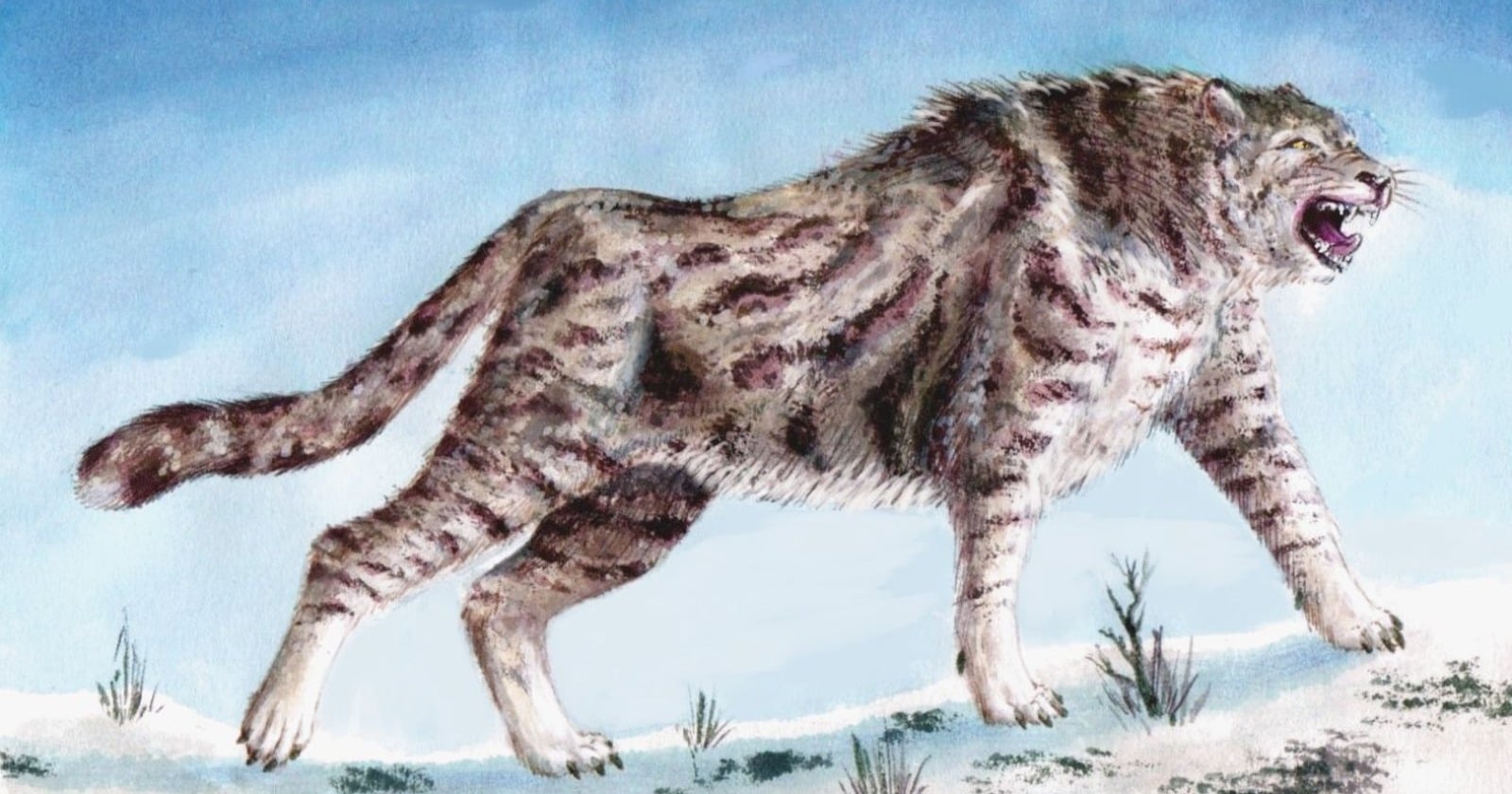
A team led by Molly Cassatt-Johnstone at the University of California, Santa Cruz reports in Current Biology that three Ice Age cat fossils from the Yukon Territory, tentatively identified as puma, are Miracinonyx trumani, the animal usually called the American cheetah.
That places the species more than 20 degrees of latitude north of its recorded range. It also puts a puma-sized cat in the Arctic Yukon whose bones carry a nitrogen signature above those of the other Ice Age carnivores of its time and region in the study, and inside the range the paper gives for fish eating carnivores. The explanation the authors offer for that signature is an aquatic food chain, which they say could include migratory fish.
Sister to the puma
Mitochondrial sequencing did the reassignment. Nuclear data settled a separate and older question about what the animal was in the first place.
The team built a 38 fold coverage genome from the best preserved Yukon fossil, recovered from Bluefish Cave III near Old Crow, and a 22 fold genome from a Miracinonyx petrosal bone collected at Natural Trap Cave in Wyoming in July 2021. Analysed alongside genomes from nine other cat species, they place Miracinonyx trumani as the closest relative of the puma rather than of the African cheetah, a placement the paper describes as definitive.
The split from the puma lineage came around 2.6 million years ago, at the Pliocene to Pleistocene transition, when cooling climate was pushing grassland across North America. The common ancestor shared with the living cheetah sits much further back, around 4.7 million years. The long legs, the light build and the enlarged nasal passages that earned the American cheetah its name evolved twice, separately, under what the authors presume were similar pressures in open country.
Population histories from the two individuals came out almost on top of each other. Both show a long decline in effective population size over the last million years, from close to 100,000 individuals down under 10,000 by 70,000 years ago, with the trajectories only beginning to separate about 80,000 years ago.
Genome wide heterozygosity, 0.0298 per cent in the Wyoming animal and 0.0384 per cent in the Yukon one, falls inside the range reported for other felids and low diversity taxa while also sitting close to the highly inbred Florida panther and the critically endangered Iberian lynx. The paper cautions that those published figures come from different processing pipelines and are a reference point rather than a like for like measurement. Runs of homozygosity showed the authors no evidence of an extreme bottleneck or of inbreeding.
The genomic work carries limits the paper states rather than hides. A scan for positive selection produced 48 genes with evidence of selection at an uncorrected threshold, 32 of them recovered by a second method, and 23 candidates after filtering. Not one reached significance once the authors corrected for false discovery, and they present the list as hypotheses for future work. The loss of function variants, including in the circadian gene PER3 that is inactive in many Arctic mammals, come from two individuals, and the paper flags the sample size before drawing anything from them.
Where the bones came from
Two of the specimens came out of permafrost at an active placer gold mine on Quartz Creek, in the Klondike goldfields of west central Yukon, where miners have been washing frozen sediment off Ice Age bone for decades. A left metacarpal was recovered on 19 September 2012 and a fibula fragment in August the year before, and both are held in the Government of Yukon collections.
The third, a complete left metacarpal from Bluefish Cave III, was excavated between 1977 and 1987 and is held by the Canadian Museum of History. It had been morphologically misidentified as a cougar, which is an easy mistake from a single foot bone.
New calibrated dates put the Yukon fossils between 31,000 and 34,000 years ago, before the peak of the last glaciation, in the warmer interval geologists call marine isotope stage 3. The Wyoming individual dates to 23,500 years ago. Mitochondrial sequencing identified all three Yukon fossils as Miracinonyx trumani, though two of them, the Quartz Creek pair, were later dropped from the divergence dating because their DNA recovery was too poor.
Taken together the specimens stretch the species from present day Florida to the Arctic Yukon, across temperate grassland and Arctic steppe tundra: different prey, different climates, and at the northern end a very different cycle of daylight through the year. The paper says plainly that how the animal held a niche in the crowded northern carnivore guild, alongside cave lions, scimitar cats, grey wolves, brown bears and short faced bears, remains unclear. Worth adding, because the paper does not: fossils from two localities establish presence, not abundance.
The authors also leave the timing open. The Yukon and Wyoming populations share a maternal ancestor around 43,000 years ago, and one reading of that, which they raise themselves, is that the move into the Arctic Yukon was relatively recent and ended in isolation behind continental glaciers.
The nitrogen in the northern bones
Nitrogen 15 accumulates up a food chain, so a predator’s bone collagen carries a rough record of how many steps sit beneath it. Bulk measurements on the three northern Miracinonyx samples came back roughly six parts per thousand higher in nitrogen 15 than the other carnivores and the terrestrial prey of the same region and period.
The gap is large and it is consistent. The Yukon localities lie nearly 400 kilometres apart and span more than 2,000 years, yet their carbon and nitrogen values sit within a standard deviation of a tenth of a part per thousand, close to the precision of the measurement itself. Whatever the northern animals were eating, they ate it steadily.
Bulk values alone cannot resolve trophic relationships, and the paper says so directly. What the authors offer instead is a parsimonious explanation: exploitation of an aquatic food chain, which they say could include anadromous fish. The Yukon values also fall within the range the paper gives for piscivorous carnivores, which it calls consistent with specialization on fish.
Salmonids, inconnu and other migratory fish are abundant in the Bluefish Caves deposits and other Late Pleistocene sites in Alaska and Yukon, several hundred kilometres from the coast, so the resource was available. Modern fishing cats and jaguars take fish in shallow water, and the paper allows that Miracinonyx could have scavenged spawned out carcasses on riverbanks, hunted spawning runs, or simply grabbed what came within reach.
One comparison gives the signal a scale, with a caveat the authors put first: whether Pleistocene bears exploited salmon the way their modern counterparts do is unknown. Even so, modern Kodiak and Alaskan brown bears, for which salmon is roughly 60 per cent of dietary intake, carry substantially lower nitrogen 15 than these cats, a dilution the authors say probably reflects the plant matter bears also eat.
The trophic number and its limits
To push past the bulk values the team ran compound specific nitrogen analysis on individual amino acids, comparing phenylalanine against glutamic acid to estimate trophic position. That analysis used the two Quartz Creek individuals and three of four Wyoming individuals, the fourth having too little collagen left. The Bluefish Caves fossil, the northernmost of the three and the one carrying the 38 fold genome, is not in it: the methods list only the two Quartz Creek samples, and the per sample values sit in the study’s extended data tables on Dryad.
The two Quartz Creek cats came out at trophic position 4, functioning as tertiary consumers. The Wyoming animals averaged position 3, plus or minus 0.3, which is what a cat feeding primarily on terrestrial herbivores should look like.
There is a circularity in that number worth naming. Converting amino acid nitrogen into a trophic position requires choosing a baseline, and the team applied an aquatic baseline to the Yukon animals precisely because the bulk values had already pointed that way. Trophic position 4 is therefore consistent with the fish reading rather than an independent test of it.
No tooth marked fish bone appears anywhere in this study, and the paper does not say whether anyone looked. Fish is offered as a parsimonious explanation, not as an observation. Two further items belong in the record: the Bluefish Caves specimen carried a previously published radiocarbon age of 18,970 plus or minus 1,490 years, which the study’s new dating replaces, and Beth Shapiro, the study’s senior author, is employed by and holds stock options in Colossal Biosciences, disclosed in the paper’s declaration of interests.
What survives all of that is the identification and the placement: mitochondrial sequencing naming all three Yukon fossils, and nuclear genomes putting the species beside the puma. The diet stays an inference, and the paper’s own text mostly writes it as one, though its highlights do not.
The paper ends by suggesting that other collections are likely worth reassessing, since a Miracinonyx foot bone and a puma foot bone are hard to tell apart. Two metacarpals and a piece of fibula have stretched a species’ known range across a continent and put the northern animals’ diet, on isotopic evidence alone, into water. What else is filed under the wrong animal?