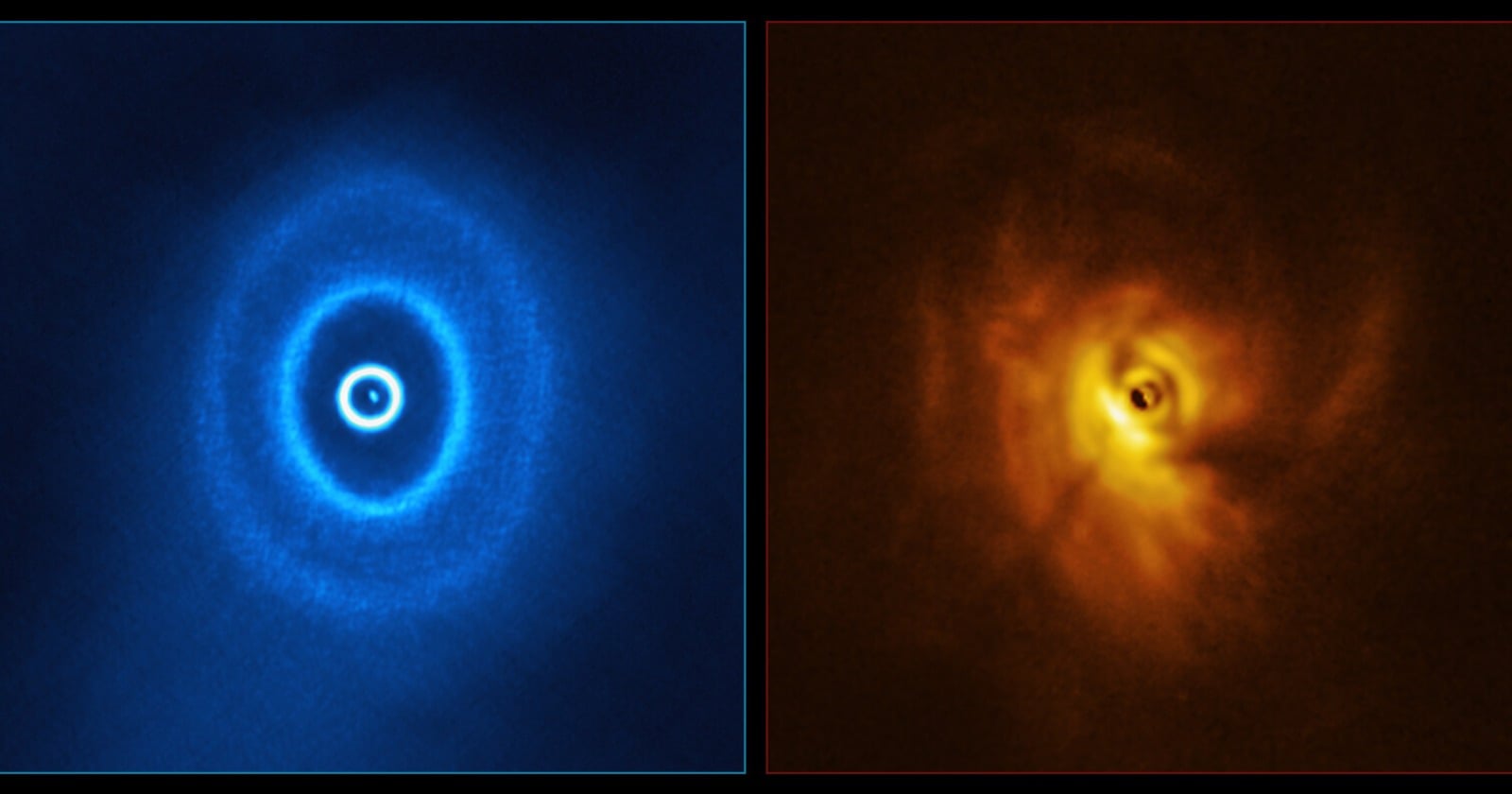
Three degrees. That is the gap between the direction a river of gas is falling into the triple star system GW Orionis and the direction the outermost of its three planet-forming rings is tilted, and a team working with the Atacama Large Millimeter/submillimeter Array has published it as what they call strong observational evidence for why those rings do not stack flat. The same gap is 8 degrees for the middle ring and 32 degrees for the innermost one. The arithmetic of coincidence is what carries the claim: the authors calculate that two unrelated directions would land within 3 degrees of each other about 0.07 percent of the time.
A river of gas arriving from outside the system
GW Orionis sits about 402 parsecs away, a little over 1,300 light-years, in the constellation Orion. Its primary star has two companions, one at roughly the Earth-Sun distance and one about eight times further out, and around all three is a broad disk of gas and dust containing the three rings, with inclinations of about 11, 35 and 40 degrees from the innermost outward. Earlier work established that all three are misaligned with the orbital plane of the inner two stars, which is a bit like finding three records on a spindle that refuse to settle into one plane.
Astronomers call the incoming feature a streamer: a long, narrow flow of gas arriving from a star’s birth cloud onto the disk around it, late and from an angle nobody planned. A streamer had been noticed here before in Submillimeter Array data. Archival ALMA images, from an earlier program led by another group, then ran out of field of view at 25 arcseconds before the flow did, which is why this team asked for extra pointings offset from the star itself and combined those with the 2017 and 2018 archive.
They tracked the flow in carbon monoxide, an easy molecule to see in cold gas and a standard stand-in for the hydrogen that holds most of the mass. Two forms of it showed the streamer, out to about 30 arcseconds on the sky in the commoner form. At this distance that is roughly 12,000 astronomical units, one astronomical unit being the average Earth-Sun distance, or about 0.19 light-years and a little over a trillion miles. The paper quotes 12,000 astronomical units and leaves it there; the light-year and mile figures are conversions, which the observatory’s own announcement of the result also carries.
A rarer form of the molecule, which traces deeper into the flow, reached only about 18 arcseconds, or 7,200 astronomical units. That is the form the mass estimate rests on, and it puts the streamer at about 1.6 Jupiter masses, with an upper limit of 4.6 set by a third form that turned up only in the central disk and never in the streamer. Fitted trajectories put the gas on a bound elliptical orbit, arriving from behind the disk as we see it, with too little energy to escape again.
The three degrees is a fitted number
Both a disk and an infalling stream have an axis describing the plane they move in, and the two need not point the same way. The team derived the streamer’s axis from a trajectory fit, using an open-source model that treats the flow as a cloud of points falling under the gravity of the central star. They took the rings’ axes from the inclinations measured in earlier ALMA work rather than remeasuring them.
That matters for how much weight the 3 degrees can bear. It is a fitted result standing on a borrowed assumption, not a ruler reading, and the paper says the large uncertainty on the streamer’s angular momentum is mostly down to one parameter nobody can see: its starting distance along the line of sight, which the model returns as 5,000 astronomical units give or take 4,292. The paper attaches no error bar to the 3 degrees at all.
What the fit does deliver cleanly is a landing site. Projected onto an image of the dust, the best trajectory meets the disk on or very near the outermost ring, and the next five best solutions land on the outer or middle ring too. The authors call the alignment strong observational evidence that the streamer is the source of the misalignment, and they do not walk that claim back: the conclusions repeat the phrase, add that the outer ring looks like a second-generation disk assembled from the infalling material, and open the closing paragraph by saying the observations establish a direct link between late-stage infall and disk misalignment. A softer formulation sits two sentences later in the same paragraph rather than replacing it: the results support a scenario in which the streamer contributes to reorienting the disk. The hedges the paper does apply are attached elsewhere, to the angular momentum rather than to the alignment.
Two genuine rivals stay live in the same section. The rings may have been torqued by the gravity of the three stars, or shaped by a planet forming in the disk that nobody has seen. A third item on the paper’s own list, primordial misalignment inherited from a mismatch between the spin of the collapsing core and the spin of the cloud around it, is not a competitor: it is the family the streamer picture belongs to, and the authors say explicitly that it is the scenario they are exploring.
The accounting problem
At its present strength the streamer falls short of the job the paper wants it to have done. Its total angular momentum works out to about 2,500 in the paper’s units, give or take 1,800, against roughly 19,000 for the disk. On the central values that is a factor of about eight, but the streamer’s figure carries an uncertainty most of the way to zero and the disk’s is quoted without one, so the factor itself is not well determined. The authors put it as the streamer not having enough angular momentum to significantly perturb the disk’s alignment. Their conclusions do add a hedge, though to a different comparison: the streamer’s specific angular momentum, 1,682 give or take 1,269, does overlap the 2,381 they compute for the disk’s edge.
Their response is not an answer but a possibility they say they cannot rule out: that the tilting happened earlier, when the flow was far heavier, and that what is arriving now is the tail of it. Several numbers support the end-stage reading independently of the angular momentum. The material takes about 0.04 million years to fall in, against a system age estimated at 0.3 to 1.3 million years. The mass infall rate comes out at 3.6 times ten to the minus eight solar masses a year, with an uncertainty of plus or minus 3.19 in the same units, roughly an order of magnitude below the rate at which the stars themselves are accreting. The paper reads that gap as a sign the streamer was feeding the disk far faster in the past, while noting that the system’s multiplicity may also play a part.
The cost of that answer is a mass budget. For past infall to have set the outer ring’s angle, the streamer must have delivered at least 180 Jupiter masses over its lifetime, about 0.17 solar masses, and that figure assumes its specific angular momentum has not changed along the way. The present disk holds about 0.12 solar masses. So the scenario requires that a significant amount of the disk mass arrived this way, which is the authors’ own phrasing.
They do offer a way to close the budget, and the simulations they cite cut both ways: one finds only about 13 percent of a collapsing cloudlet’s material ends up in the disk, while magnetohydrodynamic work has some stars gaining upward of half their mass from late infall. If the streamer visible today holds about 15 percent of what the original cloudlet held, they put that cloudlet at roughly 2 solar masses, which they describe as consistent with observed dense cores and filaments in Orion. The step to 2 solar masses is not shown, though it is recoverable: the present disk mass and the required past delivery come to 0.29 solar masses between them, and dividing that by 15 percent gives about 1.9. That route is ours, not the paper’s.
One further figure looks like a contradiction until you follow the reasoning. If the middle and outer dust rings are made entirely of imported material and the present infall rate has held steady, the infall has been running for 3.4 million years, several times the system’s age. The paper takes it the other way round from how it first scans, reporting the figure and then saying it further supports an infall in its end stages. The implication the authors leave unstated is that the steady-rate assumption behind the 3.4 million years cannot hold. The awkward number is doing work in the argument.
Where the paper disagrees with itself
At least five places in this paper do not match themselves. The streamer mass carries an uncertainty of plus or minus 0.8 Jupiter masses in the results section and plus or minus 0.3 in the conclusions. The infall rate carries plus or minus 3.19 in the text and exactly zero in the table. The rest frequency of the third carbon monoxide form is 219.55 gigahertz in one paragraph of the observations section and 219.94 in the next. The separation between the star and the surrounding cloud emission is about 70 arcseconds early in one discussion section and about 50 by the end of the same section, while the 28,100 astronomical units quoted alongside it only works out for 70. And the bright patch of cloud emission is placed toward the upper right of the field in the discussion and the upper left in the conclusions.
None of these touch the 3-degree result, and where the same 15-kelvin temperature is used twice it is justified separately each time, as the median brightness temperature in the flow for the mass estimate and as a freeze-out threshold for the upper limit. Where the answer turns on care, the paper is careful; the slips sit in the places that do not change a conclusion.
Sweeping up gas on the way through
The proposed origin of the stream is that GW Orionis is simply ploughing through its birth cloud and collecting material as it goes, a process named after Hermann Bondi and Fred Hoyle. Large-scale ALMA data does show bright emission out along the streamer’s direction, at a projected separation the paper puts at about 28,100 astronomical units, against a radius of about 31,000 for that process to operate. The paper gives no percentage and says only that it falls well within the radius. How comfortable that is depends on which of its two separations you take: 28,100 astronomical units is the figure that follows from the 70 arcseconds stated earlier in the section, and on that reading the emission sits at about 91 percent of the limit, on our arithmetic; on the 50 arcseconds printed beside it the separation would be nearer 20,100 and the margin roomy. The radius is in any case explicitly an upper limit, carrying an uncertainty of plus or minus 18,000 astronomical units.
Two caveats travel with it. The separation is a projection onto the sky, and the paper says the true three-dimensional distance cannot be determined. The radius is an upper limit, because only the cloud’s motion toward or away from us could be measured, not its motion across the sky. The paper does not rest the case on that margin alone: it also notes that the streamer’s angular momentum matches the scaling relation the same accretion process produces in numerical simulations.
A sulphur compound often used to flag the shock front where gas hits a disk did not appear in these observations. The authors say that does not necessarily mean there are no shocks, that it is more likely a matter of their sensitivity, and that sulphur-bearing molecules have in fact been tentatively picked up in other archival ALMA data of this system, which they leave for later work. The dark lane running down the middle of the streamer is likewise unresolved. The authors judge spatial filtering unlikely, since the split is not centred on a velocity and their pointings sample the relevant scales, and do not attribute the structure to it; a hollow tube whose rim carries more material along the line of sight than its centre, a rotating one, and two separate streams that have since merged all remain on the table.
So the next measurement is a sharper sulphur map, pointed at the place the trajectory says the gas lands. That is an observation somebody can schedule. Until it happens, is the impact site something a better shock map could actually pin down, or does this system’s one striking number have to carry the whole argument on its own?