

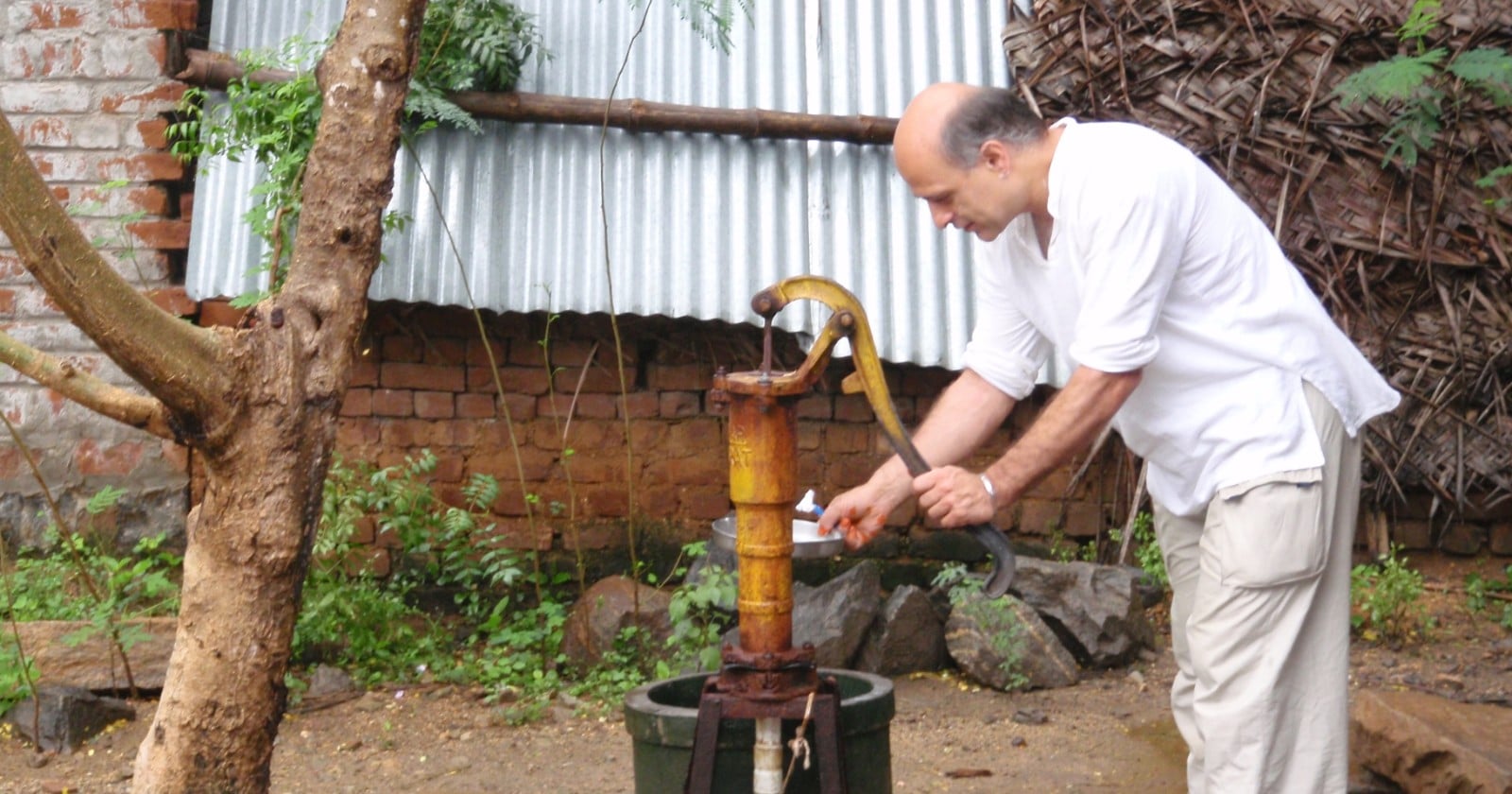
A fish with no scientific name came out of a hand pump in a village in Bihar, northern India, in January 2025. It measured 40.6 mm from snout to tail base, had no body pigment at all, and had eyes reduced to skin-covered spots.
The animal now has a formal name, Gangaichthys indonepalicus, and its describers place it in a new species and a new genus. Their paper appeared on 11 August in the journal ZooKeys, and the route by which they found it began on a phone.
The tip-off came from a phone
In the Introduction to their paper, Akshay Khandekar and his co-authors state plainly where the project started. “We came across a video posted on the social media platform TikTok in 2024 from the India-Nepal border area,” they write, “that showed a tiny, apparently stygobitic fish, with little melanin and reduced eyes, that had emerged from a borewell.”
A borewell, as the paper glosses it for readers who have never used one, is a machine-drilled shaft that reaches groundwater in an underground aquifer. Someone had pumped one, a strange pale fish had come out with the water, and the clip had gone up online.
The paper does not name the uploader. What the video did was point at a place.
A week of hand-pumping
Khandekar and his colleagues went to the Indo-Gangetic Plain in Bihar across 2024 and 2025 to try to find the animal. “We sampled more than 15 borewells by hand-pumping for approximately one week,” they write, “and were able to collect three specimens of the new species from two borewells.”
Two of those three arrived damaged. The holotype and one paratype came up the same well after roughly 2,000 to 2,500 litres had been pumped out of it; the holotype emerged intact, and the other fish sustained damage during pumping and died immediately. A third, fragmentary, came from another hand pump about 900 metres north two days later.
That one undamaged animal is why the osteology exists.
It was photographed alive, then euthanised, fixed, and taken to the National Centre for Biological Sciences in Bengaluru, where Sunil Prabhakar ran it through a micro-CT scanner in February 2025 without contrast agents.
A diagnosis built from one animal
The scan is where most of the counts come from. The fish has 64 vertebrae in total, 28 abdominal and 36 caudal, along with 37 dorsal fin-rays, 35 anal fin-rays, six caudal fin-rays, and a single pectoral fin-ray that the scan itself did not resolve: the osteology records no ossified pectoral ray at all.
It is the combination that the paper calls unique, not the individual figures. Several of these counts overlap with other members of the family Chaudhuriidae, the earthworm eels: the paper describes the new fish as similar to Pillaia in total, abdominal and caudal vertebrae and in dorsal and anal fin-rays, and similar to Chendol in dorsal and caudal fin-rays. The pectoral and caudal ray counts are the ones it calls non-overlapping against its nearest neighbour. No other chaudhuriid has all of these characters together, and the family’s members are all diminutive, none exceeding about 90 mm in total length.
The fish also appears to have no ribs, and here the paper explains a hedge its abstract already carries. The Discussion says that “though no ossified ribs were observed, the lack of contrast agents precludes the detection of weakly ossified or chondrified structures typical of miniaturized subterranean fishes.” With one intact specimen, the team could not scan again. The abstract and the diagnosis both call the absence of ribs apparent, and that qualifier is the authors’ own.
The other reductive traits are less ambiguous. Complete loss of body pigment and reduced eyes are what the paper calls classic reductive traits associated with hypogean environments, and it notes that such traits are often the result of convergent evolution driven by relaxed selection in dark, resource-poor habitats. They are evidence about environment; they say nothing about descent.
Sequencing has not caught up with the morphology
Only two species in the entire family have comparative mitochondrial CO1 sequence data available, one from each of two genera. Against those, the new fish’s CO1 sequence, deposited in GenBank as PZ760211, differs from Chaudhuria caudata by an average of 20.7 percent and from Pillaia indica by 22.2 percent, calculated as uncorrected p-distance. That is the basis for the abstract’s claim of more than 20 percent divergence. There is no comparative nuclear sequence data for the family at all.
The authors are explicit about what this does and does not settle. “The combination of unique morphological characters clearly distinguishes the new genus and species from other members of the Chaudhuriidae,” they write, “but a lack of comparative sequence data for the family prevents elucidation of generic inter-relationships and the position of the new genus within the family. This should be a priority for future work on the family and to confirm our recognition of Gangaichthys indonepalicus gen. et sp. nov. as a new genus.”
So the morphology, on their argument, carries both ranks. What is unresolved is where the new genus sits inside its family. They name the alternative reading themselves: the fish could be construed as a member of an expanded Chaudhuria, which they consider unlikely given the long branch length and the number of distinct morphological characters that separate it. That is a defended position, not a settled one, and it stays that way until more of the family has been sequenced.
An earlier blind eel that never counted
In 2008 Shrestha provisionally named a small blind eel-like fish, 33 mm long, from an unspecified locality in Narayani, southern Nepal, without designating a type specimen or pointing to any museum material.
Under the naming rules that makes “Neoanguilla nepalensis” a nomen nudum, a name with no standing. What that animal actually was remains unclear, and the new paper says so. It does rule out the simplest possibility: on Shrestha’s account that fish had 26 to 28 dorsal fin-rays against the Bihar fish’s 37, and had melanophores and a lateral line, both of which the new species lacks.
Gangaichthys indonepalicus is known from two closely spaced localities in Balgangwa village, Pashchim Champaran District, plus photographic records from Triveni in Nawalparasi District, Lumbini Province, Nepal. All of it sits inside 11 km in a straight line. The Nepali end of that range rests on photographs; no specimen has been collected there.
Pressure on the water below
The describers withheld the GPS coordinates, releasing them on request, to protect against illegal collection. They also name a second pressure, and it is upstream of anyone collecting.
India’s known hotspot for subterranean fish is the lateritic aquifer system of Kerala, in the south, with 11 species. This is the first subterranean fish from the alluvial aquifers of the Gangetic Basin, on the authors’ account, and it extends the known range of the earthworm eels roughly 500 km westward. Their recommendation is for targeted sampling of these fish across India, because what they call “dangerously high levels” of groundwater extraction and contamination are, on their account, “likely affecting” the subterranean fauna.
Nothing in this paper measures a decline, and it does not claim to. It establishes that something lives down there at all, in an aquifer under a heavily farmed plain, and that it reached science through a hand pump in a village and a phone.