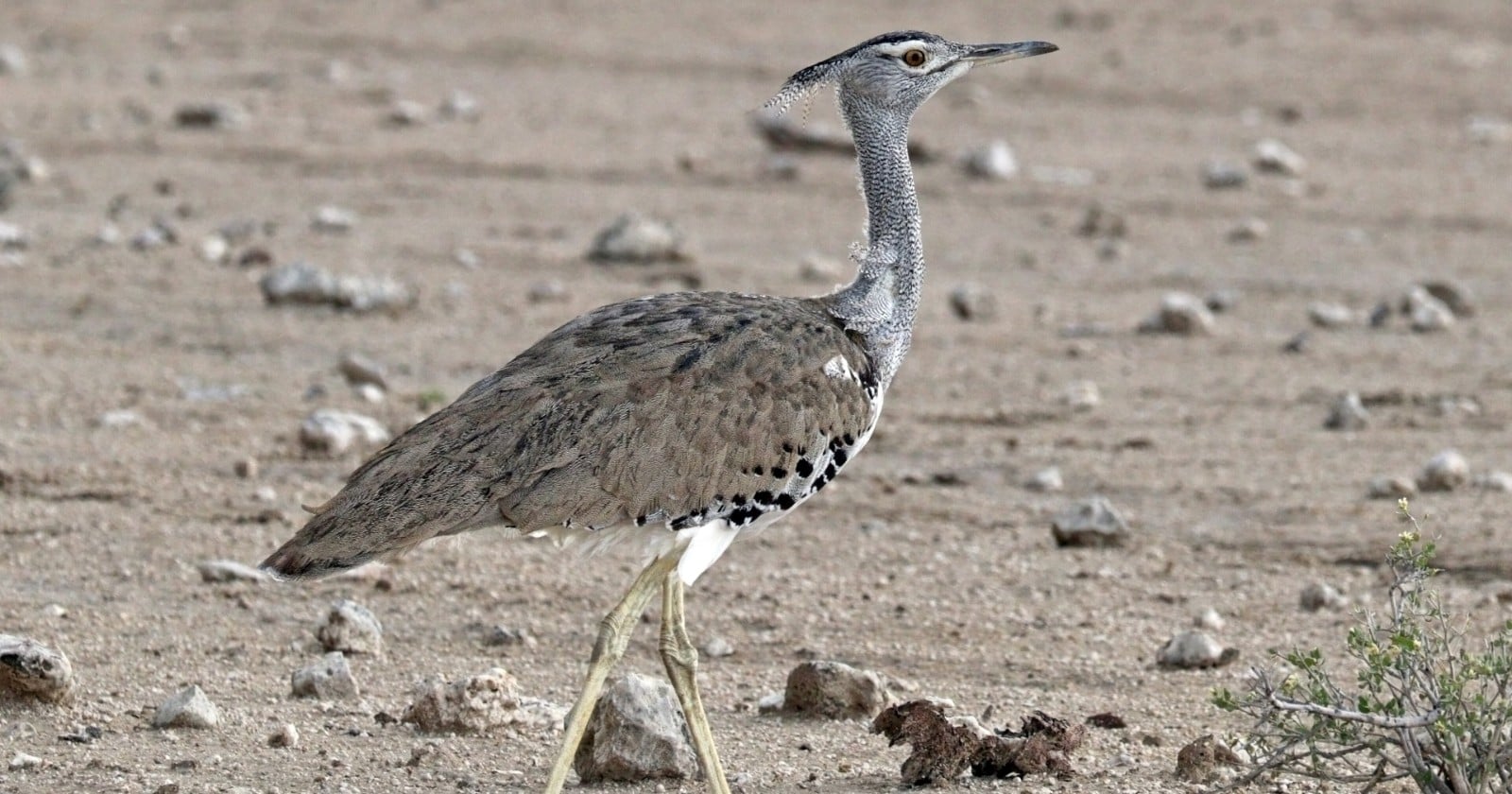
A female kori bustard chick at Franklin Park Zoo weighed 83 grams when she came out of the shell on 1 August, and keepers have been visiting her in a steady rotation through the day to make sure she gets enough exercise. Zoo New England, in an announcement on 2 September, says she is being raised by the zoo’s animal care team, and that she is the first kori bustard the Boston zoo has hatched successfully since 2003.
A month on, the zoo put her at more than 300 grams and still gaining daily. The zoo calls that exercise critical to healthy development, and Robles gives a specific reason for it: in the wild, the chicks follow their parents.
A keeper rotation stands in for a parent
Bill Robles, Area Curator at Zoo New England, put it plainly in the zoo’s announcement. “Exercise for long-legged birds like cranes, storks and kori bustards is essential for proper development of their legs, muscles and behavior,” he said. “In the wild, the chicks follow their parents all over grasslands and plains, and through the exercise schedule we have established, we are emulating that here.”
The Smithsonian’s National Zoo gives a slightly different account of who a chick would be following. Its fact sheet for the species says the male mates and then leaves, playing no part in incubation or in the rearing of chicks, and that chicks remain with the female well after the fledging period, which comes at about five weeks.
Robles is explicit that the schedule is there to emulate the following, which implies the chick is not getting it any other way. So the zoo substitutes. Keepers come through the day in a steady rotation, and the chick moves.
What hatching fully developed still leaves to do
Kori bustards belong to a group of birds whose chicks arrive more or less operational. The Smithsonian’s fact sheet describes them hatching fully developed, out of a clutch of one or two eggs laid on the ground in a shallow scrape the female has made, after 23 to 24 days of incubation.
The adult body this chick is heading toward is unusual. The same fact sheet notes that kori bustards have only three front toes, short and broad and well adapted for running, and gives a height of about five feet. They fly. But the page also records that the species lives on the ground and is reluctant to fly unless in serious danger, which is a strange thing to be true of a bird routinely introduced as the heaviest flyer alive.
That combination is what makes the leg development load bearing. A bird that lives on the ground, and is heavy even by the standards of birds that fly, has to reach adulthood with the skeleton and the muscle to manage it. The window for building them is the one this chick is in now.
The provenance of the forty-pound figure
Zoo New England’s announcement says the species is “one of the heaviest flying birds in the world” and that adults “can weigh more than 40 pounds.” The second figure sits at the top of the range, not in the middle of it. It does not describe this chick, and it does not describe most kori bustards. It describes males, at the top of a range the people who measure these birds hold loosely.
Start with the sex. The Smithsonian gives male kori bustards a range of 24 to 42 pounds, or 11 to 19 kilograms, and says females are roughly half the size of males. Its own 2011 press release is blunter: “Weighing in at 40 pounds, male kori bustards are the world’s heaviest flying birds.”
Then the upper end. In a 2009 paper in The Auk on sexual size dimorphism in the great bustard, Juan C. Alonso and colleagues take the question on directly, under a section heading that reads “Are Great Bustards the heaviest flying birds?” They report the high published figures for kori bustards as 10.9 to 19.0 kilograms, citing del Hoyo et al. 1996, and separately a 19 kilogram captive male reported to them by S. Hallager as a personal communication. Those figures, they write, “could also be somewhat exaggerated.” The “also” reaches back to an earlier passage in the same discussion, where the authors say they think most old references putting great bustards close to or above 20 kilograms “should be considered exaggerations from hunters.”
Against those figures they set measurements. The only sample of wild kori bustards taken in recent times, they write, gave a mean of 11.5 kilograms for adult males, ranging from 7.14 to 15.2 kilograms across 19 birds measured in Namibia between 1997 and 2002, reported to them by T. Osborne as a personal communication rather than as published data. The heaviest wild male there works out at about 33.5 pounds. The mean is nearer 25.
The same source gives adult females a mean of 5.6 kilograms, from a range of 4.31 to 6.73 kilograms across 37 birds. That is a mean around twelve pounds, with the heaviest under fifteen.
Their doubts attach to particular records. The conclusion itself is generous: male great and kori bustards “have comparable mean and maximum weights and may be considered the two heaviest flying birds, on the basis of recent samples taken in the wild.” The authors’ own heaviest great bustard weighed 13 kilograms, and they put a realistic ceiling for Iberian males at about 15. The one bird that beats both, a male found dead at Albacete in south-eastern Spain in February 2009, they accept on another personal communication, writing that it “indeed reached 19 kg.” Of the Iberian ceiling they allow that “some exceptional individuals may reach higher weights.”
So Zoo New England’s “one of the heaviest flying birds in the world” survives all of that intact. The forty-pound line is the half that slips, and not because the number is wrong: the zoo attaches it to “adults”, and both Smithsonian sources that specify a sex attach it to males. The Smithsonian’s male range runs to 42 pounds and it puts females at roughly half the size of males; the wild adult-female sample those authors report puts them at a mean near twelve pounds, in a range from about nine and a half to fifteen. This chick is female.
Fifty at the National Zoo by 2011, none at Franklin Park since 2003
A gap of twenty-three years sounds like a species-level drought. The captive record says otherwise, at least for the stretch of it these documents cover.
The Smithsonian’s National Zoo announced its fiftieth kori bustard chick in June 2011, saying it had bred the species consistently since 1997, when it became the fourth zoo in the world to hatch them, and that many of those offspring had gone on to breed at other North American zoos. No later captive-breeding record was checked for this piece. What that one establishes is that the managed population was reproducing steadily somewhere in the network from 1997 to at least 2011, while one particular institution had not managed it since 2003.
Zoo New England describes this hatch as the result of a recommended breeding. The Smithsonian’s release describes the Association of Zoos and Aquariums Species Survival Plan for the species as matching animals across the country to ensure genetic diversity in the population, and names Sara Hallager, a zoo biologist there, as its head at the time. Franklin Park Zoo keeps a male, Onyx, and two females, M’Guu and Kibibi. The chick, the zoo says, will move to another AZA-accredited institution once she is old enough.
A listing built on suspected decline
The wild picture is looser than the captive one. BirdLife International’s assessment for Ardeotis kori, last updated in 2025, lists the species as Near Threatened under criteria A2bcd+4bcd, with a decreasing population trend across a disjunct sub-Saharan range. Its extent of occurrence is 8.71 million square kilometres. BirdLife records its area of occupancy as unknown. It does carry a separate figure, 3.42 million square kilometres of occupied area from a range-wide effort to collate records, but notes that this was not produced on the standard grid the measure normally uses.
BirdLife gives the number of mature individuals as unknown. What it does carry is a tentative, suspected total population placed in a band of 20,000 to 50,000 individuals, arrived at from summed national estimates that themselves come to 14,000 to 30,100 across part of the range, including 2,000 to 5,000 in South Africa from a figure the assessment notes was presented without justification. The decline is placed at 10 to 29 percent over a past-and-current 36-year period, which BirdLife equates to three generations, and the word the assessment uses for it is suspected.
Suspected decline is a legitimate Red List category of evidence, and the work underneath it is real: BirdLife cites a 2013 analysis finding the species’ extent of occurrence contracted by 21 percent in East Africa and 8 percent in southern Africa since the late nineteenth century. The named threats are collisions with power lines, hunting and habitat degradation. But when a hatch announcement calls itself significant for the species, the wild baseline it is being measured against is a band BirdLife itself calls tentative and suspected, assembled from national estimates, not a census.
The rotation continues either way. Somebody comes for her through the day, and she does the work a wild chick would be doing behind an adult, at a zoo that had not hatched one successfully since 2003.