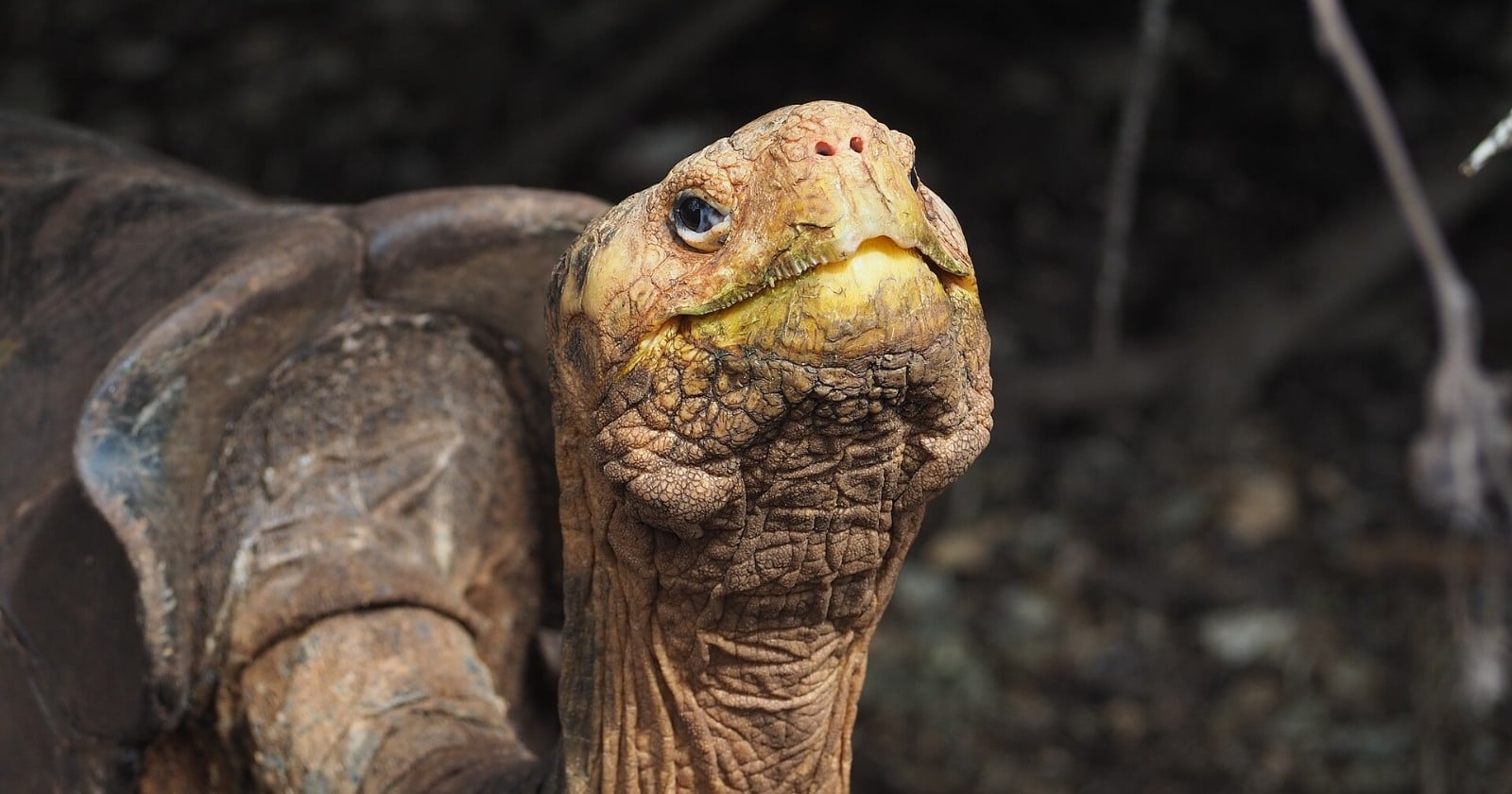
Sometime in the mid-1930s, a research expedition took a giant tortoise off Española Island, at the southeastern edge of the Galápagos, and he eventually ended up in the collection of the San Diego Zoo. Nobody involved could have known they were removing one of the last members of his species that would ever be found.
Four decades later, that tortoise became one third of the male breeding stock in a rescue effort that rebuilt an entire species. By the time the Galápagos National Park Directorate carried him back to Española in June 2020, an island that had been down to 14 known resident tortoises held a wild population of roughly 2,300, rebuilt from 15 survivors.
An island emptied one ship at a time
Española once supported a tortoise population that researchers estimate at no fewer than 3,000 animals. The island is one of the flattest and most accessible in the archipelago, so its tortoises were among the first in the Galápagos to be depleted. Hunters from the sealing, whaling and pirate ships that worked these waters through the 1800s reduced them generation after generation.
The ships left something behind, too. Introduced goats multiplied over two centuries and converted a densely vegetated island to open thorn scrub, degrading the habitat the remaining tortoises needed. By the mid-1960s, no reproduction appeared to be happening on Española at all.
Searches of the island turned up just 14 survivors: 12 females and two males. All of them were transferred to what became the breeding centre run by the Charles Darwin Research Station and the Galápagos National Park on Santa Cruz Island, where a programme created in the mid-1960s produced its first captive-bred hatchlings in 1971.
The fifteenth survivor was living in California
Fourteen animals, with only two males, is a desperate starting hand. The programme’s managers launched a worldwide search for any additional Española tortoise, especially a male, that could add genetic variability to the group.
The search paid off exactly once. An adult male at the San Diego Zoo, the one collected in the mid-1930s, was identified as an Española tortoise and repatriated to the Galápagos in 1977, bringing the breeding group to 15. He came to be known as Diego, and he became the programme’s celebrity. He is credited in the park directorate and Galápagos Conservancy’s joint accounting with approximately 40 percent of the offspring repatriated to the island, and the same 2020 release puts his age then at more than 100.
The captive colony was quietly productive on a scale that is hard to picture. By August 2002 the 15 breeders had generated 1,200 repatriated offspring, according to the genetic analysis of the programme published in Proceedings of the Royal Society B in 2004, and the total eventually reached nearly 1,900 tortoises returned to Española. The wild population responded: tortoise nests were observed on the island in 1988, and offspring hatched in the wild were documented in 1994, evidence that the repatriated animals were breeding without human help.
By the programme’s close, the Galápagos Conservancy and the park directorate put the island’s population at approximately 2,300, which the joint release describes as the offspring and “grandchildren” of the original 15 surviving Española tortoises.
What the DNA did to the 40 percent legend
The popular version of this story gives Diego the starring role. The genetics recorded a more crowded cast.
In a study published in 2004, a team led by Michel Milinkovitch genotyped 134 tortoises sampled on Española in 1994, out of an estimated 347 then surviving of the 556 repatriated by that time, and assigned parentage for all but two of them. The contributions of the 15 breeders turned out to be highly skewed, enough that the researchers rejected the hypothesis of randomly distributed reproductive success. Two females had produced many offspring with one of the two males caught on the island itself, a tortoise known in the study only as E5, and none with anyone else. Diego, recorded in the paper as E15, had bred successfully with a different set of females, and the study’s authors wrote that his presence in the programme “has been important.” The other island-caught male, E3, had contributed very little.
The joint release credits Diego with approximately 40 percent of the repatriated offspring. That is a large share, but it is an estimate, and it is not a majority. If the estimate is right, most of the repatriated offspring were fathered by the two less famous males. And since the 2004 study found E3 contributed very little among the survivors it sampled, the bulk of that majority points to the uncelebrated E5.
The skew also carried a genetic cost. The 2004 study estimated the breeding group’s effective population size at just 5.7, a number the paper itself calls very low, and reported that the population’s allele counts and average heterozygosity were much lower than in other Galápagos tortoise populations. A follow-up analysis published in Evolutionary Applications in 2013 kept the figure under 8, computing 5.5, 7.6 and 7.9 across samples taken in 1994, 2003 and 2007, and put it down to unequal reproductive success among the breeders combined with nonrandom mating in captivity.
The same 2013 study is also the reason for confidence. Sampling across repeat visits, the team found that none of the 134 island tortoises tested in 1994 had hatched on Española, against 9 of those sampled in 2003, or 2.6 percent, and 50 of those sampled in 2007, or 24 percent. The paper’s abstract dates that middle sample to 2004 and rounds it to 3 percent, while its methods and results both place it in 2003; the 2003 figures are the ones used here. A species that had apparently stopped reproducing was, by then, increasingly raising its own young in the wild, despite minimal genetic variation. The single-hero version is the part that overshoots.
Carried home the last mile and a half
The programme was formally closed in 2020, judged to have done its job. On June 15 of that year, after a quarantine extended by the pandemic, park rangers and scientists sailed the 15 original breeders back to Española, according to the joint announcement by the park directorate and the Galápagos Conservancy.
The last leg was on foot. Each of the 12 females, averaging around 77 pounds, was carried overland by a single person; the three males, each over 120 pounds, took two carriers working in relays. The route ran about a mile and a half inland to Las Tunas, a stretch of the island dense with the Opuntia cactus that anchors a tortoise’s diet, chosen to ease the animals back into wild living. Staff stayed roughly four more hours, watching the breeders settle into an island that goats no longer strip bare; the goats were eradicated decades ago, and the release notes the island can now support its growing tortoise population long term.
Every returned tortoise was fitted with an identification microchip and a GPS unit transmitting six positions a day, and 40 motion-triggered cameras were distributed across the release area. A first monitoring expedition was planned for about six months after the release, according to Washington Tapia, who directs the tortoise restoration initiative through the Galápagos Conservancy. Diego’s captive breeding career is over. The transmitters fitted to the old breeders’ shells, and the cameras posted in the cactus at their release, were set up to record how the rest of the story goes.