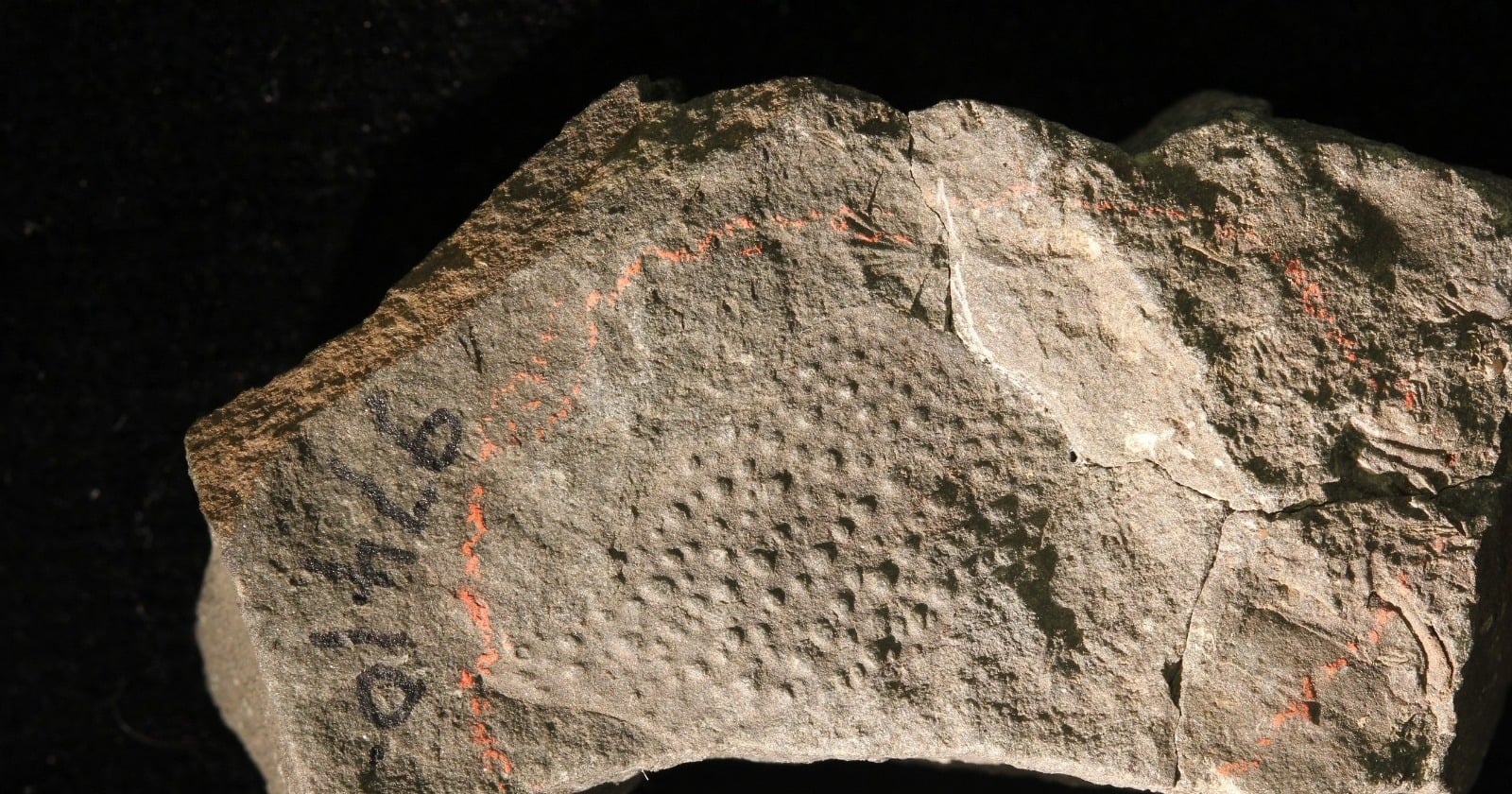
A fossil pincer held at the Natural History Museum in London is more than 159 millimetres long. One of the largest scorpions alive today, Gigantometrus swammerdami, has a pincer of 37 millimetres, a figure the new Palaeontology revision takes from a 2020 study by Prendini and Loria.
Announcements from the University of Manchester and the museum call the animal that carried the larger pincer the largest scorpion ever to exist, and put it at about a metre in length. The revision they are announcing, published in Palaeontology by Richard J. Howard, Russell J. Garwood, Gregory D. Edgecombe and David A. Legg, states neither of those things. It gives no total body length for the animal anywhere, and its own wording is “extremely large scorpion”.
What the paper does argue is harder and more interesting. It argues that this animal was a scorpion at all, a reading that only emerged in the 1980s, was rejected again as recently as 2024, and applies to a fossil whose affinities have been argued over since 1870.
The groups it has been put in
Woodward described the first four specimens in 1870 and took them for an isopod, the group that includes woodlice and their marine relatives. The genus name carries the reading: Arcturus, its root, is a living genus of isopod.
Later interpretations moved through most of the arthropods. Zittel compared the fossils to arthropleurids in 1885, the lineage that produced the two-metre myriapod Arthropleura. King called them eurypterid in 1934, a sea scorpion, a different animal entirely. Hessler put the genus among the peracarids in 1969, the larger group that contains the isopods. Rolfe called it indeterminate the same year, then came round to scorpion by 1980. The paper’s own summary is that Praearcturus has been variously interpreted over the past century, most commonly and most recently as a crustacean.
Kjellesvig-Waering’s posthumous 1986 monograph re-described it as a gigantic scorpion, but printed very little illustration, and few photographs of the material have appeared since. In 2024 Braddy argued the crustacean case again, on the absence of features unique to scorpions and on what that paper read as crustacean-like features of the head shield and back plates, without figuring any of the material.
The announcements date the original description to 1871. The paper’s synonymy list gives 1870, with follow-up notices in 1870 and 1872, and 1870 is the date used here.
The case for a scorpion
There is not much material to work from. Table 1 lists twelve catalogued specimens, nine at the Natural History Museum and three at Amgueddfa Cymru in Cardiff, and they represent fewer than twelve animals: two entries are the halves of one split slab, and three more are a single three-dimensional finger plus the two impressions it left in the rock.
What that adds up to is the back of a head shield, less than half its length, preserved in relief; a flattened pincer; several walking legs and a scatter of leg bases; and one slab from a Welsh quarry carrying the whole front section of the abdomen, all seven of its plates, and the first segment of the tail.
The strongest character in the new work is the sternum, the plate on the underside of the head region. In Praearcturus it is much longer than wide, lance-shaped and grooved down the middle, and it is flanked by the fourth pair of leg bases and probably the third, its tip reaching forward to the level of the second. That is close to the sternum of Eramoscorpius brucensis, a Silurian animal from Canada that the authors treat as an unambiguous scorpion, and it is unlike the small five-sided sternum that living scorpions typically have.
The pincer helps too. In Praearcturus the movable finger sits on the outer side of the fixed finger, the arrangement scorpions use. In crayfish and lobsters it sits on the inner side.
A strip of cuticle on the base of the pincer-bearing limb carries shallow, evenly spaced parallel ridges. Kjellesvig-Waering read these as part of a sound-making organ, and the new paper agrees, supposing they were rubbed against a matching set of ridges on the opposite side. Computed tomography at the Natural History Museum, 3,142 projections reconstructed at a voxel size of 0.095 millimetres, showed cuticle that is unusually thick in places, particularly at the leg bases.
Set against all of that is a gap the paper does not hide. The features treated as unique to scorpions include a sting and pectines, the paired sensory combs carried under the abdomen, and no Praearcturus specimen shows either. That was one of the two grounds of the 2024 objection.
The paper’s answer is that the regions where both would sit, the end of the tail and the underside behind the sternum, are not preserved in any specimen, so the absence is a gap in the fossils rather than a checked result. Its reconstruction drawing marks the point: in the ventral view, the front two abdominal segments carry dotted lines to show how uncertain the genital cover and any pectines are.
The ridged strip is qualified the same way. It meets the first of the criteria Davranoglou and colleagues set out for identifying a sound-making structure, and preservation and the number of specimens rule out testing the further criteria they propose, such as whether the structure is bipartite or occurs in both sexes. On the flattened pincer, the authors report that dentition could not be observed, and the specimen preserving the back of the head shield appears to have been filled with fine sediment before burial, which may indicate it is a moult.
The other names for the same animal
Brontoscorpio anglicus was named in 1972 from a three-dimensional finger collected beside a Birmingham Water Works track at Trimpley in Worcestershire, together with the two moulds it left in the surrounding rock. It has been Britain’s other giant Devonian scorpion ever since, and it was erected on two grounds: its large size, and what its describer read as unique dentition on the inner face of that finger.
Both grounds go. The revision reports that the supposed dentition is indistinguishable from the surface texture elsewhere on the same specimen, that its distribution is disorganised, and that it sits among scratches and thinned cuticle, so corrosion may account for it. Nor is the finger meaningfully larger: nearly complete, it measures a fraction of a millimetre more than the slightly incomplete Praearcturus finger. Both carry a lateral ridge at almost 45 degrees to the finger’s outer margin, though the paper places that ridge on the outward face in its description and on the inner surface in its remarks.
Bennettarthra annwnensis goes the same way. Described in 2010 from Tredomen Quarry near Brecon and compared then to hexapods and to malacostracan crustaceans, its head-region tuberculation, its limb segments, the rounded rear margins of its back plates and the inferred outline of its sternum all match the Praearcturus type material. Some of what was drawn as its rear appendages, the new authors suggest, is angular rock in the surrounding matrix.
The size the paper declines to give
The headline size measurements it publishes are a pincer of more than 159 millimetres, a movable finger exceeding 76 millimetres and a smaller complete one of 69.5, and a head shield 94 millimetres across. Table 2 records the maximum head shield length as a question mark. The paper does make one size inference of its own, in the description of the specimen preserving that region: 56 millimetres survive, and the authors write that the full length was conservatively at least twice that.
Beyond that they stop. The metre figure appears in the Manchester and Natural History Museum announcements, not in the paper. The study gives no total body length for Praearcturus, and where it discusses the problem it sends readers to Kjellesvig-Waering’s 1986 estimates instead. That discussion is about the six giant fossil scorpions as a group: it concedes that estimating their total body lengths includes some uncertainty, holds that the more complete of them beat the largest living scorpions, and stops short of even that for Titanoscorpio, because the taxon is known mainly from its pedipalps and the authors cannot rule out an otherwise smaller animal with enlarged ones.
A giant among non-scorpion neighbours
Early Devonian land had no forests and no deep-rooted trees, and vertebrates had not yet come ashore. Scorpions aside, the Siluro-Devonian arachnids are tiny. Palaeotarbus, the only unambiguous non-scorpion Silurian arachnid, has a body 1.4 millimetres long. The harvestman Eophalangium from the Rhynie chert is 5.7 millimetres. The trigonotarbid Palaeocharinus reaches 14 millimetres. The paper puts the non-arachnid land arthropods of the period an order of magnitude below Praearcturus, and says the fossil record suggests little to no overlap in body size between early scorpions and the land arthropods around them.
The scorpions were already the exception. The paper lists Eramoscorpius at 165 millimetres, Proscorpius at 41.5, Palaeoscorpius at 120.7 and Waeringoscorpio at about 60, none of them giants by the standard of living scorpions, and all of them larger than the other arachnids of their time, which the paper puts an order of magnitude smaller.
The atmospheric oxygen peaks usually invoked to explain giant arthropods belong to the Late Carboniferous and Early Permian, long after this animal, so the authors treat its size as decoupled from that explanation and reach for ecological opportunity instead: nothing else had taken the large-predator niche.
Then they question their own suggestion. They doubt an animal that size could have met its metabolic needs on millimetre-scale land arthropods, and propose that it was at least partly aquatic, taking larger prey from fresh water. Eurypterids and early fish are known from the same rocks, which were laid down in the channels and floodplains of sinuous rivers.
An unresolved mode of life
Praearcturus has one feature the paper says no other scorpion has: wing-like flanges, called epimera, projecting from the sides of abdominal plates three to seven. The paper calls them crustacean-like. They are visible on one specimen, the Welsh slab this same paper is newly assigning to the species, so the uniqueness claim rests on a reassignment the paper is itself proposing.
The paper then sets several of its own observations against the aquatic reading. Praearcturus lacks gnathobases, the grinding structures on the limb bases that fully aquatic relatives use to process food. Its thick cuticle could as easily be structural support for a heavy animal walking on land, though heavy cuticle occurs in aquatic arthropods too. Sound-making structures are widespread on land but present in some decapods.
Whether the animal had coxapophyses, coxal endites forming an oral tube for liquid feeding and interpreted as marking a scorpion that fed on land, is difficult to say with certainty: the relevant region is poorly preserved in the lectotype and in the Welsh slab alike. A 2025 analysis by Callaghan and Boyce also contested one of the older arguments for aquatic early scorpions, finding that walking on the tips of the feet is a poor predictor of aquatic against terrestrial life.
The authors’ own conclusion is that the animal’s way of life might have incorporated both aquatic and land-based elements, with neither convincingly ruled out, and that hydrodynamic function cannot be discussed without more complete fossils.
A separate loose end is catalogued at the University of Bristol. BRSUG 28848 and BRSUG 28854 are assorted cuticle fragments between 24 and 36 millimetres long and 27 millimetres wide, from the Woodhill Bay section at Portishead in Somerset, in rocks a good deal younger than the beds that produced everything else. They were noted in 2009 as possibly Praearcturus and nobody has confirmed them since. If they are, the animal’s range runs into the Late Devonian, and the extension will have come out of material catalogued years ago.