

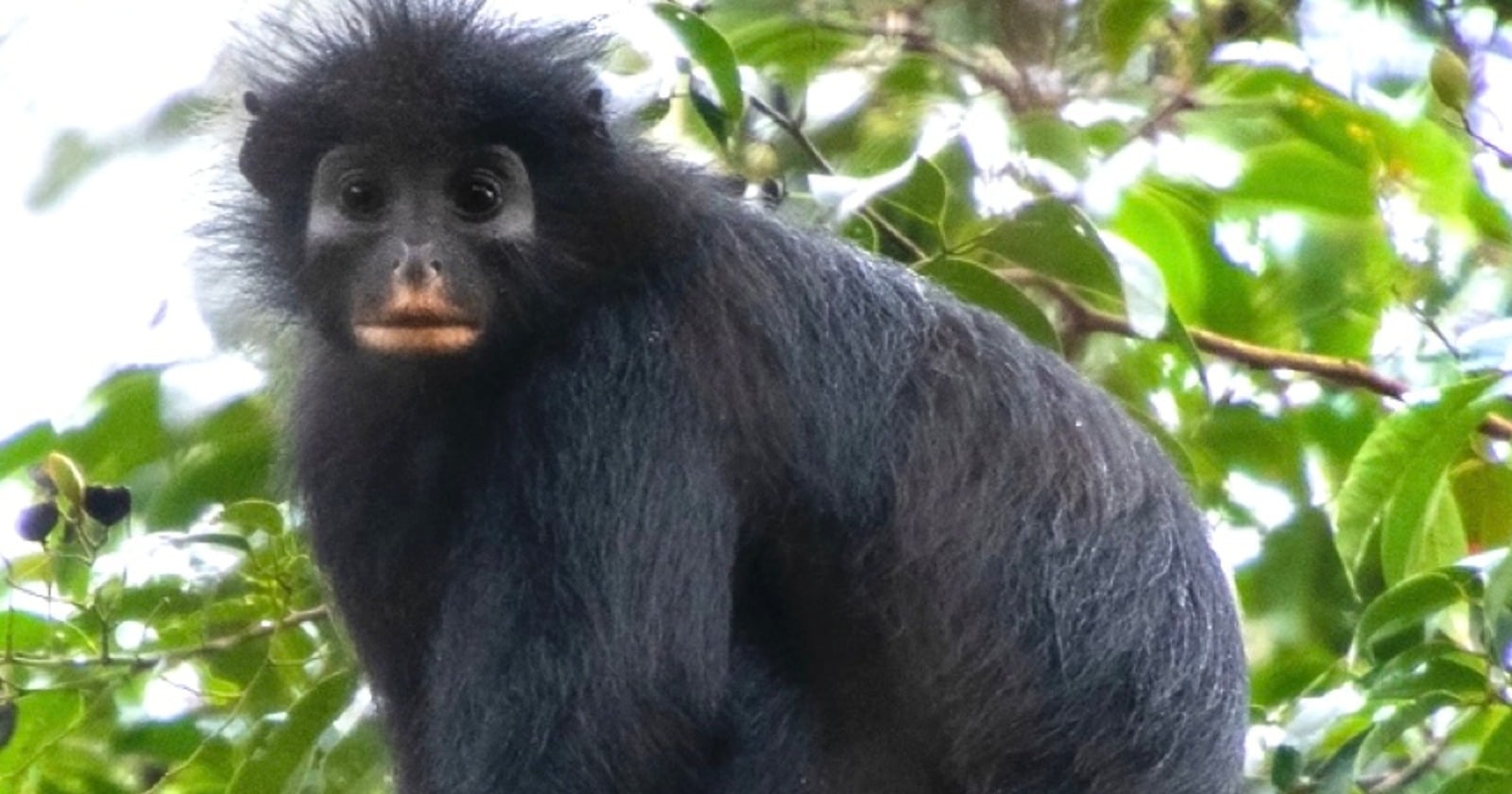
The Mituku communities along the eastern edge of the range call it kasaba nkoni, the branch shaker. Across the Lomami River to the west, in the national park’s buffer zone, villagers of the Balanga group offered a different name, Likweli, and that is the one that stuck.
Both names belong to a small black monkey with a patch of bare pinkish to orange-cream skin around its mouth, and until this summer it had no scientific name at all. Eleven researchers described it in PLOS ONE on 15 July 2026 as Colobus congoensis, which their paper calls only the fifth new species of African monkey to be discovered in the past 75 years. That is a count of populations previously unknown to science, and it excludes the taxa the same paper says were elevated from subspecies to species over those 75 years, at least four apes and six monkeys among them.
Its entire known range is currently estimated at 1,700 square kilometres in the Democratic Republic of Congo, most of it inside Lomami National Park. Most other known species in the genus occupy ranges exceeding 60,000 square kilometres.
The animal in the photograph
The first evidence arrived in 2008, when Ashley Vosper and Bernard Ikembelo photographed an unidentified monkey high in the canopy on the east bank of the Lomami River. The picture showed only part of the animal. The field team suspected it was not any species they already knew from the region.
Nothing followed for a decade.
In November 2018 Jean-Pierre Kapale led a surveillance patrol through the same sector and photographed a black monkey with pale markings around its mouth and a white perianal patch. Over the next ten months his team documented it seven more times in different places. Shown those photographs, Jonathan Kingdon recognised the significance of what the patrols had found, as potentially an important new species of Colobus.
The record turned out to be slightly older even than that. A patrol had photographed the same monkey in August 2018, about 35 kilometres north, and misidentified it in the report, so the sighting was never announced at the time.
Specimens came in April 2021, confiscated from hunters during park patrols. One adult male and two adult females went to the Yale Peabody Museum, the male as the holotype. Both females were pregnant.
The neighbours barely knew it was there
Interviews were conducted in 52 villages bordering the range, and the paper is explicit that what residents offered about this monkey was collected “fortuitously or secondarily” during village gatherings held to raise awareness about the park, rather than in a systematic survey of local knowledge. Residents of only eight of those localities could describe the animal accurately, which the paper sets against the extensive knowledge those same communities hold about other primates.
One hunter said he had killed the monkey once, opportunistically, and could describe it but had no name for it. Another mentioned its strong odour. Several informants said its calls, heard mostly at dawn, resembled those of the Angola colobus.
The species is also hard to find by systematic survey. Between 2020 and 2022, terrestrial surveillance patrols covered 3,063 kilometres inside the range and logged 29 detections, an encounter rate the paper puts at 0.01 detections per kilometre. Line transects totalling 1,285 kilometres produced 38 detections out of 709 primate detections of all kinds, or 5.4 percent. Dawn call surveys picked the animal up on 10 of 351 attempts.
What separates it from the black colobus
The nearest relative is the black colobus, Colobus satanas, which lives more than 1,200 kilometres away in west-central Africa. A 4,090 base-pair stretch of mitochondrial DNA, sequenced from three individuals and yielding two unique haplotypes, entered an alignment of 46 African and seven Asian colobine samples. That analysis makes the two sister species, and makes the pair sister to every other species in the genus Colobus.
At a glance the two are similar, both being almost uniformly black where every other Colobus species carries bold white markings. In the details they diverge. Around the mouth C. satanas is black, while C. congoensis carries the pale patch across the upper lip and nostrils. The mask the paper describes comes from elsewhere on the face: bare dark grey skin over the zygomatic arches and temporal region, contrasting with the black skin on the eyelids and around the eyes. C. satanas has a long tuft of hair at the base of its tail and no white perianal patch; C. congoensis has the patch, no tuft at the base of the tail, and shorter hair along the middle of the back.
The teeth part company too. The enlarged upper central incisors and the short, broad lower molars that distinguish C. satanas from the rest of the genus are both absent in the new species, whose molars are elongated instead. Of those two characters only the molar difference reaches statistical significance, and the authors are explicit that several craniodental comparisons fall short of it, on a sample of three skeletons with a single male among them. What does clear the bar is overall size: the paper reports the new species as significantly smaller in cranial size than every other Colobus, C. satanas included. On the paper’s own phenetic measurements, all other species of Colobus are closer to each other than any of them is to C. congoensis.
The evidence is thinner than the announcement suggests
The split from C. satanas is dated twice, and the two dates disagree. Calibrated on fossils, it comes out at 5.0 million years ago, with a 95 percent interval of 4.3 to 5.8 million. Calibrated instead on a previous molecular study, it comes out at 4.1 million, interval 3.6 to 4.7 in the results, which the discussion prints as 3.44 to 4.73 without reconciling the two. The authors say the gap between the two dates is likely due to the limits of applying molecular dating methods to small mitochondrial datasets, and to the different calibration approaches. That dated split, they add, is the deepest between sister species anywhere in the genus.
The dataset underneath it is three individuals, of which two carried unique haplotypes, and a single mitochondrial region. There is no nuclear DNA, and the authors write that comparative whole-genome data will provide more accurate divergence dates for the genus. No percentage of genetic divergence between the two species appears in the paper at all.
The conservation status carries its own hedge. The paper proposes a provisional listing of Endangered, and its abstract cites the species’ small range area and population size. No population estimate is given anywhere in the paper.
Nor is a measured body mass, in a running text that mentions this monkey’s size only as “greater than 5 kg” in a list of extinction-risk predictors. The “about 15 pounds” quoted in the university announcement of the discovery is offered there as the size of the species. The paper gives no species mass at all. Its only weights are three animals in a supporting data table, where the holotype male came in at 6.9 kilograms, the one figure 15 pounds matches, and the two females at 7.4 kilograms each on a spring balance. What the announcement drops is the caveat the paper attaches: the male was a young adult and both females were gravid, which likely skews any estimate of size difference between the sexes.
A roar that falls where the other one arches
Six roaring events were recorded in 2020 and 2021: four on a digital camera, one on a shotgun microphone, one on a phone. Three produced audio clean enough to analyse. The sex of the caller could not be determined in any of them, although roaring is more common in adult males in other Colobus species.
Phrases from one of those recordings were compared against two recordings of C. satanas across 23 acoustic measures, and the two species’ calls sorted into separate clusters. The primary roar of C. congoensis falls in pitch across the phrase where the black colobus arches, and the black colobus inserts a snort between its primary and secondary roars where the new species does not.
Observers describe one bout of rapid, repeated roaring during an attack by a crowned eagle on a group of about ten animals. The pale skin around the mouth, the paper notes, produces a distinctive visual display in a roaring individual.
The pressure around the range
Almost all the records, 104 of 114, came from pediment forest within 10 kilometres of the Lomami River. The species has not been found on the west bank at all, despite forest the authors describe as apparently suitable. Observed groups ranged from one to twenty animals, averaging 6.2, and in most observations where composition could be determined the monkeys were travelling with other primate species.
The threats the paper foregrounds are projected rather than observed. Local informants told the team the monkey had not been specifically targeted by hunters in the past, and that its range had not shrunk in living memory. What is already counted is the pressure around it: on the park’s own unpublished figures, at least 15 new villages appeared within and beside the range in the buffer zone between 2015 and 2023. The country’s human population is growing at an estimated 3.2 percent a year, and primary forest in Tshopo Province is being lost at an estimated 4 percent a year.
Three skins and three skeletons now sit in the Yale Peabody Museum, and on the strength of them a monkey has a Latin name. Its proposed conservation status rests on something else: a range estimated at 1,700 square kilometres, 114 detections, and the villages arriving beside it. Which of those will decide more about what happens to it?