
Eutelsat’s new satellite will support growing bandwidth demands for both current digital and future broadband applications, with Europe, Africa and Asia all connected by one satellite.
With the launch of a new satellite slated for the night of April 17 at 21.06 GMT, Eutelsat is continuing its strategy of expanding its satellite resource, already one of the largest in the world, and extending the reach it can offer its growing customer base.
The first of three satellites to be launched in 2000, SESAT (Siberia Europe Satellite) is an 18-transponder Ku-band spacecraft that will be positioned at 36 degrees East.
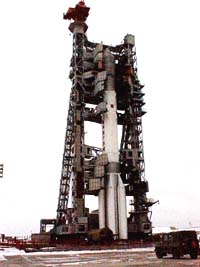
Built by NPO-PM of Krasnoyarsk and equipped with a payload supplied by Alcatel Space, SESAT will be launched directly into geostationary orbit out of the Cosmodrome at Baikonur by a Proton/Block DM launcher. It is scheduled to go into service in the second quarter.
SESAT is the first of seven satellites to be launched by Eutelsat within the next 24 months as part of a far-reaching satellite expansion and replacement programme requiring an investment of nearly ¿1 billion.
Six additional satellites, including HOT BIRD 6, which will carry Eutelsat’s first Ka-band payload, are under construction.
With two beams – one stretched Widebeam over Europe, western Siberia, North Africa and the Middle East, and a steerable Spotbeam over India – SESAT will enable Eutelsat to consolidate its position in its core markets, and will open its first gateway to the Indian subcontinent to meet high bandwidth demands for Internet traffic between Europe and India.
Up to six of the 18 transponders on the satellite can be switched one by one into the Steerable Beam. Communications can be established between the Widebeam and the Steerable Beam and also within the Steerable Beam in order to offer users a high degree of operational flexibility.
Services to be carried on SESAT include
- Data and videobroadcasting, Internet backbone connections, high-speed Internet access, distance-learning, telemedicine, transfer of software etc. In addition to leasing fixed bandwidth capacity for business networks, Eutelsat will offer SESAT capacity on a bandwidth-on-demand basis, enabling users to instantly access satellite capacity as required and to be billed for the exact amount used.
- EUTELTRACS, the leading fleet management service in Europe, that provides data-transmission and position-reporting for mobiles via satellite. Eutelsat will be expanding the coverage zone offered to fleet managers by upgrading EUTELTRACS from a Eutelsat II satellite to the Widebeam coverage on SESAT.
SESAT will soon be joined at Eutelsat’s 36 degrees East orbital position by the W4 satellite which is due for launch next month at Cape Canaveral by an Atlas 3 launcher.
The two satellites will enable Eutelsat to consolidate its position as a leading provider of capacity for television and data services and open important business opportunities in Russia, Africa and Asia.
With the addition of SESAT and W4, Eutelsat’s resource will consist of 17 Ku-band satellites spanning the orbital arc from 12.5 degrees West to 48 degrees East.
SESAT is expected to enter service by June 2000 at an orbital position of 36 degrees East Transponders. It will offer 18 Downlink frequencies: 10.95-11.20 GHz, 11.45-11.70 GHz, 12.50-12.75 GHZ at a bandwidth of 72 MHz EIRP (beam centre), a widebeam rate of 47 dBW and a steerable beam of 49 dBW.
