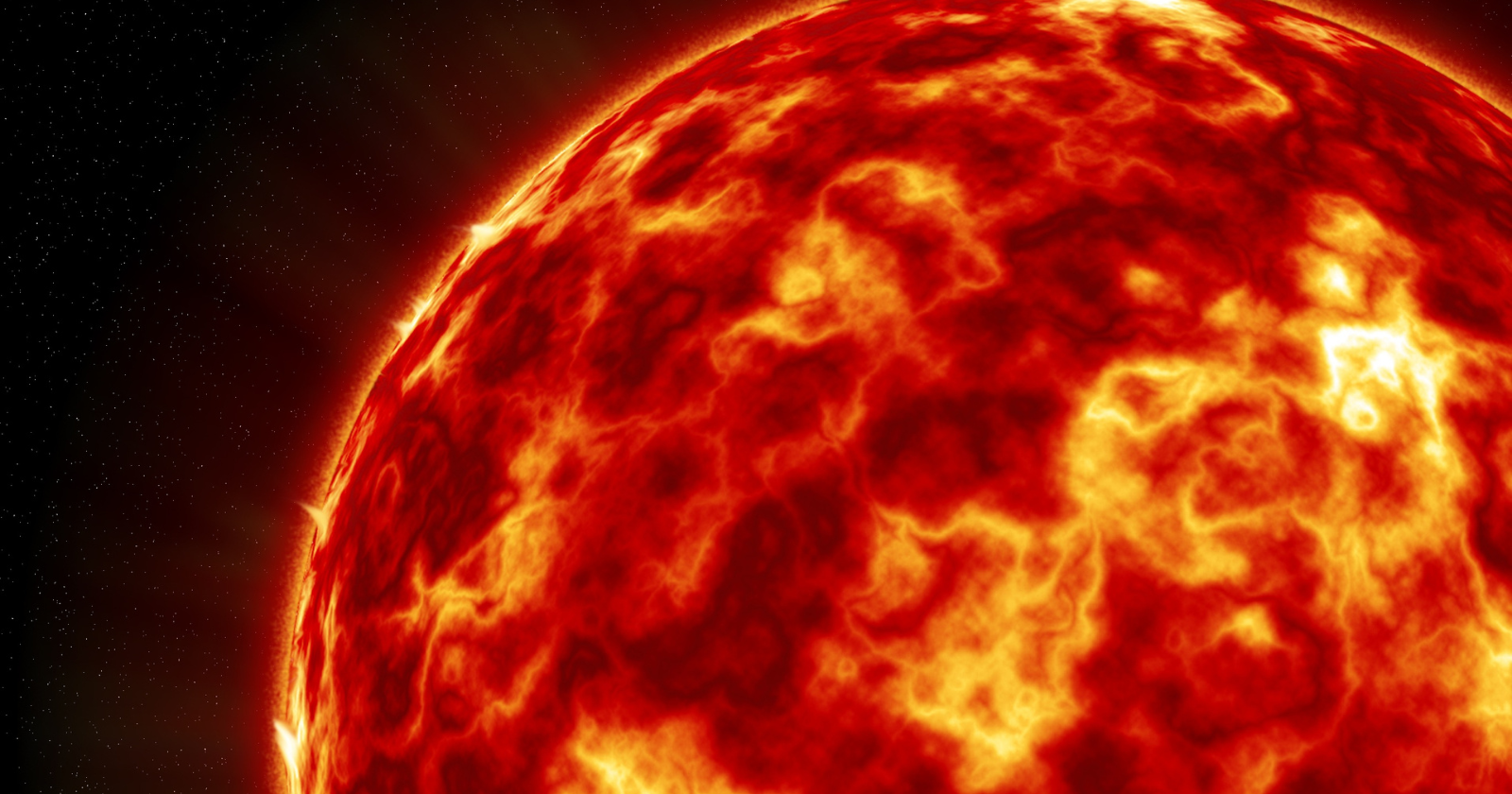
On my 27th birthday, I watched a film about the sun dying.
Project Hail Mary does not waste time on sentiment about this. If you don’t know it yet, this is the 2026 film directed by Phil Lord and Christopher Miller, starring Ryan Gosling as a schoolteacher-turned-astronaut who wakes up alone in deep space with no memory.
The premise arrives quickly: something is eating the sun’s energy output, the planet has years not millennia to respond, and one man wakes up alone in a spacecraft with no memory of how he got there or why. The horror of it is partly the scale, but mostly the speed. The sun is going wrong on a timescale humans can actually perceive. That is what makes it feel catastrophic.
What stayed with me after was a different question. Not what happens when it goes fast, but what is already happening, slowly, all the time — and what scientists have actually found when they study it.
The answers are stranger than the film.
The sun is already dying — just not the way we picture it
The sun is 4.6 billion years old. It sits at the midpoint of its main sequence life, the long stable phase during which it fuses hydrogen into helium in its core. In roughly 5 billion years, that hydrogen will run out. The core will contract, the outer layers will expand, and the sun will become a red giant large enough to engulf Mercury, Venus, and possibly Earth.
After that, it will shed its outer layers in a glowing cloud called a planetary nebula, leaving behind a white dwarf — a dense, Earth-sized remnant that will cool over trillions of years into something dark and cold that astronomers call a black dwarf, though none yet exist in a universe still too young to have produced one.
This is not an explosion. It is not sudden. It is a slow transformation, shaped entirely by physics and the finite supply of hydrogen. There is no drama in the mechanism. Just time, and the gradual exhaustion of fuel.
But here is the part that tends to get quietly omitted from the comforting version of this story.
The real deadline is not 5 billion years from now
As the sun ages through its main sequence, it brightens. The rate is approximately 10 percent every billion years — slow enough to be imperceptible across any timescale human civilization has ever experienced, significant enough to end life on Earth long before the red giant phase arrives.
In roughly a billion years, that accumulated brightening will push Earth out of the habitable zone. The oceans will begin to evaporate. Water vapor will accumulate in the atmosphere, trapping more heat, accelerating more evaporation, until the surface is dry and the atmosphere holds what the oceans once did. High-energy solar radiation will then split the water molecules in the upper atmosphere into hydrogen and oxygen. The hydrogen will escape into space. Earth will bleed itself dry.
Some models put the timeline at closer to 600 million years before conditions become critical. Others extend it toward 1.5 billion. The precise number depends on atmospheric feedback mechanisms that are still being refined. But the range sits comfortably within “unimaginably far away” and “much sooner than the sun’s actual death.”
The story of life on Earth, in other words, is already approximately 80 percent finished. Not because of anything catastrophic, but because of the ordinary, incremental brightening of a middle-aged star doing exactly what middle-aged stars do.
What scientists are finding when they look more closely
Project Hail Mary imagines a foreign organism consuming the sun’s output. What researchers actually study is in some ways more disorienting: a star that is changing from the inside, driven by physics so deep that even our own sun’s core remains partially mysterious to us.
Researchers at the Institute of Science and Technology Austria recently published work on fossilized magnetism in white dwarfs — the remnants of stars that have already completed the journey our sun is still on. By studying starquakes in red giants and connecting them to magnetic signatures preserved in white dwarf surfaces, they are beginning to trace how magnetic fields formed early in a star’s life persist through every subsequent phase, reshaping the star’s interior and influencing how long it lives.
“We still don’t know whether the sun’s core is magnetic,” team co-leader Lukas Einramhof noted. “Even though it’s our own star, we’re practically blind to what happens at its center.”
That line lands differently once you sit with it. The object that has defined every day of every human life in all of recorded history, and we cannot see its center clearly. We know it is changing. We can model the trajectory. But the precise internal mechanics remain, in places, opaque.
What the timescale does to the mind
One of the reasons Project Hail Mary works emotionally is that it compresses a geological horror into a human one. The sun failing within a generation is something the nervous system can process. Grief, urgency, sacrifice — these are emotions scaled to human time.
The actual timeline does something stranger. A billion years is a number that resists comprehension the same way true distances in space do. You can say it. You can write it. But you cannot feel it the way you feel a year or a decade or the gap between who you were at twenty and who you are now.
And yet something shifts when you try to hold it anyway.
The sun has been brightening slowly since before complex life existed on this planet. Dinosaurs lived and disappeared within that brightening. Every civilization, every language, every philosophy about what the sky means was constructed under a star that was already, imperceptibly, moving toward its end. The permanence that every human culture has projected onto the sun was never technically true. It was just true enough, on the timescales any of us have ever actually inhabited.
There is something almost clarifying about this, if you let yourself stay with it without reaching immediately for comfort or distance.
What the slow version of the story asks
The film poses the question as a survival problem. If the sun is failing, what do you do? The answer it arrives at is characteristically human: you find someone unexpected to solve it with, you make sacrifices, and somehow that is enough.
The real science does not offer that resolution. The brightening continues at its 10 percent per billion years regardless. No spacecraft can address it. No collaboration between species, however moving, changes the physics.
What it offers instead is something quieter. The knowledge that the conditions sustaining life here are not fixed and never were. That the stability which has allowed everything — every ecosystem, every idea, every form of love or language humans have ever developed — rests on a set of circumstances that are themselves slowly, incrementally shifting.
That is not nihilism. To me, it reads more like context.
The sun is already dying. Just slowly enough that every generation before ours could reasonably treat it as permanent. We happen to be the first generation with the science to know otherwise — to see the arc, even if we cannot see its end.
Whether that knowledge changes anything about how an ordinary day feels is, perhaps, the more interesting question.