

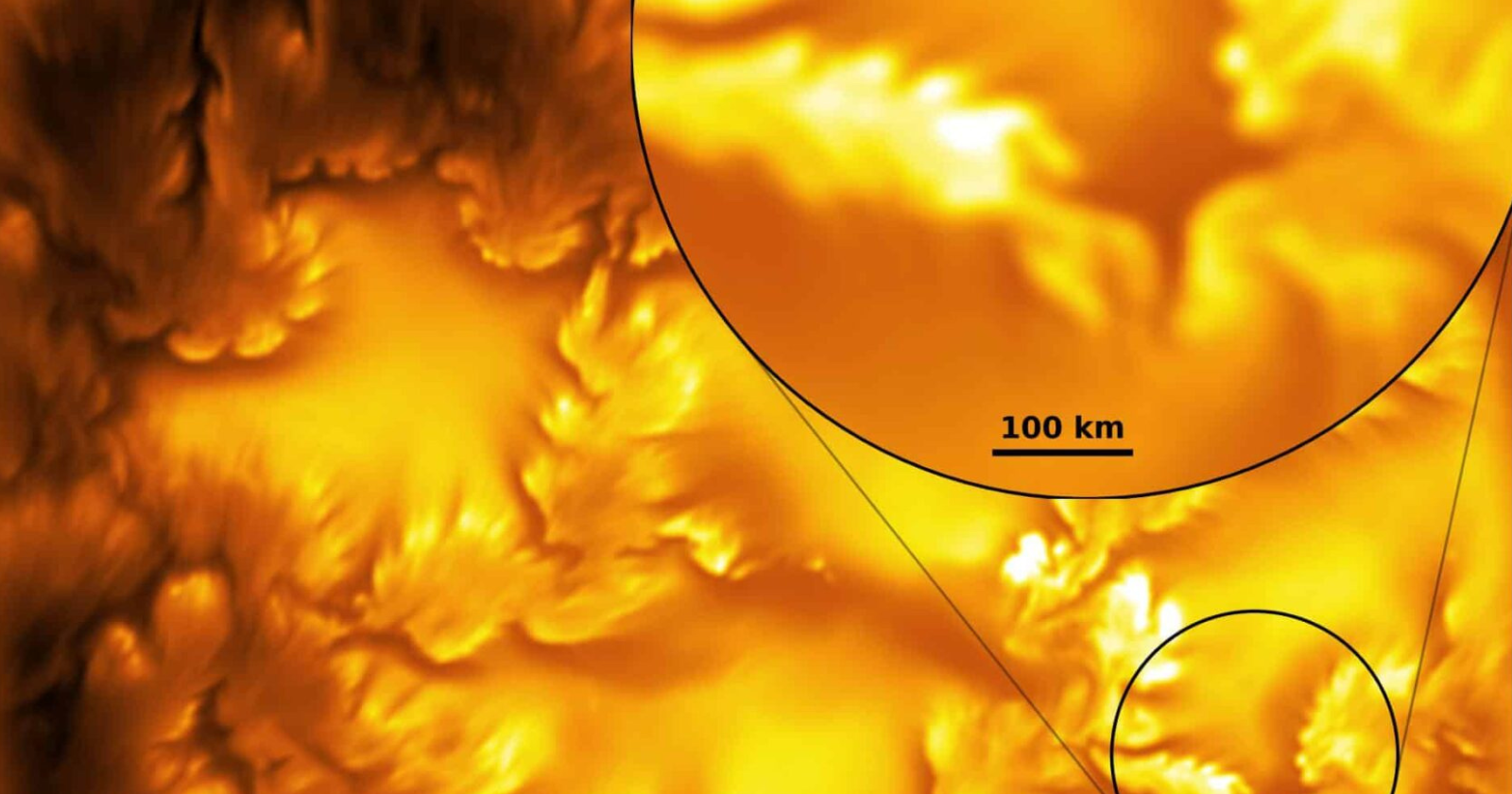
The National Science Foundation’s Daniel K. Inouye Solar Telescope, on Maui, has produced the highest-resolution images yet taken of the Sun’s surface, and they show something researchers had predicted but never directly confirmed: spinning vortices of plasma, some as narrow as 20 kilometres across, forming at the boundaries of magnetic structures in the photosphere.
The images and analysis appear in a paper published in Nature on 5 August 2026, “Ubiquitous Kelvin-Helmholtz instabilities driving plasma mixing on the Sun,” led by David Kuridze with colleagues from the National Solar Observatory, which operates the Inouye telescope, and the Max Planck Institute for Solar System Research. The paper’s authors frame the vortices as a possible contributor to one of solar physics’ oldest open questions, the coronal heating problem, but the paper is precise about how far it actually goes in answering it.
A puzzle that predates this telescope by decades
The corona, the Sun’s outer atmosphere, runs to roughly a million degrees Celsius, while the visible surface beneath it, the photosphere, sits at around 5,500 degrees Celsius. Why the outer layer is so much hotter than the layer producing the heat in the first place has been an open question in solar physics since 1939, when the corona’s temperature was first inferred spectroscopically. Various mechanisms have been proposed over the decades, including waves travelling up from the surface and small, localised bursts of magnetic energy release known as nanoflares. None has been confirmed as the dominant process, and the paper’s authors are explicit that free magnetic energy of the kind their vortices could generate is only “thought to power” coronal heating in general terms.
The temperature mismatch was established through spectroscopy: astronomers had recorded unexplained spectral lines from the corona since a total eclipse in 1869, before the Swedish physicist Bengt Edlén, building on a suggestion by Walter Grotrian, identified them in 1939 as coming from highly ionised iron, a state of matter that only forms at temperatures in the range of a million degrees. That identification turned the corona’s heat into a defined physics problem, and the question it opened has stayed open since. The new vortex observations are best read as one additional data point in that decades-long line of research.
What the images actually show
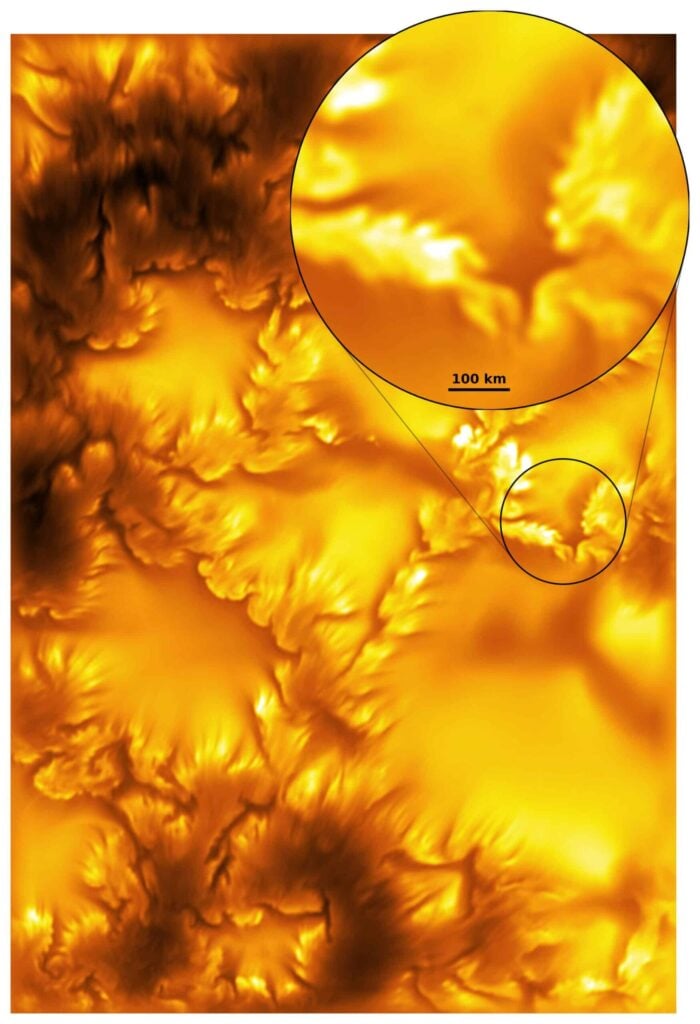
The instability identified in the vortices is the Kelvin-Helmholtz instability, the same shear-driven process that curls the crest of a breaking ocean wave and produces the banded cloud structures visible on Jupiter. It forms wherever two adjacent layers of fluid, or in this case plasma, move past each other at different speeds. Solar physicists have predicted for years that this kind of shear should occur at the edges of magnetic flux concentrations on the Sun’s surface. The Inouye telescope, imaging at a wavelength of 416 nanometres near the very limit of its resolving power, is the first instrument to have confirmed it directly.
Michiel van Noort, one of the paper’s authors, described the difficulty involved: “To detect the vortices, we needed to resolve structures on the solar surface about 20 kilometres in size. That is at the limit of what even the world’s largest solar telescope and state-of-the-art simulations can achieve.” Kuridze noted that the boundaries of magnetic elements turned out to be “not simple, smooth or randomly deformed edges but dynamic swirling patterns.” Vortex sizes in the study vary, with a median characteristic wavelength of about 65 kilometres and a range from roughly 25 to 170 kilometres. The smallest vortices, close to 19 or 20 kilometres, sit at the resolution limit of the telescope itself: that figure describes the smallest structures caught on camera, well below the study’s median size of 65 kilometres.
What the paper claims about the corona, and what it does not
The paper’s proposed link to coronal heating is that the twisting, braiding motion of these vortices, described by co-author Friedrich Wöger as likely to “braid” the magnetic fields like hair, could act as a steady driver helping move magnetic energy upward from the surface into the corona, where it might then be released as heat through processes that are themselves still debated. That is a hedged claim about a candidate mechanism. The paper does not report having measured how much of the corona’s actual energy budget this process could account for, and it does not rule out the other mechanisms researchers have proposed over the past several decades. It adds a newly confirmed, previously unobserved process to a list of plausible contributors.
The same observations have also been reported elsewhere as bearing on a separate question, the Sun’s roughly 11-year magnetic activity cycle, with Kuridze suggesting the vortices could supply a source of magnetic diffusion that current dynamo models have had to estimate rather than measure directly. That is a distinct claim from the coronal heating one, resting on the same underlying observation but pointing at a different open problem, and it should be treated as a separate claim from the corona result.
The instrument matters as much as the finding
The Inouye telescope is the first solar telescope built with a 4-metre-class mirror, and this observation sits at the edge of what it can currently resolve. That matters for how the result should be weighted. A structure only visible at the diffraction limit of the most powerful instrument available is one whose measured size, speed and lifetime are more likely to be refined, or revised, as instruments improve or as other observatories attempt to reproduce the observation independently. No independent confirmation has been published yet.