

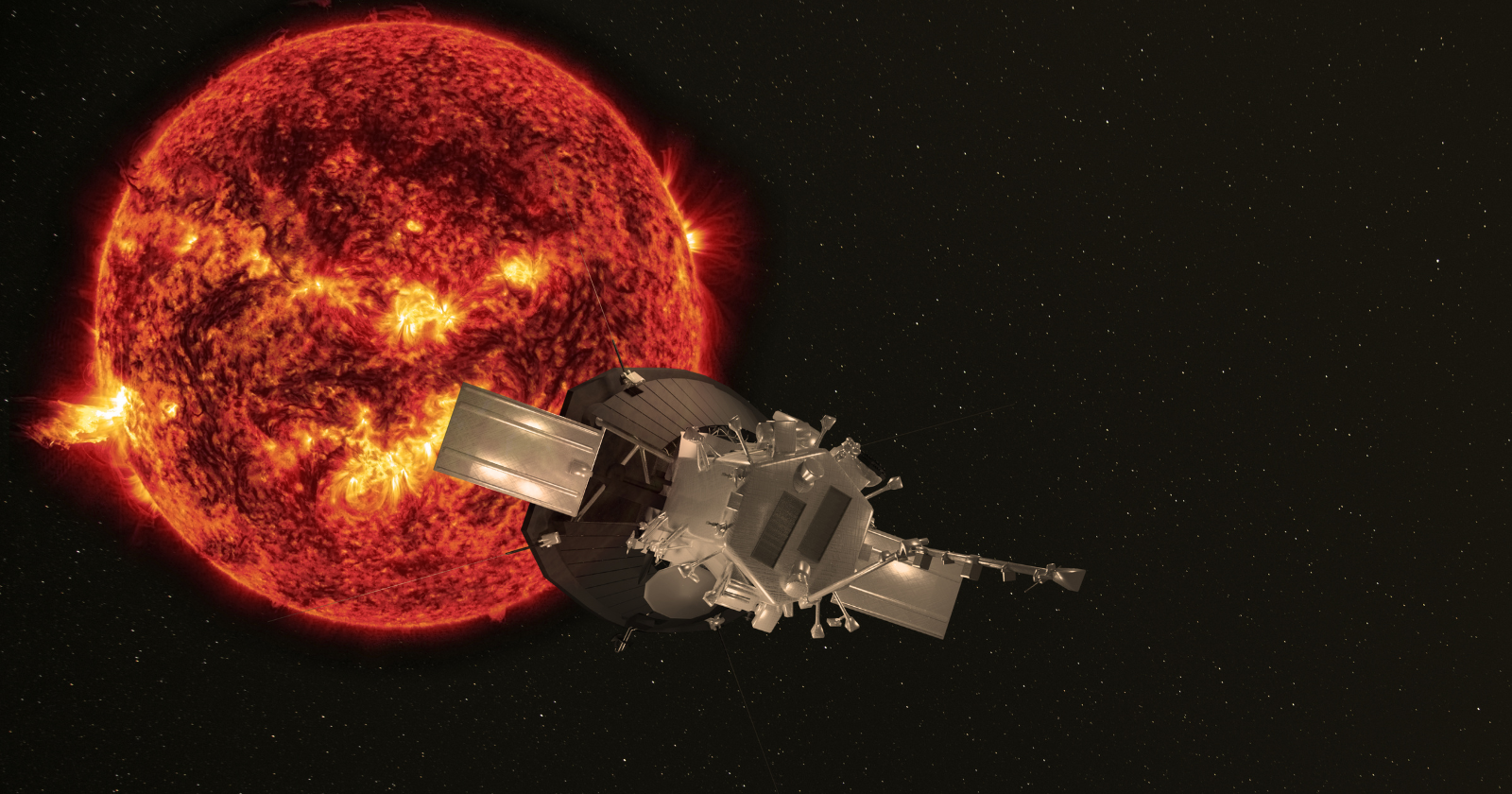
When NASA’s Parker Solar Probe passed through the solar corona during perihelion encounters at the heliospheric current sheet, its instruments recorded energetic protons at energies far above what existing models of particle acceleration at that location could account for.
A team led by Mihir Desai at the Southwest Research Institute, with James Drake, Marc Swisdak, and Zhiyu Yin from the University of Maryland’s Institute for Research in Electronics and Applied Physics has published an analysis of those measurements in The Astrophysical Journal Letters, identifying magnetic reconnection at the heliospheric current sheet as the mechanism responsible. The proton energies detected were, in the study’s framing, approximately a thousand times greater than the available magnetic energy per particle that models of this process had predicted.
The finding matters for two reasons: it identifies a source of energetic particles close to the Sun that was not anticipated, and it raises questions about how far the existing understanding of reconnection-driven particle acceleration extends.
What Parker measured at the current sheet
The heliospheric current sheet is a vast, warped surface in the solar wind where the Sun’s magnetic field reverses polarity. Parker crosses it during perihelion passes, when the spacecraft dips inside the corona. At those distances, the current sheet is narrower and more structured than it appears in the near-Earth solar wind, and the reconnection events occurring there have characteristics that instruments further from the Sun cannot resolve.
Within the exhaust region downstream of a reconnection event, where magnetic field lines have broken and rejoined and the released energy is being distributed into the surrounding plasma, Parker detected trapped protons at energies up to approximately 400 keV. The particles were confined within magnetic islands, structures that form within the reconnection exhaust as reconnected field lines roll up into closed loops. Magnetic island merging, as those loops interact and combine, appears to be the mechanism that accelerated the protons to the observed energies.
The thousand-fold discrepancy between what the models predicted and what Parker measured is the number that requires explanation. Reconnection as a particle accelerator was not a new idea: the process has been theorised to play a role in accelerating charged particles in a range of astrophysical environments. What was not predicted was that the energisation within near-Sun reconnection exhaust could reach this level through the island-merging pathway.
Why this source was not in the models
Current models of solar energetic particles, the high-speed charged particles that propagate through the solar system and can affect spacecraft and astronauts, have generally attributed the most energetic events to large-scale shocks: the driven shock fronts of coronal mass ejections, and the slower-building shocks of co-rotating interaction regions. Reconnection at the current sheet was considered a secondary contributor at best, capable of producing modest particle energies close to the Sun but not a major accelerator of the particles that eventually arrive as energetic storm particle events near Earth.
The Parker measurements suggest that picture needs revision. The magnetic island merging mechanism Desai and colleagues identify can evidently produce proton populations at energies that challenge the boundary between what reconnection does and what shock acceleration does. Whether this source can explain a significant fraction of observed near-Earth energetic particle events, or whether it contributes mainly at energies and scales that remain confined close to the Sun, is a question the paper does not yet resolve.
What this adds to the corona heating problem
A separate thread connects to the longstanding question of why the solar corona is so much hotter than the surface below it. The corona reaches temperatures of several million degrees Celsius while the photosphere sits at around 5,500°C. The energy source sustaining that gradient has not been fully identified. Reconnection, along with wave heating, is one of the leading candidates.
If reconnection at the current sheet is producing particles at the energies Parker measured, it is also depositing energy into the surrounding plasma at rates that may be higher than the models assumed. That does not resolve the corona heating problem, but it shifts the accounting. The energy going into particle acceleration through magnetic island merging is energy that must come from somewhere in the magnetic field, and tracing it may tighten the constraints on how much reconnection contributes to coronal heating overall.
Drake and Swisdak contributed the reconnection theory component of the analysis. The collaboration between the observational data from Parker and the theoretical modelling capacity at the University of Maryland is the structure the paper’s analysis rests on.
What comes next
Parker Solar Probe has now completed more than two dozen perihelion passes, with each close approach yielding data at distances and speeds no prior mission could reach. The heliospheric current sheet crossings that provided the data for this paper are repeatable: Parker will continue to encounter the current sheet during future perihelia, allowing the team to look for the magnetic island signature in additional events and test whether the particle energies observed here hold up as a consistent feature rather than a single anomaly.
Solar Orbiter, the European Space Agency mission operating in coordination with Parker, offers complementary measurements at somewhat greater distances. Comparing what the two spacecraft measure of the same particle populations as they propagate outward from the Sun will help establish which features originate close to the source and which are modified by the intervening solar wind. The energetic particle observations that puzzled researchers in the pre-Parker era now have a candidate mechanism. Whether that mechanism accounts for a large or small fraction of what actually reaches Earth remains the open question.
Now watch
In 1859, a solar storm set telegraph offices on fire. In 1989, one knocked out power for six million people in ninety seconds. In 2012, a storm strong enough to rival 1859 missed Earth by a single week. The Sun has hit our infrastructure before — and a repeat is roughly a one-in-eight bet every decade. This is what a single solar storm could do to the satellites, the power grid, and the internet we now depend on, and why we might not be able to simply switch it back on. Learn more in our latest YouTube video: