

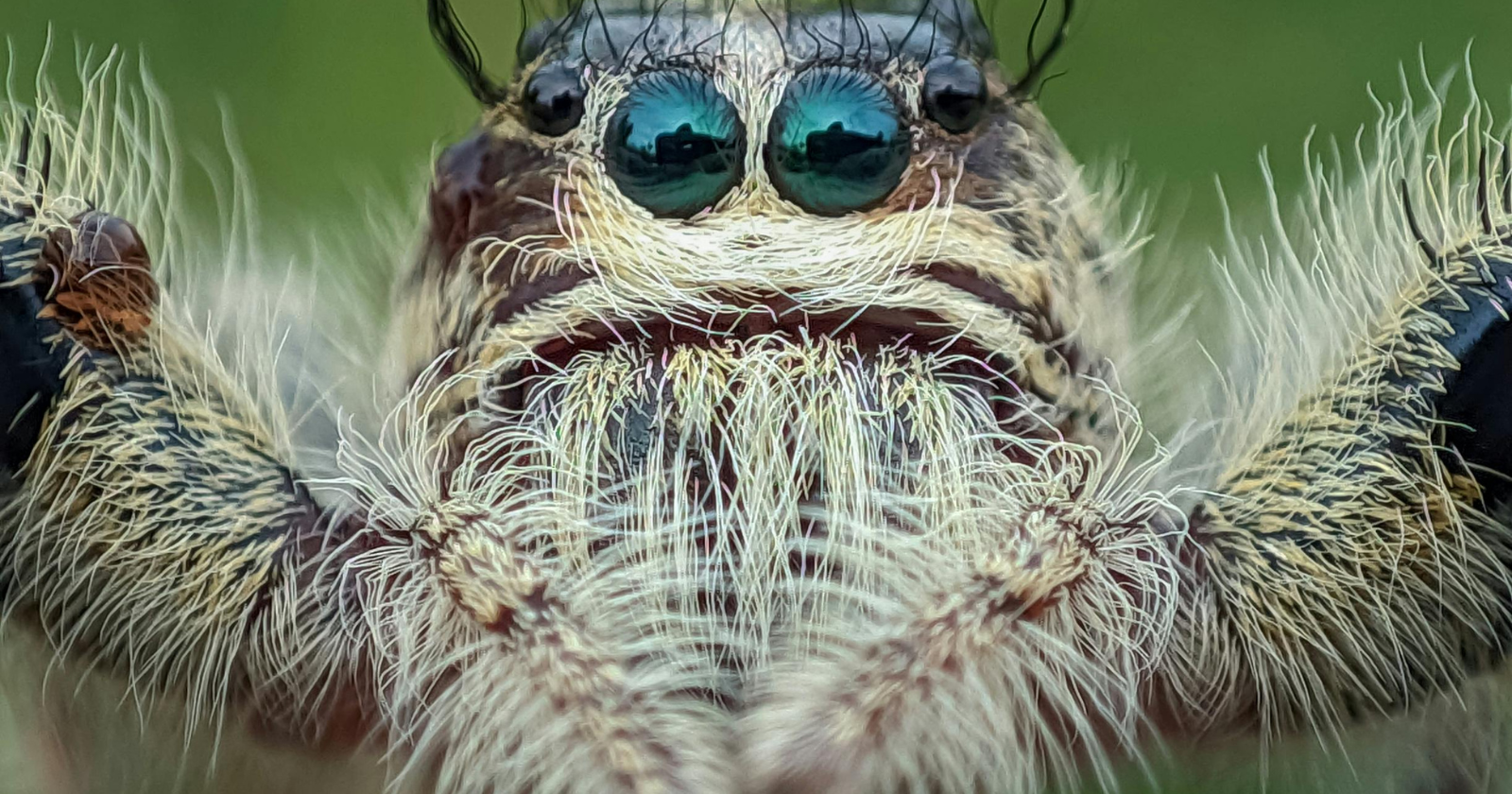
Mimicry in the animal kingdom follows a fairly predictable grammar. An organism resembles something dangerous, something inedible, or something it wants to eat. Biologists have spent two centuries cataloguing the variations: butterflies that look like monarchs, spiders that walk like ants, orchids that smell like female bees. What researchers had not documented, until earlier this year, was an animal that mimics a disease.
Taczanowskia waska, a new species of orb-weaving spider from the Ecuadorian Amazon, appears to impersonate a parasitic fungus that kills other spiders. The description was published in February 2026 in the journal Zootaxa by David Díaz-Guevara of Fundación Waska Amazonía, Alexander Griffin Bentley of the Instituto Nacional de Biodiversidad INABIO, and Nadine Dupérré of the Leibniz Institute for the Analysis of Biodiversity Change in Hamburg. The species name honors Fundación Waska Amazonía, the Ecuadorian organization where the lead author works and which has contributed to biodiversity surveys across the Llanganates-Sangay Connectivity Corridor, the region where the spider was found.
What the spider looks like
The model Taczanowskia waska is impersonating belongs to the genus Gibellula, in the fungal family Cordycipitaceae — the same family as the Cordyceps fungi made famous by their ability to hijack insect behavior. Gibellula species are specifically araneopathogenic: they infect and kill spiders. When they do, they produce characteristic pale, elongated fruiting structures that grow outward from the spider’s body, often on the undersides of leaves.
Taczanowskia waska reproduces this image with its own anatomy. The spider has pale coloration and elongated projections extending from its abdomen that closely resemble the fungal growth visible on a genuinely infected spider carcass. The resemblance is detailed enough that, when researchers encountered the animal during a nighttime survey in the Ecuadorian Amazon, they initially mistook it for a mushroom. The discovery was only recognized as a spider after iNaturalist users reexamined photographs originally posted to the citizen science platform.
Appearance and behavior together
Visual resemblance alone does not complete the illusion. The authors also suggest Taczanowskia waska may complete the illusion behaviorally. Like other members of its genus, it is thought to remain motionless — and the undersides of leaves, where the spider appears to rest, are exactly where Gibellula fungi grow on their hosts. Whether T. waska actively adopts this posture remains to be confirmed through field observation.”
The authors argue the combination points to a specialized and adaptive form of camouflage. A predator scanning the canopy for prey would have reason to avoid anything that looks and sits like a spider carcass consumed by fungus: it is visually unappealing, it signals contagion, and it offers nothing worth eating. By inhabiting that perceptual category, Taczanowskia waska may reduce predation risk substantially. The disguise may also provide an incidental advantage in hunting, allowing the spider to remain undetected by prey until it is within striking range.
The first of its kind
The paper identifies this as the first documented case of arachnid mimicry of an araneopathogenic fungus, and more broadly, the first known instance of any animal mimicking a disease organism rather than another animal or plant. Mimicry of pathogens has not been a recognized category in the scientific literature on animal disguise, which is part of why it took this long for the adaptation to be formally described.
The genus Taczanowskia, established by Eugen von Keyserling in 1879 and named in apparent honor of the Polish zoologist Władysław Taczanowski, remains poorly studied. It is rare in collections and rarely encountered in the field — the researchers note that almost nothing is known about its broader ecology. A species published in 2024, Taczanowskia yasuni, was also found in the Ecuadorian Amazon, but even that recent addition to the genus provides limited behavioral data.
Dupérré’s contribution to the T. waska description relied on examining reference specimens held in scientific collections at the Museum of Nature Hamburg, a step that would not have been possible without the accumulated comparative material that natural history institutions hold. The paper notes that collections of this kind are enabling taxonomic work that would otherwise be impossible, particularly for rare genera in remote tropical ecosystems.
Citizen science and what comes next
The iNaturalist origin of this discovery is not incidental. The initial post — a photograph that observers believed to show a mushroom — was re-examined by community members who recognized it as a spider and flagged it for expert review. That chain of observation and re-identification ultimately produced a peer-reviewed species description. The authors suggest this model of community-gathered photographic data feeding into formal taxonomy is likely to generate further findings, particularly for groups like Taczanowskia that are rarely encountered in traditional surveys.
What ecological pressures drove Taczanowskia waska to evolve this particular disguise remains an open question. The Llanganates-Sangay Corridor is one of the most biodiverse regions on Earth, and the selective pressures shaping camouflage there are correspondingly complex. Future work on the genus — if specimens can be found — may clarify whether this form of pathogen mimicry is unique to this species or shared more widely.
What to watch next
The paper opens a new category of inquiry in mimicry research: whether other animals have independently arrived at the same strategy of impersonating a disease rather than a predator or a toxic organism. Given that Taczanowskia waska went unrecognized for so long because the possibility was not on anyone’s conceptual radar, there may be other cases already sitting in collections or posted to citizen science platforms, waiting for someone to look in the right way.