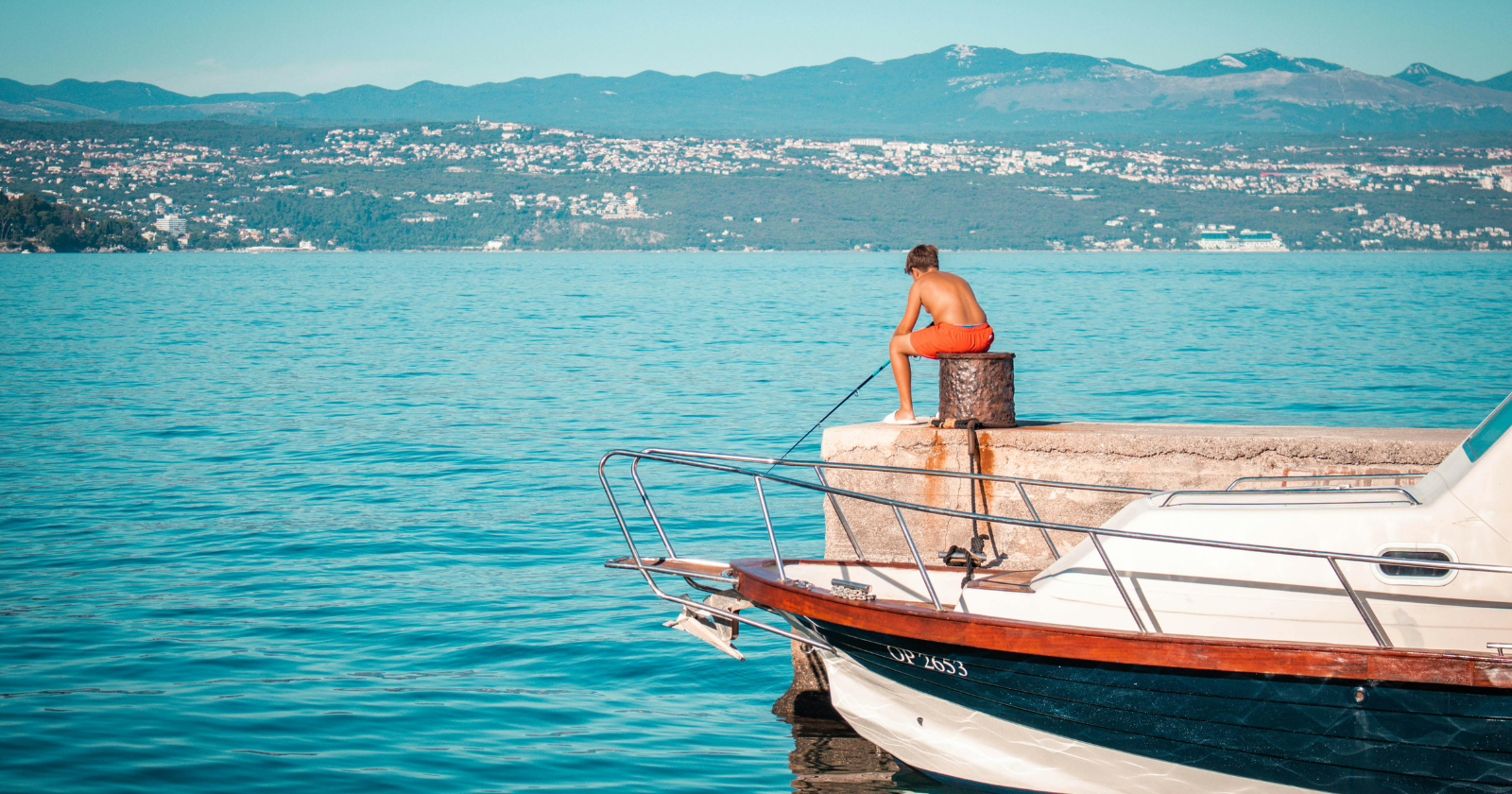
I was in Split, Croatia two years ago, sitting in the shade close to a beach, when I first understood what fjaka actually was.
A man was sitting a few meters away, not on his phone, not reading, not waiting for anyone, just present in a way that had no destination attached to it. I remember thinking he was not resting between two more useful activities. He was doing the thing itself, on purpose, and it took a single glance for me to register that this was not idleness he was tolerating. It was something he had chosen, fully, without needing to justify it to himself or anyone walking past.
I felt something close to that same recognition again recently, in Spain, in a different country with a different word for it, or possibly no word for it at all, just the same unmistakable quality of a person occupying time without spending it on anything.
What Britannica actually put a name to
In June 2025, Encyclopaedia Britannica introduced its readers to fjaka, describing it as complete relaxation, or the art of doing nothing, and noting that it is something that cannot really be learned from a definition. You have to experience it to understand what it means, which is a slightly unusual thing for an encyclopedia to admit about one of its own entries. Fjaka belongs to the Dalmatian coast of Croatia specifically, and locals are careful to draw a line between it and ordinary laziness. Laziness avoids something. Fjaka is not avoiding anything. It is a state of contentment specific enough to have its own name, built around simply existing in the heat of the afternoon without needing the day to be productive in order to count.
What struck me reading Britannica’s entry was less the definition itself and more the timing of the discovery. English speakers treated fjaka as a small revelation in 2025, a charming regional secret worth importing, in more or less the exact way they treated another word a few years earlier, one that had already quietly become a minor publishing industry of its own.
The Dutch word that got there first, and got marketed
Niksen, the Dutch equivalent, more or less, of doing nothing on purpose, had already had its moment by the time fjaka crossed into English. The writer Olga Mecking helped popularize the word internationally, turning what had been an ordinary Dutch word into a full wellness framework, complete with a book, instructions, and eventually its own small industry of articles explaining how to do it correctly. There is something almost funny about that last part. A word whose entire meaning is the deliberate absence of a goal ended up with instructions attached to it, a right way to do nothing, which is close to a contradiction if you sit with it for more than a few seconds.
Fjaka has, so far, mostly avoided that fate. It circulates as a cultural description rather than a productized practice, something Dalmatians already do rather than something the rest of the world is being taught to do correctly. I suspect that will not last. English-language wellness media tends to find an unbranded regional habit and give it packaging within a year or two of discovering it exists, and fjaka is a good candidate: specific enough to sound exotic, simple enough to summarize in a headline, vague enough that almost anyone can claim to already be practicing a version of it.
The Danish word hygge went through the same cycle a decade earlier, arriving in English as a cozy, candlelit lifestyle aesthetic, sold back to readers as a set of purchasable objects: the right blanket, the right mug, the right kind of low lighting. Somewhere in that translation, the actual Danish habit, an ordinary, unremarkable comfort built into daily life rather than staged for a photograph, got replaced by a shopping list. I do not think that happened because English speakers are uniquely bad at receiving other cultures’ words. I think it happens because a habit is much harder to sell than a product, and translation, especially the commercial kind, tends to keep whatever is easiest to package and quietly drop the rest.
Why the same skill keeps needing a new import
What actually interests me is not that English lacks its own word for unproductive contentment. It is that English speakers keep needing to borrow one, repeatedly, from wherever it can still be found intact. Hygge arrived from Denmark. Niksen arrived from the Netherlands. Now fjaka is arriving from the Croatian coast. Each one gets treated as a fresh discovery, when really it is the same import happening again, because the version that would have existed natively, an ordinary cultural permission to sit still without producing anything, keeps getting used up faster than it can regenerate.
I study emotion regulation, among other things, and one pattern that shows up consistently in the research is how much cognitive and emotional cost people pay for suppressing the impulse to simply stop.
Fjaka and niksen are not really teaching anything new, neuroscientifically. They are naming a state that already exists as a biological option and giving people cultural permission to choose it without narrating an excuse for doing so.
What is being imported, word after word, country after country, is not a technique. It is permission, and permission apparently has a shorter shelf life in some cultures than others.
What I recognized twice, in two different countries
I do not think what I saw on that wall in Croatia, or what I felt again in Spain, needed either word to be real. The man by the harbor was not performing fjaka for anyone, and I doubt he would have described what he was doing using Britannica’s definition if you had asked him. He was just doing it, the way people in a place where the habit is still intact simply do it, without narrating it as a wellness practice or a corrective to burnout.
That is the part I think gets lost whenever one of these words crosses into English and becomes a headline. The habit was never the scarce resource. The permission was. And permission, unlike a Dutch or Croatian word, does not travel well in translation. You mostly have to notice it already sitting in a stranger on a harbor wall, and recognize, with something like envy, that some places never had to import it in the first place.
I have wondered, since Spain, whether the reason I keep noticing this specifically abroad is that it is easier to see a habit clearly in a place where it is not competing with your own. At home, in the middle of teaching prep or a research deadline, the idea of sitting somewhere doing nothing in particular tends to arrive already apologizing for itself. Somewhere else, watching a stranger do it without a trace of apology, the whole shape of the thing becomes visible again, uncomplicated by whatever it is that makes it so hard to allow at home.