
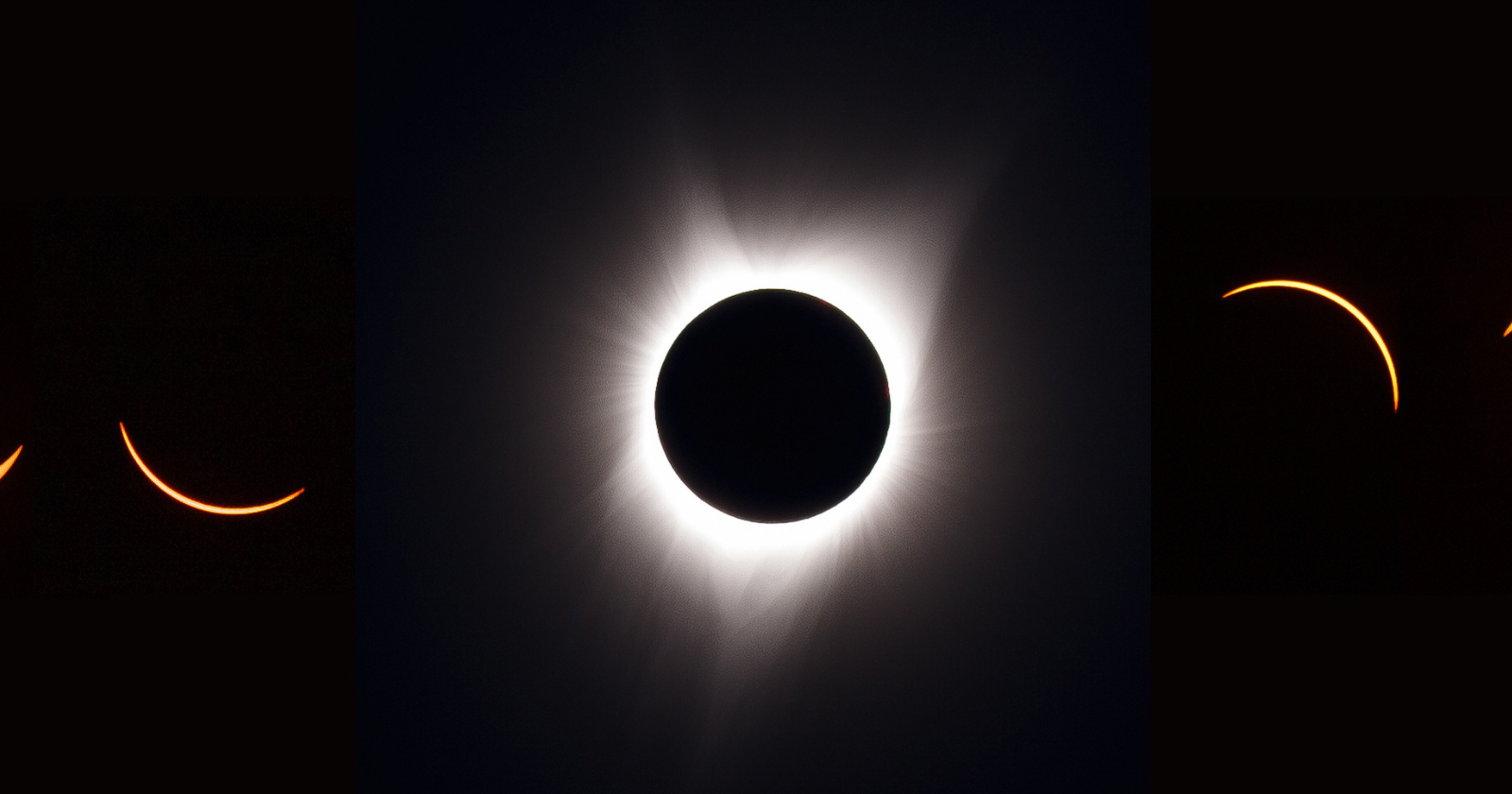
During the total solar eclipse of 8 July 1842, observers across Europe recorded a strange effect in the final moments before totality: faint, wavering bands of light and shadow moving rapidly across the ground, a phenomenon now known as shadow bands. According to the astronomer and writer George F. Chambers, whose 1902 book The Story of Eclipses is one of the earliest detailed compilations of eclipse observations, England’s Astronomer Royal, George Biddell Airy, noted “undulations” along the thinning crescent of the Sun roughly six minutes before totality that year. The 1842 eclipse is often cited as one of the earliest well-documented sightings of the effect, though as the astronomy writer Joe Rao has pointed out, “nobody can state with certainty as to when shadow bands were first noted.”
The eclipse itself is well established. Its path of totality crossed Spain, France, Italy, Austria and central Europe before reaching into Russia and Central Asia, with totality lasting slightly over four minutes near the centre of the path. It was also notable for early scientific observations of the solar corona and prominences, which is part of why detailed written accounts from multiple observers survive.
Older reports, harder to verify
Some secondary sources push the record back further, citing a report from the German astronomer Hermann Goldschmidt describing a similar effect as early as 1820, and some retellings of Airy’s 1842 account add vivid detail, describing “a strange fluctuation of light” so pronounced that children reportedly ran after it and tried to catch it with their hands. Those specific details could not be confirmed against a primary source for this piece, and they should be treated as unverified colour rather than established fact. The more solidly documented reference remains Chambers’ 1902 account of Airy’s “undulations,” itself a secondhand compilation written six decades after the eclipse it describes.
The explanation most textbooks give
Shadow bands have a standard explanation, and it is not correct to say, as is sometimes claimed, that nobody has ever proposed why they happen. The dominant account, formalised by the physicist J.L. Codona in 1986, treats shadow bands as a scintillation effect: as the Sun narrows to a thin crescent in the last seconds before totality, its light passes through the atmosphere as an increasingly narrow source, and ordinary atmospheric turbulence, the same turbulence that makes stars twinkle, refracts that narrow band of light unevenly as it travels to the ground. The result is the flickering, moving pattern of light and dark bands that observers have reported for centuries.
This is the explanation general references like Wikipedia give today, and it accounts for the basic character of the phenomenon well: bands that appear only in the minutes surrounding totality, move with variable speed and direction, and are more pronounced on some eclipses than others depending on local atmospheric conditions.
What the standard model doesn’t fully account for
Where things get less settled is in the details, and that is where active research has continued. A team from the University of Pittsburgh, calling themselves the “Shadow Bandits” and led by David Turnshek with Jeffrey Peterson of Carnegie Mellon University, has flown high-altitude balloon payloads during two recent eclipses, in 2017 and again on 8 April 2024, specifically to test where in the atmosphere the bands actually originate. Their 2017 flight returned a signal consistent with bands forming above the planetary boundary layer, higher in the atmosphere than the simple ground-level turbulence model assumes. The 2024 flight, at two sites in Texas and Vermont and using improved instruments, detected no such signal above the boundary layer. In the resulting paper, the team says the mismatch means either that shadow bands were not present at their 2024 sites or that the 2017 measurement needs re-examining, leaving open the possibility that the bands are, after all, primarily a ground-level turbulence effect.
A 2026 paper on the preprint server arXiv, “The Optics of Shadow Bands” by Sretenović, goes further, arguing that “despite centuries of reports, their physical origin has remained unresolved” and that existing turbulence-based models cannot quantitatively predict several observed features of the bands, including their typical spacing and their apparent motion, drawing instead on an analogy to Young’s double-slit experiment for an alternative geometric-optical model. It has not yet been through peer review. For now it is best read as one researcher’s case for reopening a question many textbooks treat as closed, a hypothesis still awaiting independent testing.
Why the distinction matters
Neither extreme captures the situation: shadow bands do have an explanation, and that explanation is not the final word. There is a well-established general mechanism, atmospheric scintillation of a narrowing light source, that explains why shadow bands happen at all. What current versions of that model do not predict well are specific, measurable features of the bands: their typical spacing and their apparent motion. The phenomenon’s existence is not in question; its finer mechanics are what remain unresolved.
Its geometric-optical alternative has not yet been tested against independent balloon and ground-based data. The balloon programme and the Sretenović preprint do not, in fact, point the same way: the Pittsburgh and Carnegie Mellon team’s own 2024 flight undercut, rather than confirmed, their 2017 suggestion of a higher-altitude origin, and the preprint’s spacing-and-motion critique does not depend on the altitude question at all. What the two share is only that both treat the standard turbulence account as incomplete, not that their evidence converges.
The next opportunity to gather more data will come with future total eclipses, when further balloon flights or ground-based photometry can help settle whether the 2017 or the 2024 result was the outlier. Until an independent team resolves that discrepancy, and until a peer-reviewed model can be checked against real spacing and motion data, shadow bands remain a case where the framework is understood in outline but the details, the parts that would let anyone predict a given eclipse’s bands in advance, are not.