

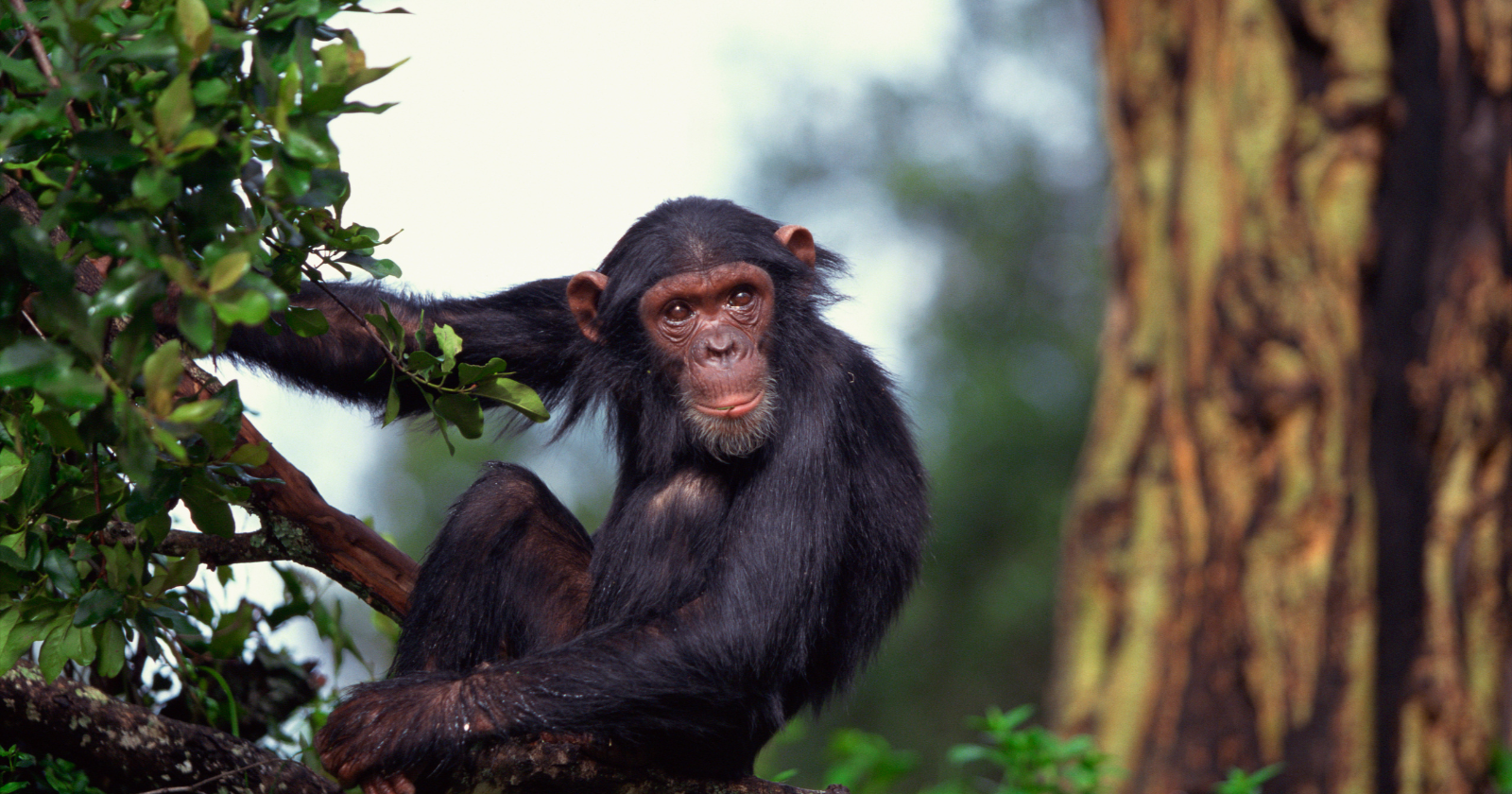
A chimpanzee at Ngamba Island Chimpanzee Sanctuary in Uganda hears a rattle from inside one of two closed boxes and picks that box, expecting food. Before it can be opened, a researcher offers a second clue about the other box, something stronger than a rattle: a clear view of what’s actually inside. The chimpanzee switches its choice. It isn’t guessing again, and it isn’t simply following the newest thing it saw. According to the researchers who designed the test, it is weighing which piece of evidence it should trust more, and acting on that judgment.
What the test was actually built to rule out
The study, led by Hanna Schleihauf of Utrecht University with colleagues from the University of California, Berkeley, the University of St Andrews and the University of Portsmouth, was published in Science in October 2025. Fieldwork took place at Ngamba Island, run in partnership with the Chimpanzee Trust and sanctuary caretaker Joshua Rukundo, working with chimpanzees who already knew the two-box food-choice setup well.
The design was built around a specific worry: that an animal switching its choice after new information might just be following a simple rule, always trust the newest clue, or always trust the clue that seems most vivid, rather than genuinely comparing the strength of competing evidence. So across five linked experiments, the researchers varied the type and strength of evidence a chimpanzee received: sometimes a weak clue like a rattling sound, sometimes strong evidence like a direct view through a clear panel. They also tested what happened when a second clue simply repeated the first one, rather than adding anything new, and what happened when a clue was later revealed to have been misleading altogether.
The chimpanzees kept their original choice when the first evidence had been strong. They switched more often when the new evidence was clearly stronger than what they’d started with. Crucially, they treated a repeated, redundant clue differently from a genuinely new one, and when evidence was later shown to have misled them, they discounted it going forward rather than continuing to weight it. When the researchers modelled the results against simpler explanations — recency bias, random switching — the data fit a rational belief-revision process.
That last test, the misleading-evidence one, is doing a lot of the work here. A chimpanzee that switches whenever it gets new information, full stop, isn’t reasoning about the evidence; it’s just reacting to novelty. The interesting result is that once a particular type of clue, say, a rattle from behind a certain panel, had proven unreliable, the chimpanzees appeared to discount that type of clue specifically, rather than becoming generally more cautious or generally more trusting of whatever came next. That’s closer to updating a belief about a specific source of information than it is to a blanket behavioural rule.
The research, funded in part by the Leakey Foundation, has also been made unusually easy to check: the underlying dataset was deposited publicly via Dryad alongside publication, the kind of transparency that isn’t universal in comparative cognition work and that makes independent re-analysis possible rather than something readers have to take on faith.
How big a claim this actually is
Coverage of the study has widely described it as the first time this kind of evidence-based mind-changing has been demonstrated in a non-human animal. That framing, made explicit in coverage from outlets like ScienceAlert, traces largely to how science journalists summarised the result rather than to the researchers’ own headline claim. Portsmouth’s Esther Herrmann, a senior author on the paper, put it more cautiously in the university’s release: “Our findings reveal that humans aren’t the only ones who make rational decisions based on evidence.” Schleihauf, in her own comments, has described the human-chimpanzee difference here as one of degree rather than kind, distinct from humans’ particular habit of explicitly giving and asking each other for reasons. The result is being compared, in terms of sophistication, to belief-revision abilities seen in four-year-old human children, not framed by the authors as evidence chimpanzees reason exactly as adult humans do.
Not everyone studying animal cognition reads the result the same way. Christopher Krupenye of Johns Hopkins University, who wasn’t involved in the work, has raised a genuine open question: whether the chimpanzees are representing the evidence in something like a propositional, language-adjacent way, or working it out more directly through picture-like association. Both could produce the same switching behaviour on this particular task. Distinguishing between them would need different experiments again.
What the researchers say this opens up, not closes
None of the researchers involved describe this as settling what’s going on inside a chimpanzee’s head. Josep Call, another co-author on the paper, called it the opening of “a new avenue of research into the psychological mechanisms underlying decision-making in chimpanzees,” which is a narrower and more honest claim than a single study proving animal rationality writ large. Jan Engelmann, a co-author at Berkeley, described being surprised the result held up at all: “None of us thought they could do it because it’s just so complex.”
What the study does support, cleanly, is that these particular chimpanzees, tested repeatedly across several linked experiments, changed their minds in a pattern that lines up with weighing evidence rather than simply reacting to whatever came last. The comparison researchers have reached for, sophistication roughly on par with belief revision seen in four-year-old human children, is worth taking as a rough calibration point rather than a precise equivalence: it says these chimpanzees can do something that isn’t trivial and isn’t fully adult-level either, not that a chimpanzee’s reasoning matches a preschooler’s in any broader sense.
Whether that pattern reflects something chimpanzees do only in a lab, or something closer to how they navigate everyday uncertainty about which tree has ripe fruit, whether a rival is bluffing, or which route through the forest is safe, is the next question, and it’s one the current paper leaves open rather than answers. Ngamba Island’s chimpanzees live in a sanctuary, not the wild; whether this same evidence-weighing shows up, or matters in the same way, for wild populations making higher-stakes decisions is a separate study nobody has yet run.