

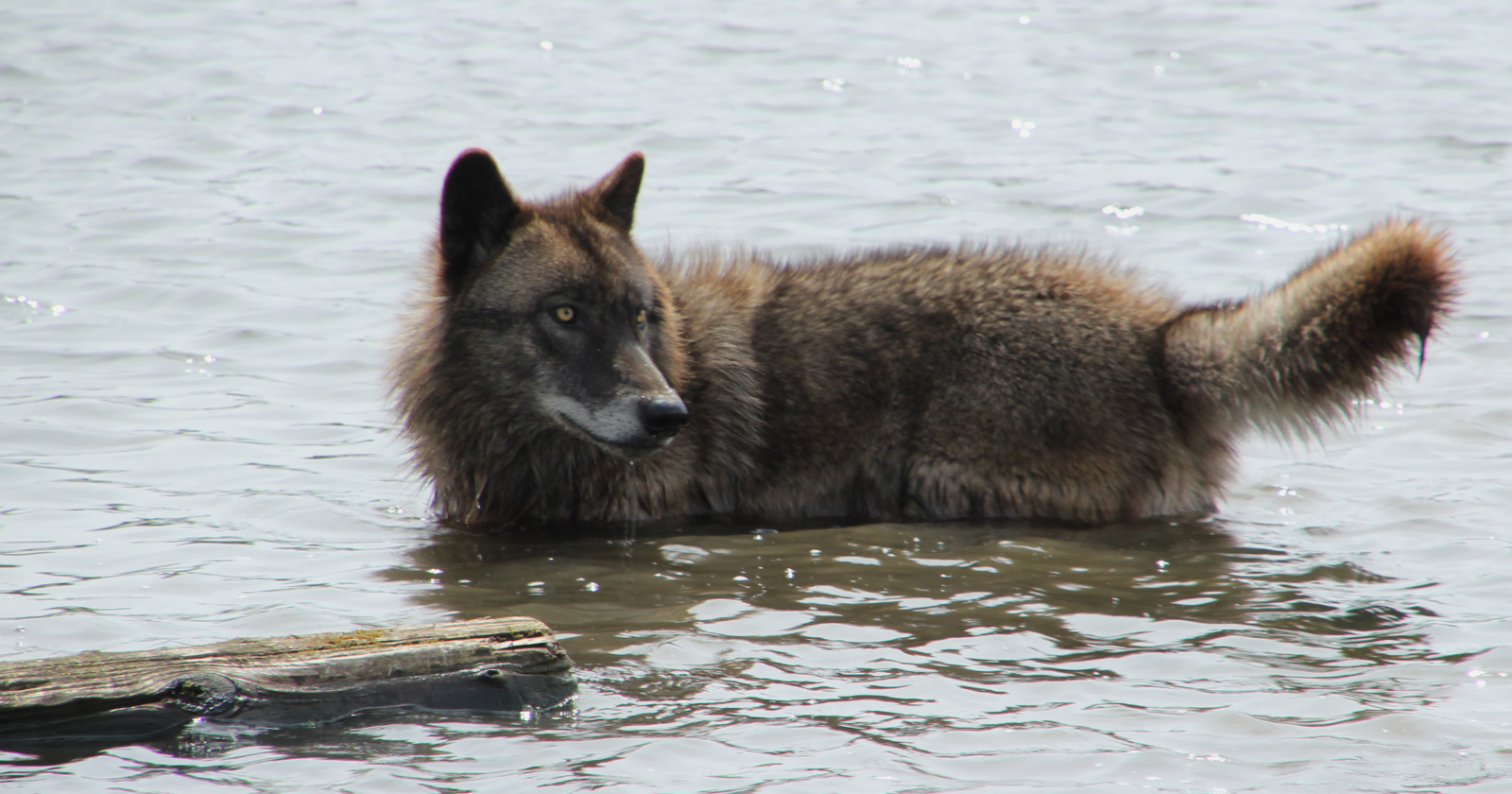
The footage runs just under three minutes. A wolf swims out from a rocky shoreline on the central coast of British Columbia, grabs a floating buoy in her jaws, and turns back toward the beach. What she is towing is not visible from the surface: a baited crab trap, fully submerged, tethered to the buoy by a length of rope. She hauls the whole rig up onto the rocks, then works at the trap’s netting until she reaches the bait cup inside.
The sequence was captured by underwater and motion-triggered cameras that researchers had set up to monitor traps used to catch invasive European green crabs, in Haíɫzaqv (Heiltsuk) Nation territory near Bella Bella. It is described in a paper published in the journal Ecology and Evolution in November 2025, authored by Kyle Artelle — who holds a joint appointment at the SUNY College of Environmental Science and Forestry and the Heiltsuk Integrated Resource Management Department — and Raincoast Conservation Foundation scientist Paul Paquet, working with Haíɫzaqv Guardians and University of Alberta researchers who assisted with the broader monitoring effort.
The title of the paper hedges its own claim: “Potential Tool Use by Wolves.” That hedge, potential, matters, because what outside experts make of the footage turns out to be genuinely split.
What the camera actually caught
The main incident was recorded on 29 May 2024. A female wolf swam out into water deep enough that the trap wasn’t visible from shore, located the buoy, and pulled the connected rope and trap back to the beach, where she tore into the netting to get at herring and sea lion bait inside. A second, less conclusive event involving a different wolf was recorded in February 2025. Researchers who reviewed the footage described the animal’s behaviour as focused rather than accidental.
“We were amazed. It was not what we were expecting, to say the least,” Artelle told CNN. “It’s problem-solving, and it’s problem-solving exactly the way humans do it.” William Housty, a Haíɫzaqv hereditary chief and director of the Heiltsuk Integrated Resource Management Department, put the visual comparison plainly to Global News: “You normally picture a human being with two hands pulling a crab trap.”
Whether this counts as tool use in the strict sense biologists apply to primates or corvids is a separate question, and one the paper’s authors don’t try to settle definitively. Bradley Smith, a canid behaviour researcher at Central Queensland University who wasn’t involved in the study, told CNN it wasn’t “a traditional or advanced example of tool use,” since the wolf didn’t make or position the connection between rope and trap herself; she exploited a link that people had already built. Marc Bekoff, an animal behaviour researcher at the University of Colorado Boulder, offered the opposite read to Science: “if this had been a chimpanzee or other nonhuman primate, I’m sure no one would have blinked about whether this was tool use.”
Wolves are fascinating creatures – they’re also essential to the ecosystem. We came across a video that breaks down how one wolf changed Yellowstone forever:
An old pattern with a new twist
The wolves along this stretch of coast, often called sea wolves in the research literature that has built up around them since the 2000s, are already known to draw heavily on the ocean rather than the forest. Work by Raincoast Conservation Foundation and University of Victoria researchers found these wolves can draw up to 90 percent of their diet from marine sources overall, with salmon runs alone accounting for close to a quarter; the rest comes from beached whale carcasses, intertidal invertebrates, and seal remains washed ashore
The crab-trap footage adds a new method of getting at food, not a new food source. Salmon in a stream or a seal carcass on the tideline don’t require solving a mechanical problem. A trap on a rope, sitting on the seafloor with its opening pointed the wrong way, does. The wolf in the footage had to find the buoy, connect it correctly to the submerged object she couldn’t see, and then defeat the trap’s netting once it was ashore. Researchers frame this as an extension of known foraging flexibility into unfamiliar terrain, rather than evidence of some entirely separate cognitive capacity.
One confirmed instance, with a second weaker case from a different individual, is not enough to say how common this behaviour is among the wider population, or whether it’s been learned socially between wolves. The paper’s authors are explicit that they’re reporting an observation, not a settled behavioural pattern.
What happens next for the traps
The invasive green crab programme that put the cameras there in the first place continues regardless of what the wolves do with the gear. But the footage has already changed how at least one research team thinks about camera placement, since a submerged trap raid was not something anyone had built their monitoring protocol to expect.
Whether other coastal wolf populations, or other individuals within this one, ever repeat the behaviour is an open question the researchers say they’ll be watching for as the camera network monitoring the green crab traps stays in place.