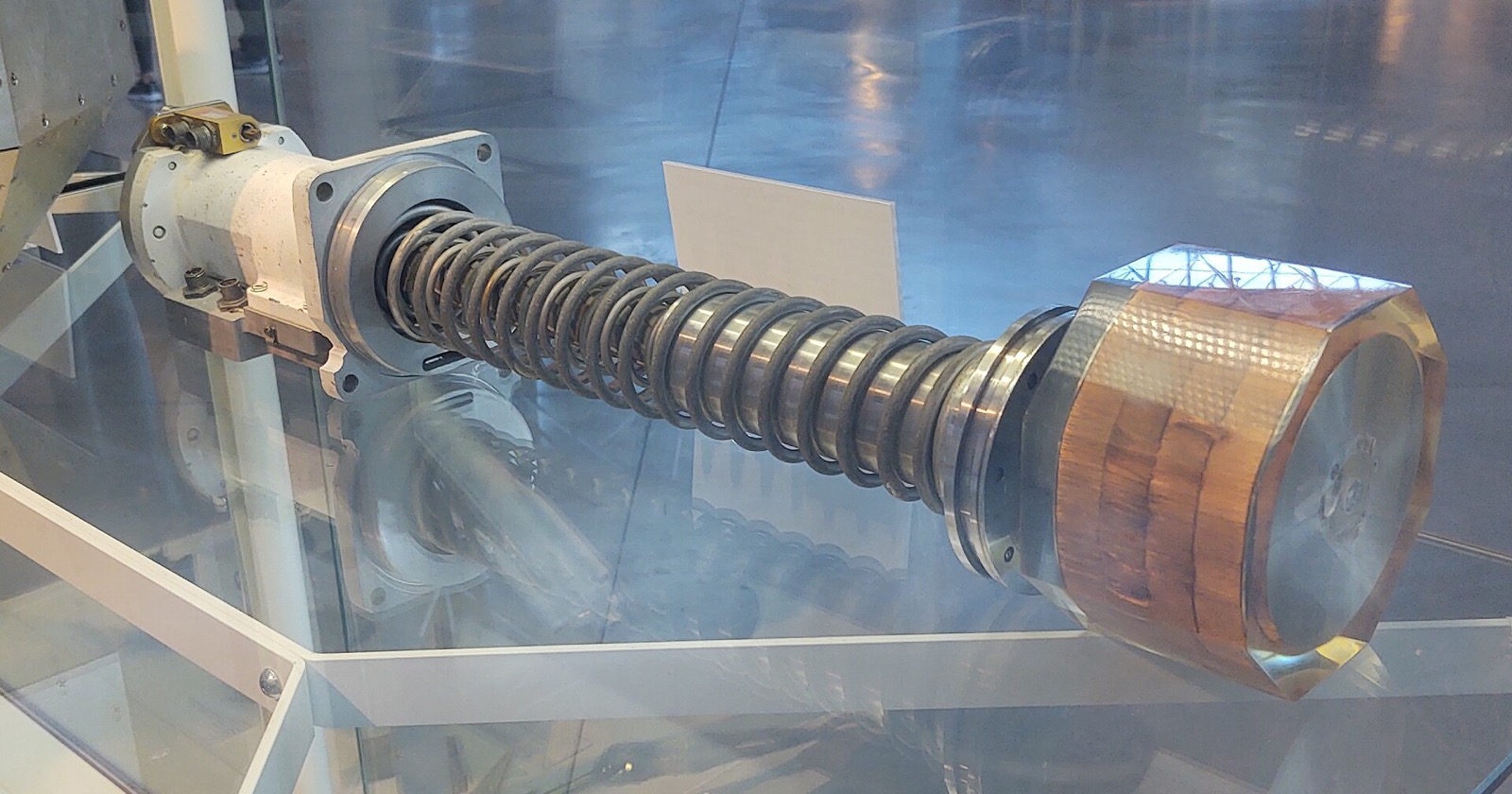
In May 1963, about 3,600 kilometres above Earth, a radio command reached a small package riding piggyback on an Air Force satellite. Inside were 480 million copper wires, each 1.78 centimetres long and less than two hundredths of a millimetre thick, set in a binder made to vanish in sunlight. As the binder turned straight to vapour in the vacuum, wires began to drift free and spread into a thin ring around the planet.
That was Project West Ford, built by MIT’s Lincoln Laboratory for the US Air Force and meant to carry long-distance radio that solar flares and jamming could not knock out. Lincoln Laboratory says the belt of loose wires had been swept from orbit by late 1965, on schedule. Many wires never came loose. Space Daily’s check of two public satellite catalogues, CelesTrak and Jonathan McDowell’s GCAT, on 8 October 2026 finds 36 to 39 clumps of West Ford wire still listed in orbit, 63 years later. CelesTrak has an orbit from the past month for 26 of its 39, and 23 of those are objects both catalogues agree are West Ford wire still in orbit. The most recent recorded reentry was in April 2024.
Space Daily told the story of the experiment itself in September. This piece follows the wire left behind, and sets two early forecasts about it, known here from the papers’ published summaries, beside six decades of tracking records.
A radio mirror for a fragile sky
In the early 1960s, much long-distance radio still worked by bouncing signals off the ionosphere, the electrically charged layer of the upper atmosphere. That mirror was unreliable. As the Harvard Crimson explained in May 1963, signals off the ionosphere could be jammed, and “a large solar flare can cause a radio fadeout by impairing the ionosphere’s ability to transmit signals.”
For a military with forces spread around the world, that was a serious weakness. Lincoln Laboratory’s own retrospective on the project describes communications for command and control as one of the Defense Department’s “acute problems” of the time. The idea, proposed by Walter Morrow of Lincoln Laboratory and Harold Meyer of Ramo-Wooldridge, was a belt of metal wires that would serve, “in effect, as an artificial ionosphere.” Morrow’s plan, the Crimson wrote, was meant “to provide a jam-proof, fail-proof, destruction-proof communication system.”
Each wire was a tiny antenna. A metal rod about half a wavelength long resonates with a radio wave, so the needles were sized for the X-band microwaves the ground stations used. Sixty-foot dishes would aim a powerful beam at the belt, and the scattered echo would reach a receiving dish across the continent. NASA’s Echo 1A balloon had used a similar passive trick in 1960 with a single giant reflector. West Ford tried it with a cloud.
The first attempt, in October 1961, failed. Lincoln Laboratory’s account says the dispenser’s ejection mechanism “didn’t spin up, so no dipoles were released.” NASA’s 2013 review puts it differently, saying the wires “did not dispense individually,” and the Crimson described “four or five useless clumps of wire floating around the earth.” The 1963 package packed its wires into a spinning cylinder, so that sunlight could turn the binder to vapour and release the needles from its surface, according to the engineering paper describing it.
A ring that worked, briefly
For a short window, it worked. The belt took about 40 days to close into a complete ring, according to a 1964 analysis of its orbit. Voice, data and teletype passed between West Ford stations at Millstone Hill in Massachusetts and Camp Parks in northern California.
The data rates fell fast. A 1964 report on the communications tests records digital data sent at 20,000 bits per second at first, sliding to around 100 bits per second. Digitised voice was sent during the first week. After about 50 days the belt was generally too sparse for the full scattering measurements, and the only traffic sent through it was teletype.
By late 1965, the Lincoln retrospective says, it was clear the future “belonged not to orbiting passive dipoles but to satellites with active transponders,” spacecraft that receive a signal and send it back out amplified.
The astronomers’ revolt
Astronomers had fought the project from the start, fearing the wires would spoil their view of the sky at both optical and radio wavelengths. The International Astronomical Union formally objected in 1961, and the Crimson reported that both the IAU and the US National Academy of Sciences set up “watchdog committees” because of West Ford.
The objection went beyond copper. Sir Bernard Lovell, head of Britain’s Jodrell Bank radio observatory, put it this way, as quoted by the Crimson: “The damage lies not with this experiment alone, but with the attitude of mind which makes it possible without international agreement and safeguards.”
The engineers’ answer was a short lifetime by design. The wires were so light for their size that sunlight itself would push on them, stretching their orbits into long ovals until the low point dipped into the atmosphere and air drag pulled them down. The Lincoln account calls this giving the dipoles “a high area-to-mass ratio.” In 1964 the Lincoln team concluded that the wires, loose or clumped, “never interfered with any astronomical observations,” a verdict from the project’s own scientists.
NASA’s Orbital Debris Program Office counts the 1967 Outer Space Treaty among the legacies of Project West Ford. Its Article IX says a state that “has reason to believe” an activity or experiment it plans “would cause potentially harmful interference” with other nations’ peaceful use of space “shall undertake appropriate international consultations” before going ahead. The office also notes that the international Committee on Space Research set up a group on potentially harmful space experiments after the failed 1961 mission. By 2013, NASA said, that group had evolved into the panel that hosts the committee’s discussions of orbital debris.
The clumps that stayed up
The loose needles behaved as predicted. In a 1966 paper in Science, Lincoln physicist Irwin Shapiro reported that radar confirmed the individual wires had reentered “in precise accord with predictions.” Calculations, he wrote, indicated that the wires survived reentry and “floated gently back to Earth,” though “the probability of finding one is minuscule.”
The trouble was how many had never separated. A 2013 review by NASA’s debris office says a post-mission investigation found only 25 to 45 percent of the planned 480 million dipoles dispersed properly. The rest are believed to have stayed stuck together, and the clumps were later picked up by the US Space Surveillance Network. NASA notes they are “still strongly affected by solar radiation pressure.”
Lincoln’s team expected those clumps to come down too, mostly. The published summary of their 1964 assessment said “the orbital lifetime of most of these clusters will be less than ten years; some, however, will orbit indefinitely.” The summary of Shapiro’s December 1966 paper went further: “Some dipole clusters remain in orbit but almost all should return to Earth within the next 2 years.”
That second forecast can at least be set against the clumps already in the US satellite catalogue when the paper appeared. The paper’s published summary does not say whether “almost all” meant only the clusters in that catalogue, but if it did, the record does not bear it out.
CelesTrak, a widely used public satellite-tracking site, lists 147 objects from the 1963 launch under the name “Westford Needles,” and the order of their catalogue numbers suggests roughly when each was first logged. About 30 clumps were already on the books by November 1966. None of them came down in the next two years. None came down within ten years of launch either. The first fell in November 1974, and CelesTrak still lists 16 in orbit today, 12 of them with orbits updated in the past month.
Across all 147, the record is slow too. Only 13 came down within ten years of launch, all of them clumps catalogued after 1966, and most of the 104 marked as decayed fell between the 1970s and the 1990s. Three came down in the 2010s and three more since 2020, in November 2020, October 2022 and April 2024.
Counting wire in the dark
CelesTrak shows 43 “Westford Needles” objects still in orbit, but not all of them are wire. Jonathan McDowell’s independent GCAT catalogue identifies two as solar array covers from the satellite that carried the package and two as parts of the West Ford package itself. That leaves 39 clumps in CelesTrak’s listing. NASA said in 2013 that two “Westford Needles” entries are assessed to be from a different mission, without saying which.
GCAT counts 36 West Ford wire objects in orbit, and five of those carry a flag meaning probably still in orbit but lost, with no recent tracking data. The two lists disagree on whether five objects are still up. GCAT records three that CelesTrak shows as orbiting as having reentered decades ago, though two of those still have current CelesTrak orbits. It assigns a fourth, which also has a current CelesTrak orbit, to a 1969 launch, and it keeps a fifth as lost that CelesTrak says reentered in 1989.
Only 26 of CelesTrak’s 39 have orbits updated in the past month, and three of those are objects GCAT disputes. That leaves 23 that both catalogues call West Ford wire and that have a current orbit, which is the firmest count of what is still circling. Small clumps on stretched, shifting orbits are hard to follow, and a missing public orbit does not prove an object is gone, or that it is still there.
The dates need care too. Fourteen objects in CelesTrak share one reentry date, 17 October 1987, which looks more like a catalogue clean-up than fourteen clumps falling on the same day. And the catalogue-number method used above to date when clumps were first logged is an inference, not a field the catalogues record.
NASA’s own figure in 2013 was 46 clumps. Both catalogues record six reentries since then, yet 46 minus six does not give either current count, most likely because entries have been added and reassigned along the way. Comparing the 2013 number with today’s is not a clean measure of decline.
The 1964 forecast is harder to hold anyone to. It covered all clusters, including small ones radar may never have caught, and it allowed that “some” would orbit indefinitely.
None of the sources reviewed for this piece reports a collision involving West Ford wire, and the 1964 team judged collisions with spacecraft “improbable.”
Looking for needles
West Ford left something else behind on the ground. Lincoln Laboratory had already been funded to develop a powerful ground terminal “of the sort that a higher-capacity West Ford system would use.” The retrospective explains the name it was given: Haystack, “because its main job was to look for needles in space.”
The future went to active satellites. Haystack stayed. In the same 2013 newsletter that counted the West Ford clumps, NASA described the Haystack radar sampling small orbital debris for its debris office.
Somewhere on Earth, more than a hundred million copper hairs from 1963 presumably lie where they settled, too fine to find. Overhead, more than 20 tangles of the same wire are still being tracked, nudged on every orbit by the sunlight that was supposed to bring them down.