

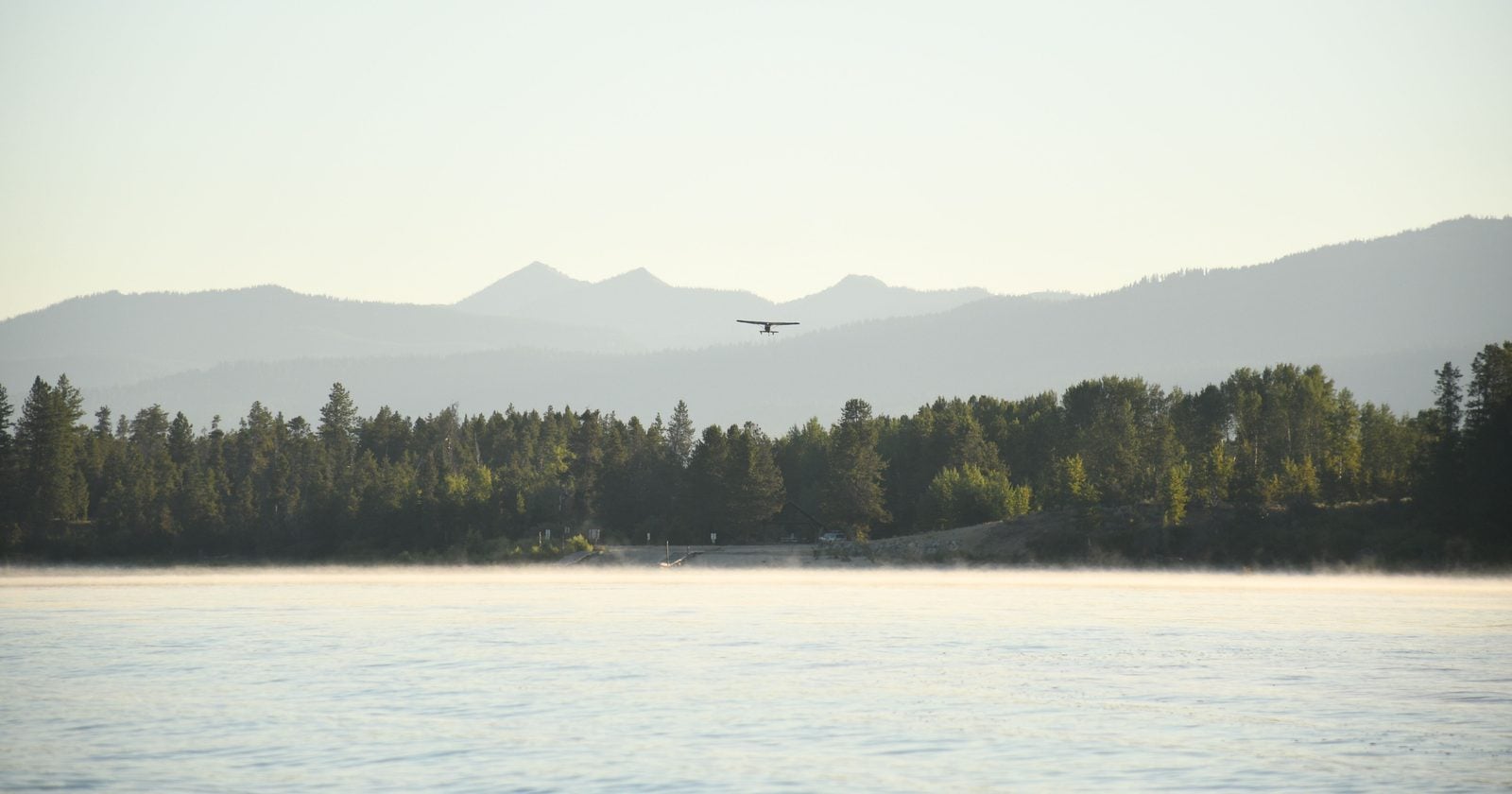
You want to put fish into a high mountain lake, one with no road and no short trail to it. Fish need water to travel in, water is heavy, and no truck can get up there. So how do you do it?
Utah’s answer, worked out over decades, is to skip the ground entirely. The fish arrive by air, and for the final stretch they arrive through open air, falling out of an airplane into the lake below.
The method: a Cessna, seven chambers, and a low pass
The plane doing this work is a small single-engine aircraft, and its cargo hold is the clever part. The Utah Division of Wildlife Resources describes a plane that “can carry the pilot and a copilot, plus one fish tank that has seven chambers, allowing the aircraft to stock seven different lakes in one flight.” Seven chambers, seven lakes, one loop through the mountains before the plane comes back to reload.
The plane comes in low and slow over the lake, about 50 to 150 feet above the water, and releases the fish from one chamber so they tumble the last stretch down. Then on to the next lake, the next chamber. A single flight can carry over 10,000 fish before anyone needs to land and refill.
Why the fish survive a fall from a plane
This is the part that stops most people. A fall from a hundred feet or more, into water, sounds like the end of the fish. It mostly isn’t, and the reason comes down to size.
The fish being dropped are tiny. They are fingerlings, young fish only 1 to 3 inches long, and at that scale the physics works in their favor. The DWR’s own explanation is that “the young fish — called fingerlings — are so small (ranging from 1-3 inches long) that the air slows their drop. The slower fall allows the fish to survive.” A body that small weighs very little for its size, so air resistance slows it fast. Instead of dropping like a stone, the fish flutter down more the way a leaf does.
We are not fish biologists, and this is the agency’s account of its own program rather than an independent study, so it reads better as the DWR’s reasoning than as settled fact. The agency is clear about the size limit, though. If you tried this with bigger fish, the DWR says, “if the fish were larger, the survival rate would not be as high.” The whole method depends on keeping the fish small enough to fall gently.
How long this has gone on, and how far it reaches
Dropping fish from planes is not a recent experiment. Utah has done it since as early as 1956, and it wasn’t the first method anyone tried. Matt McKell, a biologist with the DWR’s Northern Region, has written about the earlier, more awkward approaches. In the early days, McKell has written, the fish were carried up in metal milk cans on horseback. A horse can only carry so much water so far up a mountain.
Aircraft solved the reach problem, and they stuck. McKell writes that “by the 1950s, small airplanes became the preferred method for stocking fish into backcountry lakes, which is actually still the case today.” Seventy years on, the plane handles the long-distance work, while backpacks, buckets, and four-wheelers still cover the lakes a person can walk or drive to.
The scale now is large. The DWR reports that “more than 300 lakes are aerially stocked in Utah each year. These lakes range in size from smaller than 5 acres up to 500 acres.” Independent reporting puts the figure at roughly 300 high-elevation lakes as well, so the number is not just an agency talking point.
Why bother stocking a barren lake at all
There is a fair question underneath all of this. Many of these high lakes hold no fish naturally. Steep outlets and long winters mean fish often can’t reach them or can’t breed once there, which is exactly why they require frequent stocking rather than a one-time drop. So why put fish in a place that can’t keep them going on its own?
The plain answer is recreation. These are backcountry fishing spots, and a lake with no fish is a long hike to nothing for an angler. Stocking keeps hundreds of remote lakes worth the walk.
What makes the whole operation possible circles back to the fingerlings. The airplane, the seven chambers, the low pass over the water, all of it works only because the fish are small enough that falling a hundred feet does them little harm. Grow them a few inches and the physics turns against you. The program depends, in the end, on dropping a creature light enough to be caught by the air on the way down.