The wallet in my back pocket is darker than it was when I made it. The leather has gone soft at the corners. There is a faint shine across the front where my thumb has rubbed it a thousand times taking it in and out, and one of the edges has rounded off where it sits against my pocket. It is, by any new-leather standard, worse than it was. By the standard I actually use, it is better. I would not trade it for a new one.
I did not know what wabi-sabi was when I made the wallet, and I might not have called what has happened to it beautiful if you had asked me at the time. I would have said it was just getting used.
Perhaps, the cleanest English-language definition comes from Leonard Koren, an American artist and aesthetics writer who set out, in Japan in 1992, to put words on the kind of beauty he kept being drawn to. What he arrived at, he wrote, was the phrase: “a beauty of things imperfect, impermanent, and incomplete.” Things that are worn, weathered, asymmetrical, modest, and made of materials that show their age.
One thing to note: “wabi-sabi” as many English-speaking readers now use it owes a lot to Koren’s framing. The words “wabi” and “sabi” had existed in Japanese aesthetics for centuries as separate terms, and Koren’s book helped popularise their pairing in Western design and aesthetic writing.
I have never been to Japan. I have not sat through a tea ceremony or walked a temple garden. So I am writing about wabi-sabi as an outsider engaging with the idea, not as somebody who understands the tradition it came out of. What I can say honestly is that even at a distance — even refracted through a book and a few essays — the idea names something I had been feeling without a word for it.
I live half the year in rural Ireland and the other half usually between Vietnam and Thailand. Surprisingly, the Irish half is where the wabi-sabi feeling shows up most for me. Not in any deliberate way — I am not out there pursuing it. It is just that the part of the landscape I am drawn to is the part that is unmanicured. The hedgerows in their tangled state. The stone walls that have leaned a little. The fields after rain, when the ground is dark and the grass is heavy and the sky cannot decide what it is doing. There is nothing perfect about any of it. The bench by the back door is mossy. The sheep have made paths through the field that nobody designed. None of it would survive a landscape magazine.
And yet that is precisely the part that lowers something in me. The polished version of the same view — clipped, raked, photographed under a flattering sun — would not do the same thing. It would look better, and feel less.
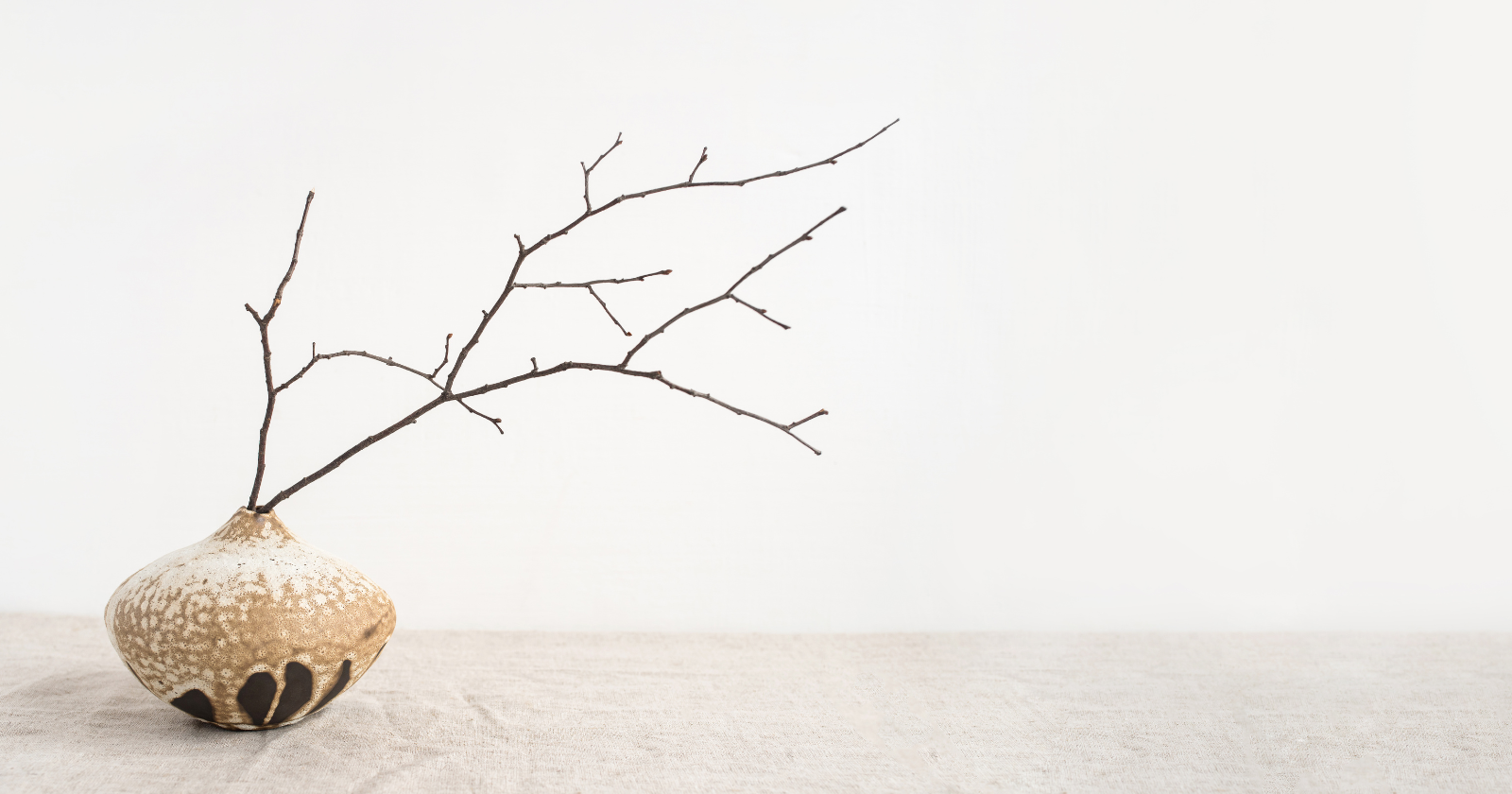
Koren makes a point I keep coming back to. He calls wabi-sabi “the antithesis of the Classical Western idea of beauty as something perfect, enduring, and/or monumental.” The Western idea, in his framing, is the slick, mass-marketed object — for him, the latest wireless device; for me, also the marble statue. Perfection objectified. Wabi-sabi is, on purpose, the other thing — the bowl that has been used, the wood that has aged, the small thing that is honest about its own decay. You can argue with where the line is drawn, but the contrast is the part that lands.
What I find interesting is what happens when you turn the idea on yourself rather than on objects. The bowl with the crack is easy to accept; the same thing in a life is harder.
I am thirty-something now, and the shape of my work history would not survive a careers brochure. I studied business and went into finance in Ireland in my early twenties, then left. I moved to Vietnam to teach English. I ended up running an adult language school for a few years. I made wallets and belts on the side. I started an online school that failed. I went into venture capital — first as an intern, having just been managing a school — and the step from manager back to intern was a real, visible drop in status I felt at the time and still remember. I started a coffee company. I left to write. I have stuck with writing.
Looked at as a CV, that path is uneven and inefficient. There are gaps. There are bets that did not pay. There is no straight line from one phase to the next. The version of me at twenty-five would have looked at it and called it a mess.
My read at thirty-something is that the imperfection is what makes it mine. I could not have written about the kind of work I write about now without the failed school. I could not run anything alone without the language-school years. The VC step, taught me how to think about what a business is for, which is a question I find I am asking often when I write. None of it would have been there if the line had been straight.
This is not me telling anybody to leave their job. The straight-line lives I admire are real, and I sometimes wonder what mine would look like if I had stayed in the Irish finance track. The point is not that the off-script life wins. The point is that the cracks in the path stopped looking to me, after a while, like damage. They started looking like the place where the path is held together.
This is, I think, what wabi-sabi is reaching for when you take it out of the studio and apply it to a life. It is not a celebration of failure, nor a moral instruction to break things on purpose — it is just a way of looking that does not flinch from the cracks. The wallet, the career path, the hedgerow out in the rain for fifty years — all of them have done a lot of work, and they are all the better, to me, for showing it.
I would have a hard time convincing twenty-five-year-old me of that. He was still hoping to arrive somewhere uncreased. The version writing this is not.