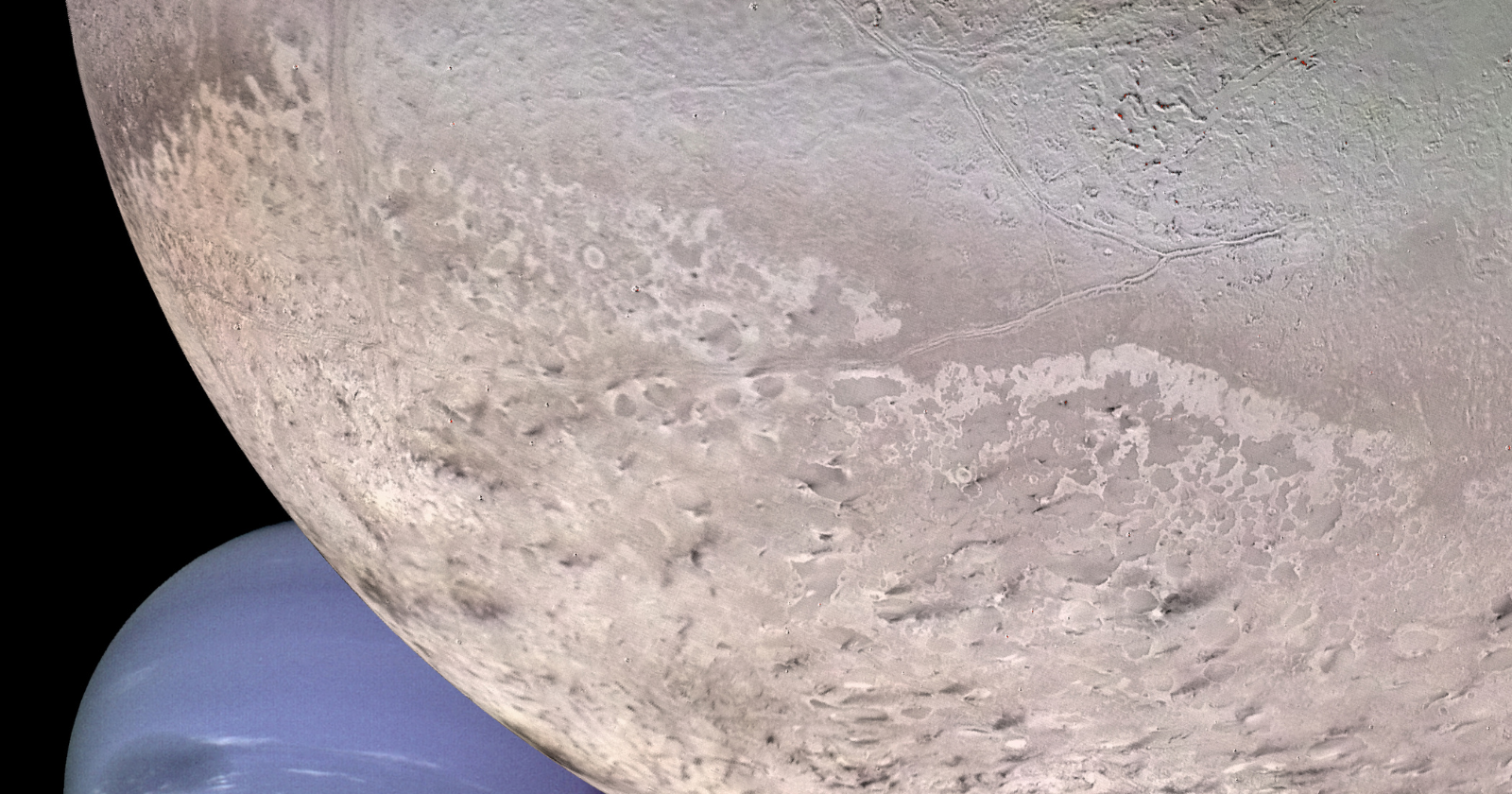
When Voyager 2 flew past Neptune’s largest moon in the summer of 1989, its active, geyser-like plumes became what JPL called the most surprising find of the encounter.
That matters beyond one moon. If the coldest surface known can still be visibly active, then “too cold to do anything” stops being a safe assumption about the outer Solar System.
Why dead ice was the reasonable bet
Before the flyby, expecting a frozen, mostly inactive Triton was not lazy. It was sensible. The moon sits impossibly far out, where sunlight is weak and temperatures fall almost as low as they can go.
Triton has the coldest surface known anywhere in the Solar System. NASA puts its surface temperature at around 38 kelvins, roughly minus 391 degrees Fahrenheit. It is cold enough that most of its nitrogen sits frozen on the ground as frost. On a world like that, the idea that nothing moves is hard to argue with. Ice that cold reads, to a human eye, as permanence.
So the surprise was not that Triton was strange. It was that an intensely cold world turned out to be visibly active.
What the cameras actually caught
As Voyager 2 approached, its cameras picked up dark columns rising off the surface. The JPL announcement described a narrow, dark plume that climbed almost straight up to nearly eight kilometres, then spread into a cloud trailing about 150 kilometres downwind in Triton’s thin atmosphere.
The spacecraft captured three sequential images of one erupting plume as it closed in.
The discovery was written up by L. A. Soderblom and colleagues in Science in 1990. They reported at least four active, geyser-like eruptions, with the two clearest rising as dark columns to about eight kilometres and drifting more than a hundred kilometres downwind.
What strikes me is how clearly visible the expelled material was. The clouds carried fine, dark particles high into Triton’s thin atmosphere, possibly with ice crystals alongside. This was not a faint wisp. It was a working engine, photographed mid-eruption.
How something this cold ends up erupting
One long-standing explanation is a kind of buried greenhouse. Sunlight, weak as it is out there, passes through surface ice and warms darker material trapped beneath it.
The JPL explanation: sunlight absorbed by dark particles inside Triton’s ice cap warms frozen nitrogen, raising the pressure of nitrogen gas until it escapes through vents, carrying dark, powdery particles up with it.
The mechanism is not settled, though. A 2022 review of the competing hypotheses noted that “Locations of Triton’s plumes/fans don’t strongly favor solid-state greenhouse model.”
Why one flyby is still the only look we have
Everything above rests on a single encounter more than three decades ago. Voyager 2 saw only about 40 percent of Triton’s surface, and no spacecraft has returned since. The other 60 percent has never been photographed up close.
The open questions have stayed open. NASA’s 2020 Trident mission concept framed the flyby as leaving big gaps: how the plumes form, and why the surface looks so young. It may be only around 10 million years old, in a Solar System that is 4.6 billion years old, with almost no craters to show its age. A surface that fresh means something has been resurfacing it, recently, on a world we filed under “frozen.” Trident was studied as a possible Discovery mission but was not selected for flight in 2021.
The scientists who wanted to go back were honest about how thin the original data was. Karl Mitchell, project scientist on the Trident concept, compared the 1989 Voyager encounter, built on early-1970s technology, to “essentially a television camera attached to a fax machine.” His deliberately unfair line, not an engineering spec, but it lands: our one good look came through equipment that would embarrass a modern phone.
Mitchell also captured why the moon keeps pulling people back. He described Triton as “weird, but yet relevantly weird, because of the science we can do there.”
Louise Prockter, who would have led the mission, said she had “always loved the Voyager 2 images” and their glimpses of a moon still poorly understood. Poorly understood because we have only ever half-looked.
My read on Triton is smaller and more stubborn than any single mission argument. A place can have the coldest surface known and still, when a camera finally shows up, be caught mid-eruption. The frozen reading was reasonable, careful, and consistent with much of what was then known. It was still basically wrong. That seems like a decent argument against deciding a world is dead before you’ve actually gone and looked at it.