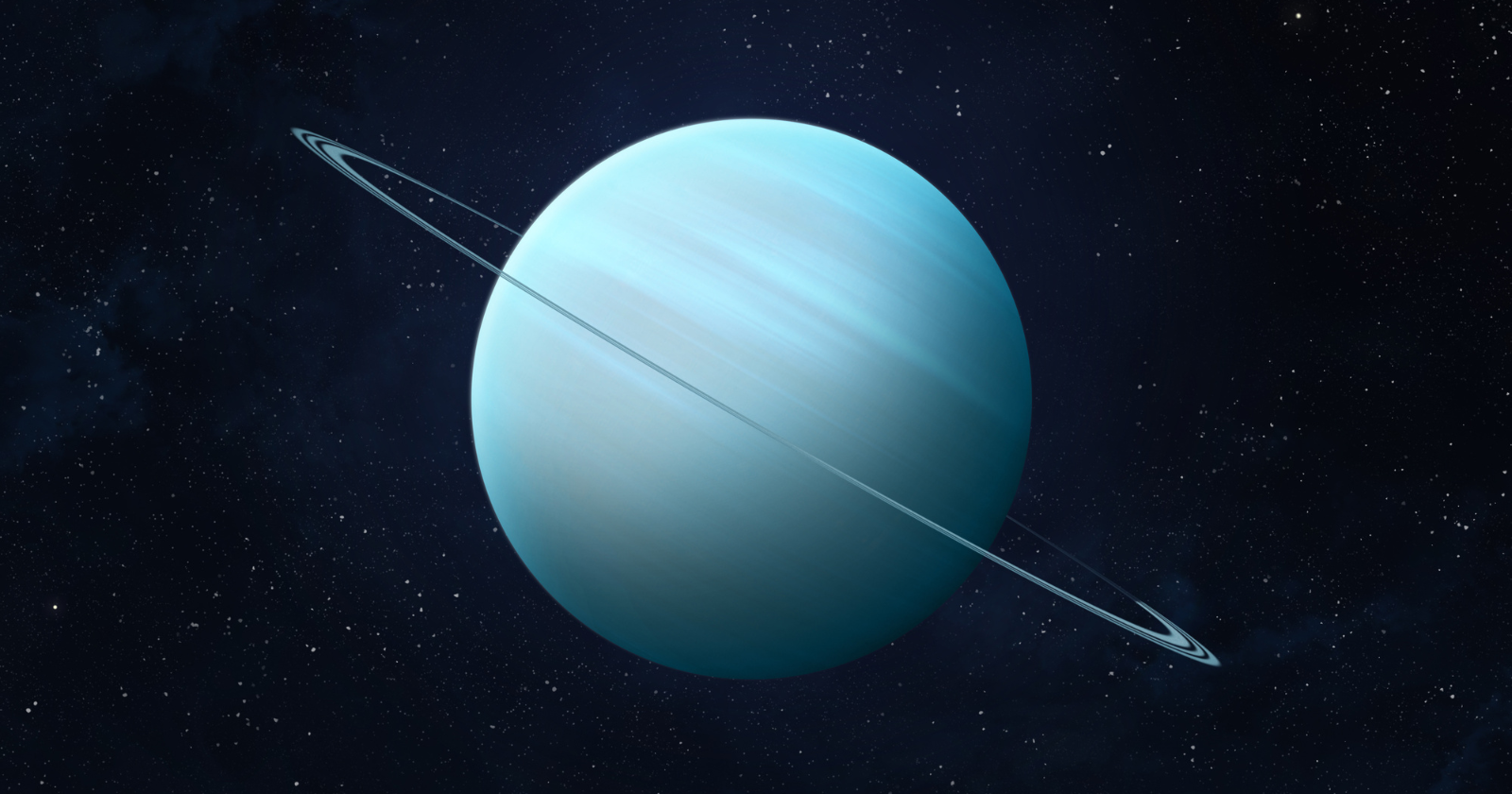
In January 1986, Voyager 2 swept past Uranus and gathered the only close-up measurements humanity has ever taken of the planet. Voyager 2’s 1986 flyby was the first and remains the only visit. Much of the close-up picture of Uranus traces back to that single pass.
That’s a lot of weight to hang on one encounter. And a reanalysis published in late 2024 suggests it may have landed on a very strange day.
A quick note before going further: we’re not planetary physicists, and this is a reading of published research rather than a settled verdict. The analysis is one team’s interpretation of the Voyager dataset, not a final word on Uranus.
Voyager 2 found new moons and rings, and mapped a magnetic field that looked oddly tilted and off-center. Around the planet sat a magnetosphere, the bubble a planet’s magnetic field carves out in the solar wind. It looked almost empty of plasma, yet held unusually intense belts of high-energy electrons. From that snapshot came the framing that stuck: Uranus had an extreme magnetosphere.
Those two features never quite fit together. A magnetosphere depleted of plasma but crackling with radiation belts is a strange combination. Linda Spilker was among the Voyager 2 mission scientists during the flyby and now serves as Voyager project scientist. “The flyby was packed with surprises,” she said, recalling the confusion over its unusual behavior and noting that Voyager 2 had measured only a snapshot in time.
Jamie Jasinski, a space plasma physicist at NASA’s Jet Propulsion Laboratory, led a team that went back to the solar wind data around the encounter. They found that the flyby happened during an extreme compression. According to their analysis in Nature Astronomy, the solar wind dynamic pressure was roughly 20 times higher than it had been about a week earlier.
The timing is the striking part. The team examined roughly eight months of solar wind data around Uranus’s orbital distance. “The flyby occurred during the maximum peak solar wind intensity in that entire eight-month period,” Jasinski said.
How rare is that? The team estimates a similarly compressed magnetopause is present less than 5% of the time. That figure comes from the team’s probability estimate based on the Voyager solar wind dataset, but if it is representative, it changes what the flyby snapshot means.
Once you know a squeeze was underway, the two puzzling features start to look less like Uranus’s normal state and more like space weather. The team argues that compression could have driven plasma out of the magnetosphere while intensifying the dynamics that feed energetic electrons into the radiation belts.
Jasinski’s what-if is where the argument bites, but it is worth flagging that this is inference from the analysis, not something directly observed. Jasinski said Voyager 2 would have observed a “completely different magnetosphere” if it had arrived just a few days earlier. Elsewhere he put it more casually: “We just caught it at this freak moment in time.”
This shouldn’t be overstated into “everything we knew was wrong.” The study revises how we read specific magnetospheric features, not every measurement Voyager 2 made. Still, Jasinski said knowing about the unusual conditions beforehand would have made scientists question the flyby’s measurements much more carefully.
The deeper issue is simple. You can’t easily tell the difference between “typical Uranus” and “Uranus on an unusual day” when you only visit once.
The reopened questions go beyond the magnetosphere. Voyager’s missing-plasma observations had helped support the idea that Uranus’s major moons were inert. The new analysis makes activity more plausible, while also suggesting Titania and Oberon usually sit inside the magnetosphere, which could make searches for subsurface oceans easier.
It gets settled by going back. The planetary decadal survey already named a Uranus Orbiter and Probe the highest-priority new flagship mission for initiation in 2023–2032. A finding like this is a direct argument for why an orbiter that watches the system over years beats any single flyby.
The lesson isn’t that Voyager 2 got Uranus wrong. It’s that one data point, taken on what may have been the planet’s strangest day in months, was never going to be enough to know it was strange at all.