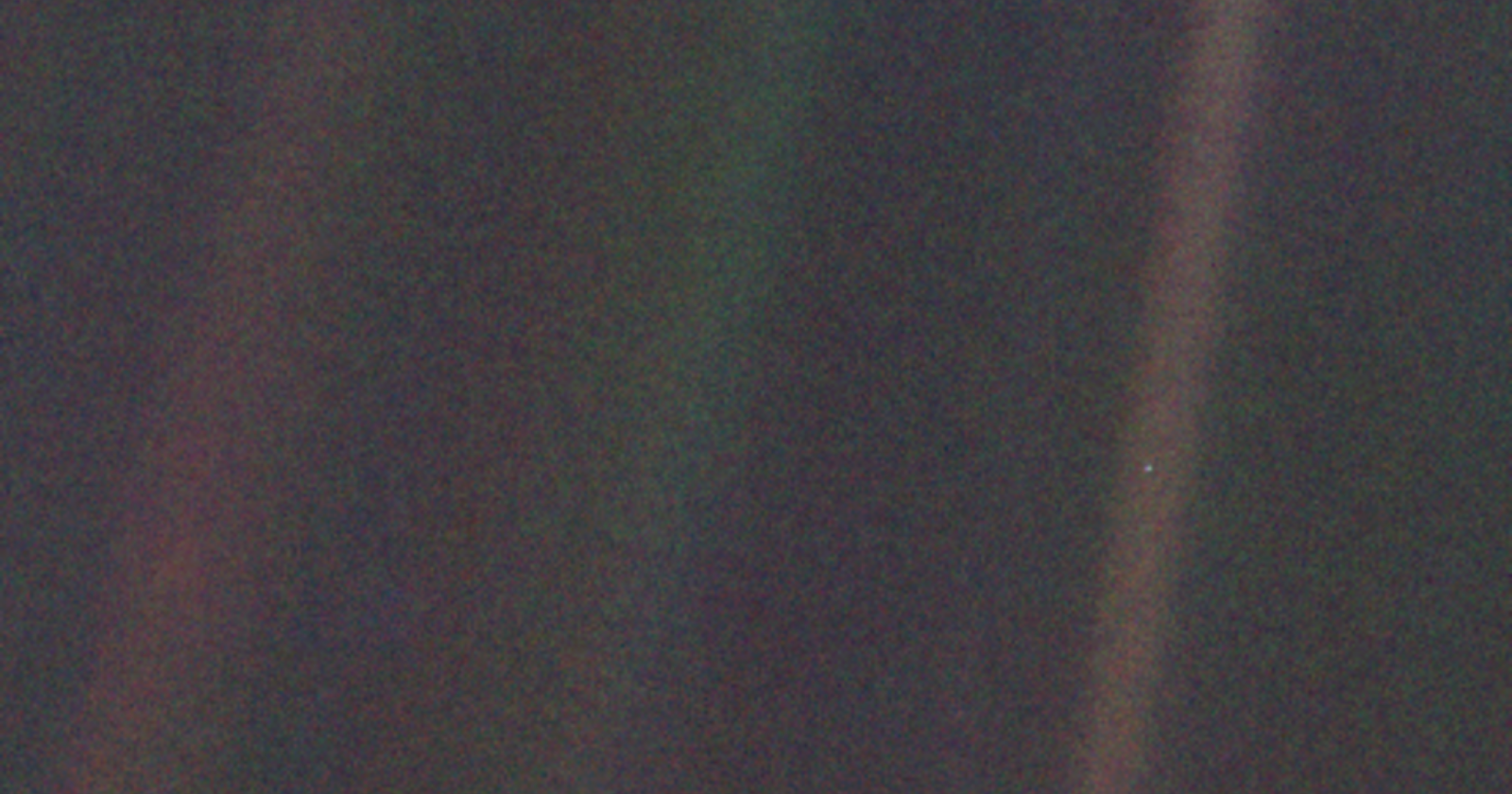
On February 14, 1990, six billion kilometers from the sun, Voyager 1 swiveled around and took a photograph of Earth. In the frame, the planet appears as a speck less than a pixel wide, caught in a band of scattered sunlight. The image, which Carl Sagan later named the Pale Blue Dot, became one of the most reproduced photographs in human history.
The part I keep getting stuck on, though, is that it almost did not happen. According to NASA, the Voyager team “turned down several requests to take the images because of limited engineering resources and potential danger to the cameras from pointing them close to the Sun. It took eight years and six requests to get approval for the images.” Eight years. Six requests. For a photograph we now treat as one of the obvious things to have taken.
The case the engineers kept making
By 1990, Voyager 1 had finished its planetary mission and was on its way out of the solar system. To photograph Earth, the spacecraft would have to point its instruments within a few degrees of the Sun, which from that vantage was still bright enough to potentially damage the camera optics. The cameras could not be repaired. Mission planners were already preparing to shut them down for good to save power for the long interstellar journey ahead.
It is easy, from here, to roll our eyes at the institutional caution. It is harder to admit that almost everything they were worried about was technically correct. The risk was real. The payoff, on paper, was zero — at that distance the image would likely not show anything of scientific value. The only argument for taking it was that it might mean something.
The case Sagan kept making
Sagan first floated the idea in 1981, the year after Voyager’s Saturn encounter. He kept floating it. His pitch, as far as I can tell from the record, was not really about science. It was about perspective — about humans seeing the planet they were busy fighting over from far enough away that the fighting started to look strange.
When he eventually wrote about the image in his 1994 book of the same name, the lines that stayed in circulation were these: “Look again at that dot. That’s here. That’s home. That’s us. On it everyone you love, everyone you know, everyone you ever heard of, every human being who ever was, lived out their lives […] on a mote of dust suspended in a sunbeam.”
What came back
When the image data finally arrived back on Earth a few months later, planetary scientist Candy Hansen — who served as the experiment representative for the Voyager imaging team — was the first person to look. The image was not the dramatic thing she had imagined. “It was actually kind of terrifying, because I didn’t see it at first,” she told Space.com years later. “Because of that beam of scattered light, it didn’t pop out at me immediately. And then I was so afraid that we had missed it, or screwed up the exposure or something.” She did, eventually, see it. A pale blue dot, smaller than a pixel, sitting in a band of stray light. That dot is us.