

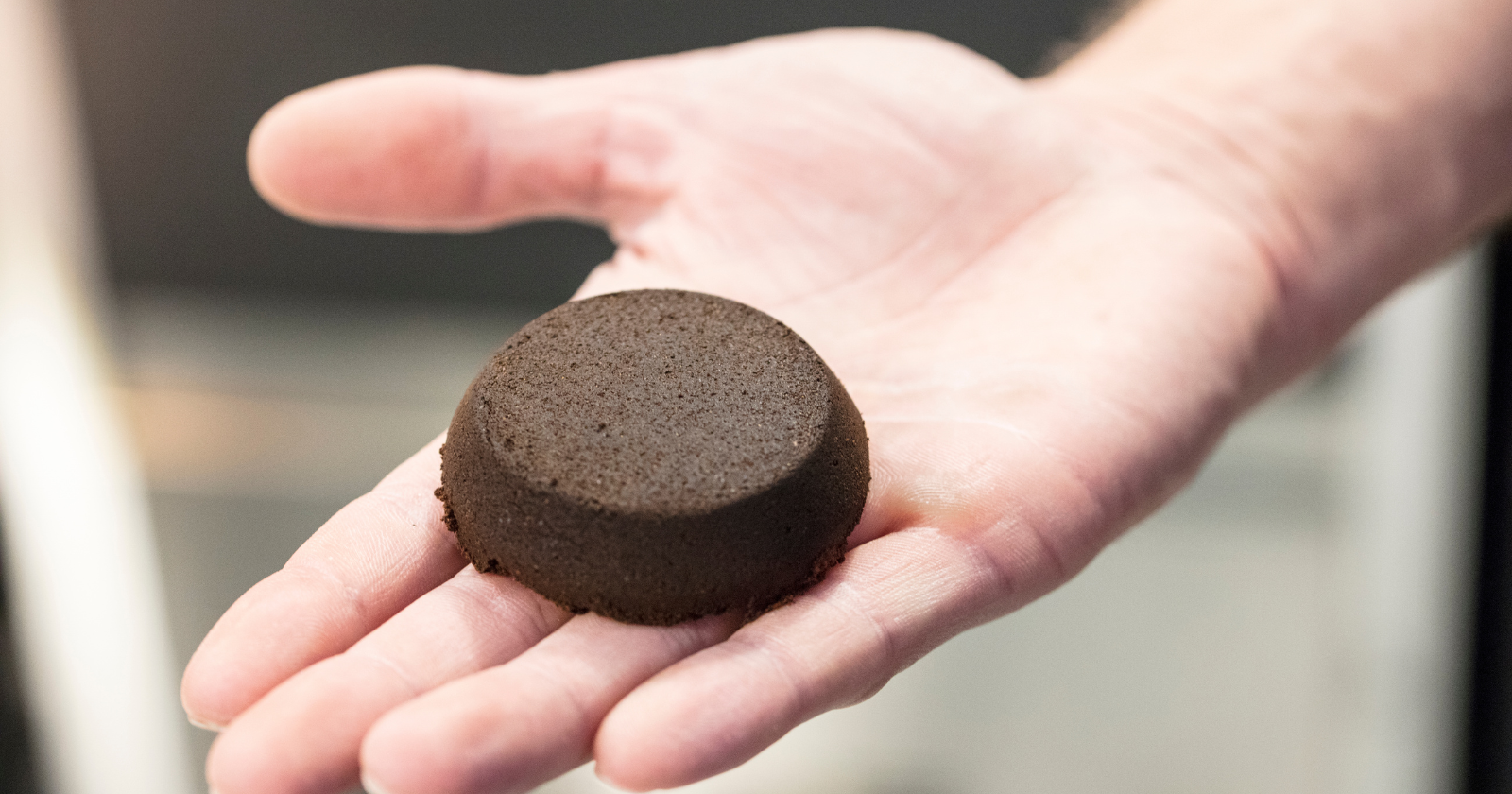
Used coffee grounds can be turned into a cheap material that pulls lead out of water. It is a neat finding: take a free waste product, char it, and use it to strip a poison out of contaminated water in the lab.
The material is called biochar. Take almost any dry organic material, heat it in a low-oxygen chamber so it chars instead of burning to ash, and you are left with a black, carbon-rich solid full of tiny pores. All those pores add up to a large internal surface, and that is what lets biochar grab onto things passing through water. People have made it from wood, crop husks, and manure.
The twist in this recent work is what went into the chamber: yesterday’s coffee.
A quick note before we go further. We are not toxicologists, water engineers, or public-health clinicians, and nothing here is guidance on treating your own water. This is us reading two lab studies and thinking about what they do and don’t show. The findings come from lab experiments on prepared solutions, not tests on real household supplies, and a lab result is not a promise about any individual tap.
Why coffee grounds make a decent starting material
Spent grounds are close to ideal. They are already granular, they are full of carbon, and they are produced in amounts that are hard to picture. Global coffee consumption ran to more than 176 million 60-kilogram bags in 2021 to 2022, and most of that ends up as waste. The raw material is free, abundant, and otherwise headed for landfill.
The team behind the headline numbers worked at Loughborough University in England, with collaborators at Banaras Hindu University in India. They collected used grounds from a single campus cafeteria, then charred them in that low-oxygen process to make biochar. What lifts the study above novelty is that they didn’t just char the grounds and hope. They tested a range of settings to find the ones that mattered.
The best settings came out at 469 degrees Celsius, heating at roughly 16 degrees per minute, for about 1.28 hours. Get the temperature wrong and the pores don’t form well. Get it right and the material’s ability to trap lead climbs sharply. As lead author Dr Monika Mahajan put it, “By optimising the decomposition conditions, we were able to significantly enhance the material’s performance while keeping the process low-cost and environmentally friendly.”
Why lead in water is worth this much fuss
The reason chemists keep circling back to lead is that there is no safe amount of it. The EPA’s goal for lead in drinking water is zero, set because the metal is harmful even at low doses and accumulates in the body over time. Infants and young children are most at risk. Formula-fed babies are a particular concern: the EPA notes that water can account for 40 to 60 percent of an infant’s lead exposure when formula is mixed with contaminated water.
That is what makes a cheap, waste-derived filter appealing rather than merely clever. A material you can make from a cafeteria’s leftovers, at low temperatures, without exotic chemicals, is exactly the kind of thing that could matter in places where high-end treatment plants are not an option.
Mahajan puts the promise directly: the work shows, she says, “how an everyday waste such as spent coffee grounds can be transformed into a high-value, sustainable adsorbent for removing toxic metals from water.” We would read the “can be” as genuinely provisional. This is one study, and its water was made in a beaker.
The circular-economy read, and where it thins out
The framing the researchers reach for is the circular economy, the idea that one process’s waste becomes another’s raw material instead of going to landfill.
A companion Loughborough study, this one on copper and zinc, made the same case. Its lead author, Dr Basmah Bushra, called it “a simple but effective illustration of circular-economy thinking in action,” and their supervisor Dr Diganta B. Das went further, saying the results show “coffee waste is not a waste at all.” As a story it is appealing: the grounds from your afternoon flat white, charred and put to work stripping poison out of water.
Where we would slow the story down is the jump from beaker to tap. These were tests on clean lead solutions, water dosed with a known amount of a single metal. Real drinking water is messier: other minerals, organic matter, and varying acidity all may compete with the biochar for the same binding spots.
None of which makes the Loughborough result less real. It’s a lab study showing that a free waste stream can be turned into a working lead filter.