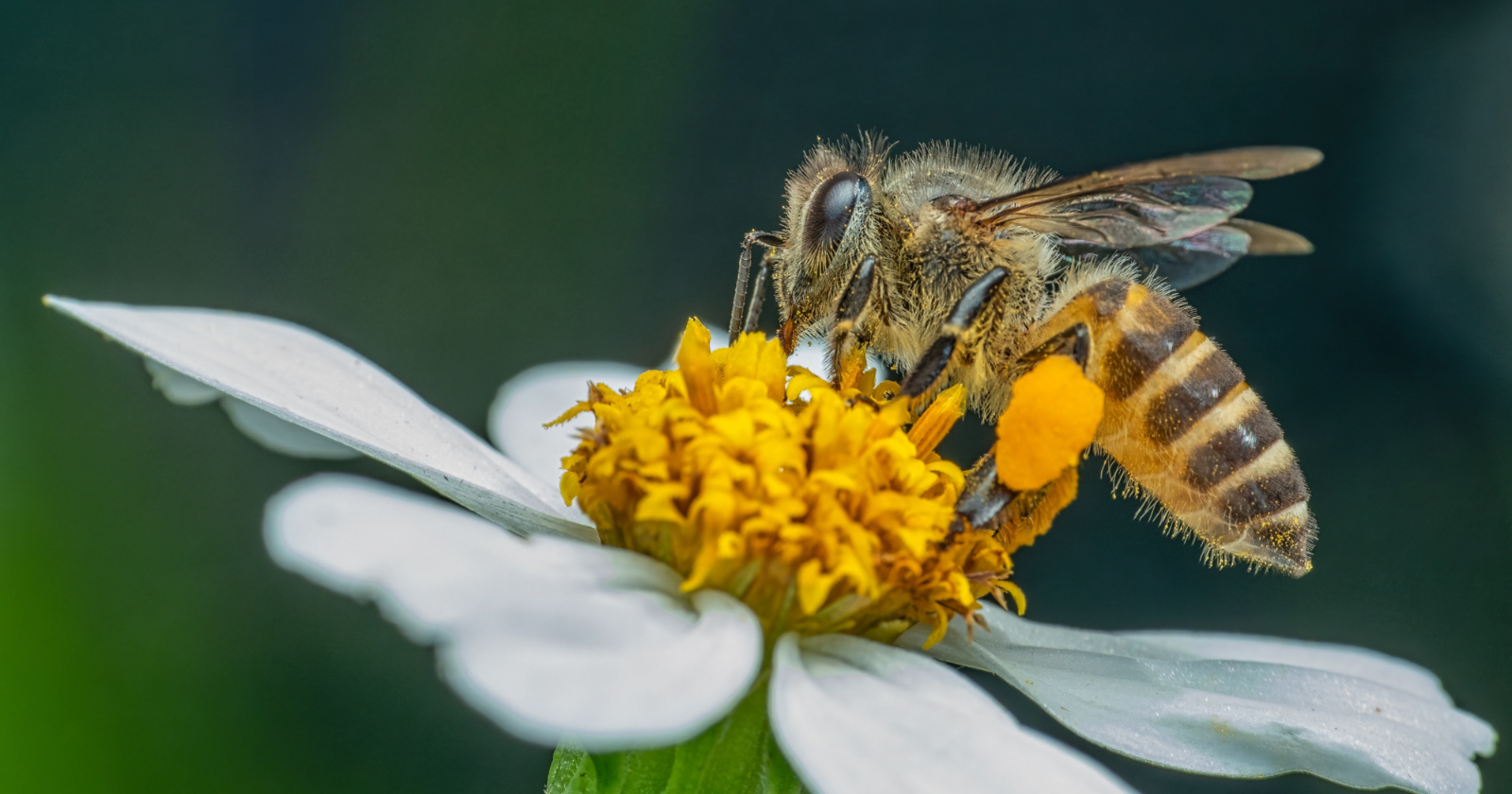
Let’s start with the flowers. To produce a pound of honey, a colony’s worker bees have to visit around two million blossoms. The figure is repeated widely by beekeeping organizations and it does something odd to the way you look at a jar. The jar stops being a grocery item and starts being a receipt for an enormous amount of small, repeated work.
That number is an approximation, worth saying up front. The Canadian Honey Council, doing its own math from older field studies, lands closer to 2.6 million, and it says plainly that “the values used for the calculation are averages.” So “two million” is a good round headline, not a fixed measurement. What holds up is the rough size of it.
What two million flowers actually means
One foraging bee makes little headway against a number like that. She typically visits somewhere between 50 and 100 flowers on a single collection trip, then flies back to the hive to drop off her load. At that rate, two million flower visits represent roughly 20,000 to 40,000 collection trips spread across thousands of workers.
The individual scale is the part that lands hardest. Over her whole life, the average worker is commonly estimated to make only one-twelfth of a teaspoon of honey. That’s it.
And she isn’t out foraging the whole time either. A spring or summer worker generally lives about six to eight weeks. She spends roughly her first three weeks on jobs inside the hive and generally begins foraging later in life, although the timing changes with the colony’s needs. So two million flowers is not the work of one tireless bee. It is the pooled effort of a rotating, short-lived workforce.
The miles are disputed, and that matters
The distance is where the tidy story gets messy. A commonly cited figure has the workers of a hive flying more than 55,000 miles combined for a single pound. The planet is about 24,900 miles around at the equator, so that’s a little over twice around the world.
Other sources land even higher, at around 90,000 miles. That is a genuine difference in estimates, not a separate measuring stick. Sources often phrase the larger number as the distance one bee “would have to fly,” but no single worker makes a pound of honey alone. It is another estimate of the aggregate flight required, built from different rounded averages.
How much nectar a bee carries per trip, how sugary that nectar is, how far the flowers are from the hive and how much water must evaporate before nectar becomes honey can all change the result by tens of thousands of miles.
Why bees do it anyway
A colony in which every bee had to discover good flowers independently would waste much more of that mileage. Bees share information through the waggle dance, the figure-eight movement decoded by Karl von Frisch, work that won him a share of the Nobel Prize in 1973. The dance carries information about both direction and distance. Modern experiments confirm that the duration of the waggle run varies with the distance to the destination, while its angle indicates the direction of the food relative to the sun.
That messaging can keep the number from being even larger. When researchers prevented colonies from communicating usable dance information, the bees foraged farther from their hives. The dance helped colonies recruit workers to smaller foraging areas and concentrate their effort.
Those 55,000-odd miles are not just brute persistence, then. They are part of a coordinated, information-sharing operation shaped by the location and quality of the available flowers.
Whichever figure you trust, the shape of it does not change. A jar of honey on a kitchen shelf is a pound of concentrated flight: roughly two million flower visits and enough combined mileage to lap the planet at least twice, produced a fraction of a teaspoon at a time by generations of short-lived workers.