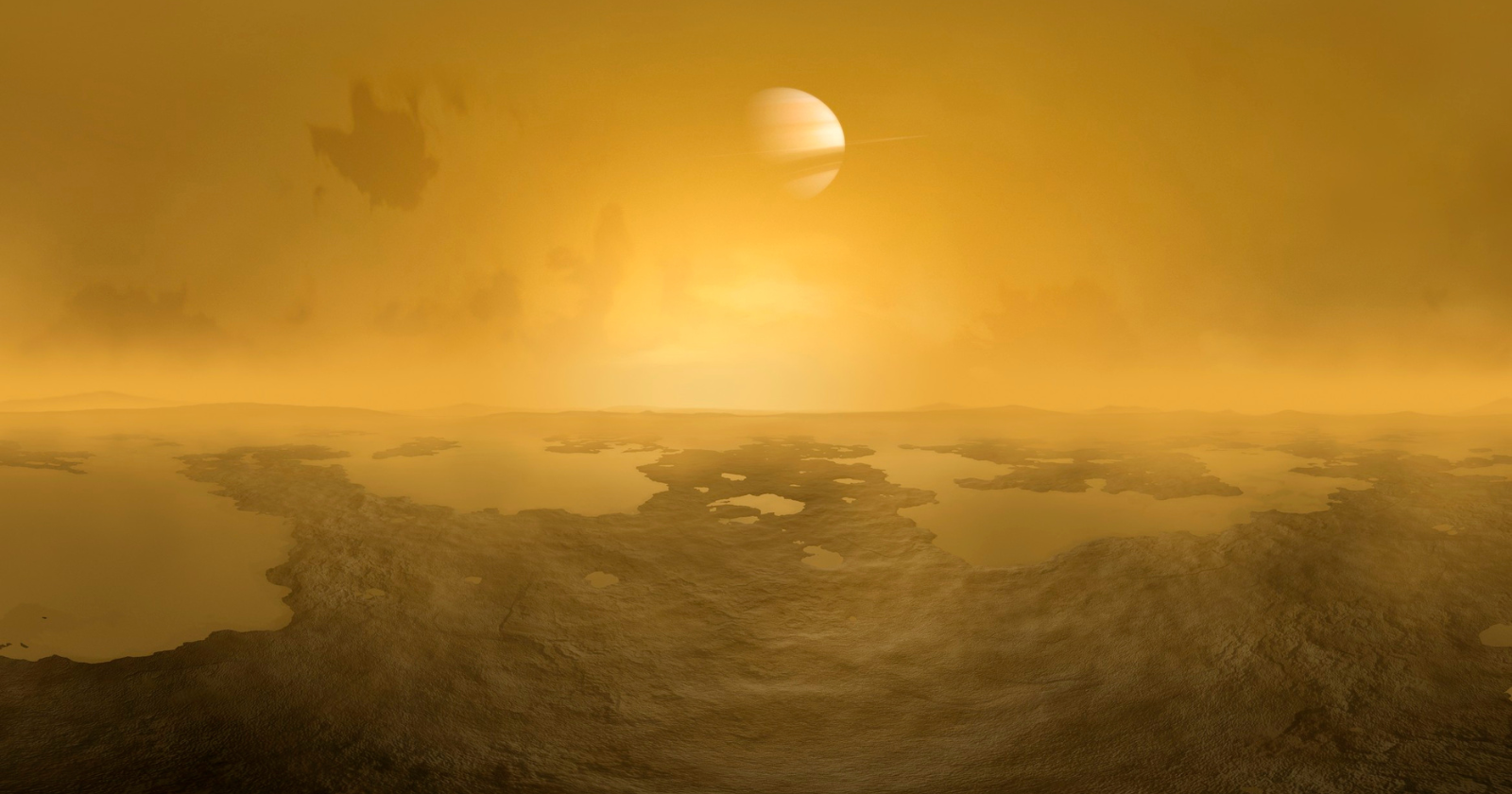
Imagine a winter that starts when you are a child and ends when you are a teenager. Years of the same cold and dim light, lasting for much of a decade before spring even flickers.
On Earth that is impossible. On Titan, Saturn’s largest moon, it is roughly the seasonal calendar, where one season lasts about as long as an entire childhood.
NASA calls it the only moon in the solar system with clouds and a thick atmosphere, and it’s the only planet in our solar system that runs an Earth-like weather cycle with rain, rivers, and lakes.
The catch is that all of it moves at Saturn’s pace, not Earth’s. And that changes what a season even is.
Why Titan has seasons at all
Seasons come from tilt. A world leans on its axis, and as it circles the Sun, first one half and then the other catches more direct light. Earth’s tilt is about 23 degrees. Saturn’s is close behind, its equator tilted relative to its orbit by 27 degrees, so the same basic machinery is in play. Titan orbits roughly along Saturn’s equatorial plane and shares its seasonal schedule, so its seasons ride on Saturn’s slow trip around the Sun.
The math is where things get odd. Saturn takes a 29-year journey around the Sun, and that single orbit is one Saturnian year. Split it into four and each season on Titan lasts about 7.5 Earth years.
Almost everything we understand about this came from a single mission. NASA’s Cassini spacecraft made more than 100 targeted flybys of Titan between 2004 and 2017, and sent the Huygens probe onto its surface in 2005. That is a long mission, and still it covered less than half of one Titan year. Much of what we know is therefore read from a partial record, not the full cycle seen end to end.
What those seasons actually look like
Titan’s weather works like Earth’s rain cycle, but with different chemistry. The surface is so cold that water ice “plays the role of rock”. What flows instead is methane and ethane, the stuff of natural gas. Titan has methane rain, methane rivers, and lakes of liquid hydrocarbons, and some shallow features appear to change as the seasons turn.
Some small northern lakes turned out to be surprisingly deep, more than 300 feet, or 100 meters, and mostly methane. Other shallower ones seem to come and go with the season. Shannon MacKenzie, the planetary scientist who led this work at the Johns Hopkins Applied Physics Laboratory, gave a careful reading of the vanishing ones. MacKenzie said, “One possibility is that these transient features could have been shallower bodies of liquid that over the course of the season evaporated and infiltrated into the subsurface.” One possibility, she says, not the answer.
The dunes tell a slower story. Titan’s equator is wrapped in long sand dunes, some standing around 100 metres high and running for hundreds of kilometres. Cassini radar identified reoriented dunes that diverge by 23 degrees on average from the orientation of the main linear dunes, pointing to winds that shifted over long climate cycles. As for why the dunes thin out toward the north, Alice Le Gall, a planetary scientist at LATMOS in Paris, has offered a hypothesis: as one goes north, she believes, the soil moisture probably increases, making the sand particles less mobile and, “as a consequence, the development of dunes more difficult”.
What makes Titan’s seasons unlike anything else
Plenty of worlds have tilt, so plenty have seasons of a kind. What Titan has that the others lack is a working liquid cycle out in the open. NASA calls it the only other place in the solar system known to have an Earth-like cycle of liquid flowing across its surface. Mars has seasons and dust. Titan has weather that can fill lakes and then empty them.
The more you look, the less settled it gets. Even the most basic question is still open. As Cornell’s Jonathan Lunine, a scientist on the Cassini team, put it, “The most interesting question is why is there still lots of methane in the atmosphere of Titan? Where’s it coming from?” That methane is the fuel for the whole weather system, and its ultimate source remains unclear.
What stays with me about Titan is smaller than the chemistry and bigger than the numbers. It is what the place does to the word “year.” A season there outlasts most of the things we plan our lives around. A person could be born, learn to read, and start school inside a single Titan winter and never see it change. Our calendar feels permanent because it is the only one we have lived inside. Titan is a quiet reminder that the length of a season is an accident of where you are standing, and how far your world must travel to get back to where it started.