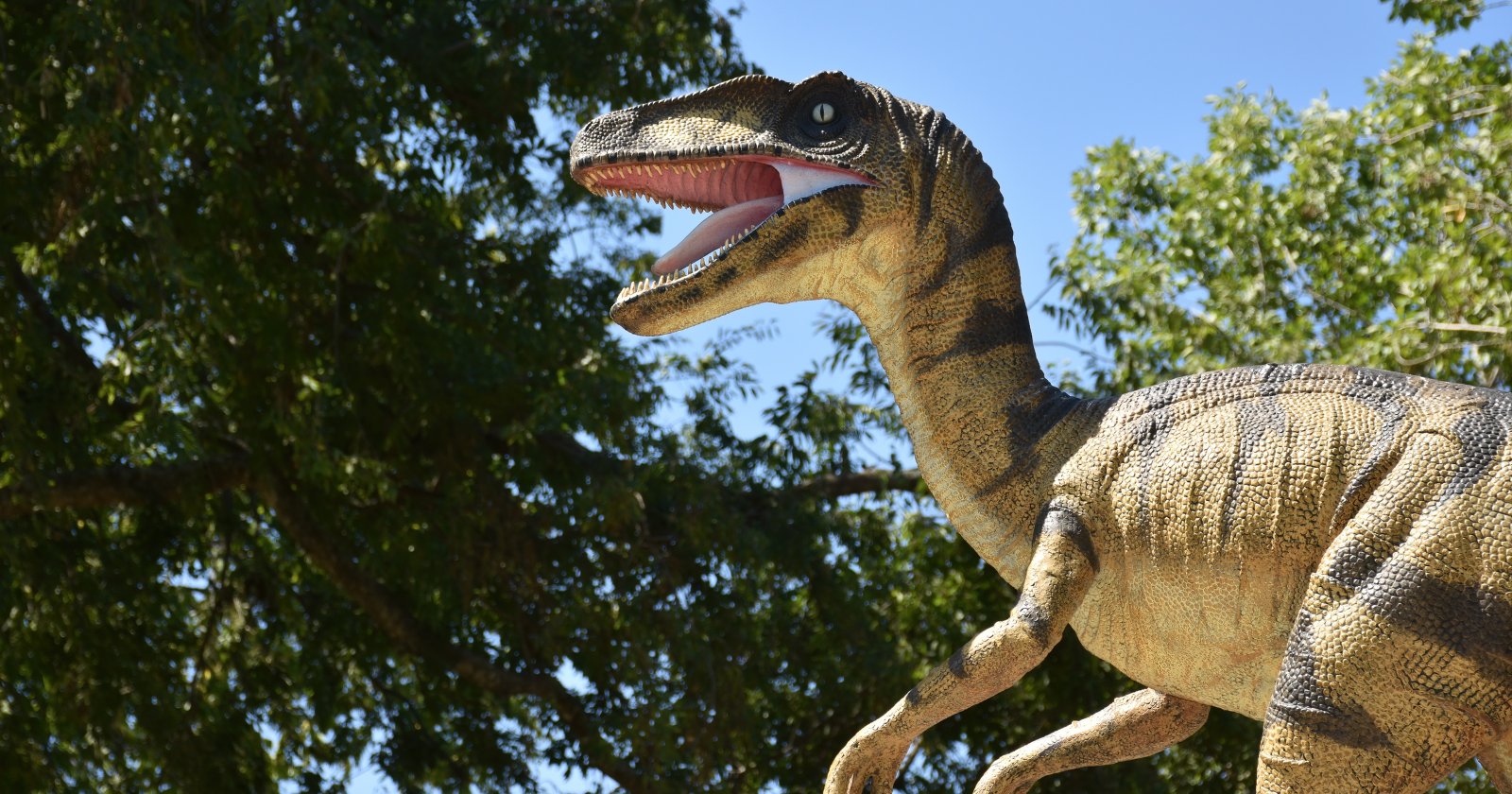
The scene I remember most clearly from Jurassic Park is the kitchen one. It was one of my favourite scenes as a kid, and it still works on me now.
Two children are trapped inside a room of stainless-steel counters and hanging utensils while a pair of raptors quietly work their way through it. They tap their claws against the floor, peer around corners and seem to understand exactly how frightened the children are. They are tall enough to look an adult in the eye, with skin like wet leather and the patience of animals that know their prey has nowhere to go.
I must have watched that sequence dozens of times. The tension is almost unbearable, but it is also beautifully controlled. For years, that was what Velociraptor meant to me. Not a fossil in a museum or a name in a book, but that animal opening the kitchen door.
It is a genuinely great piece of filmmaking. It is also, as a picture of the real animal, heavily distorted.
The real one would not have reached the counter
Velociraptor did exist, and it was a predator. It was just small. Nose to tail it ran about 1.8 metres, but most of that was tail.
One fossil individual was estimated to weigh about 15 kilos. The Natural History Museum, with a fondness I appreciate, files it under “tales of a turkey-sized dinosaur.” That is the honest comparison. Not a person in a lizard suit. A bad-tempered bird about the size of the thing you might roast at Christmas.
The animals in the film were scaled up and reworked for the screen, closer to the relative Deinonychus.
And it had feathers
The second thing the movie missed is stranger.
In 2007 a team led by Alan Turner reported, in the journal Science, that a Velociraptor forearm carried six preserved quill knobs: small, regularly spaced bumps along the bone where the shafts of large feathers would have anchored by ligament. We see the same structures today on the wings of living birds. On this specimen the spacing points to roughly 14 secondary feathers running down the forearm.
The bumps do not mean it could fly. Its body size and relatively short forelimbs meant it lacked the ability to fly. The feathers left a physical mark in the bone, and that mark is still readable tens of millions of years later.
The scaly killer of the kitchen was, in life, closer to a fast, feathered animal with a long stiff tail and an outsized sickle claw on the second toe of each foot, held clear of the ground as it moved.
What stays with me is how hard the wrong picture holds. Palaeontologists have known about the quill knobs for years. The turkey comparison is not fringe; it sits on the museum’s own website. And yet the raptor almost all of us picture is still two metres of scaly menace, because a film got there first and got there brilliantly. A striking image, arriving early, is very difficult to overwrite with a true one that arrives later.