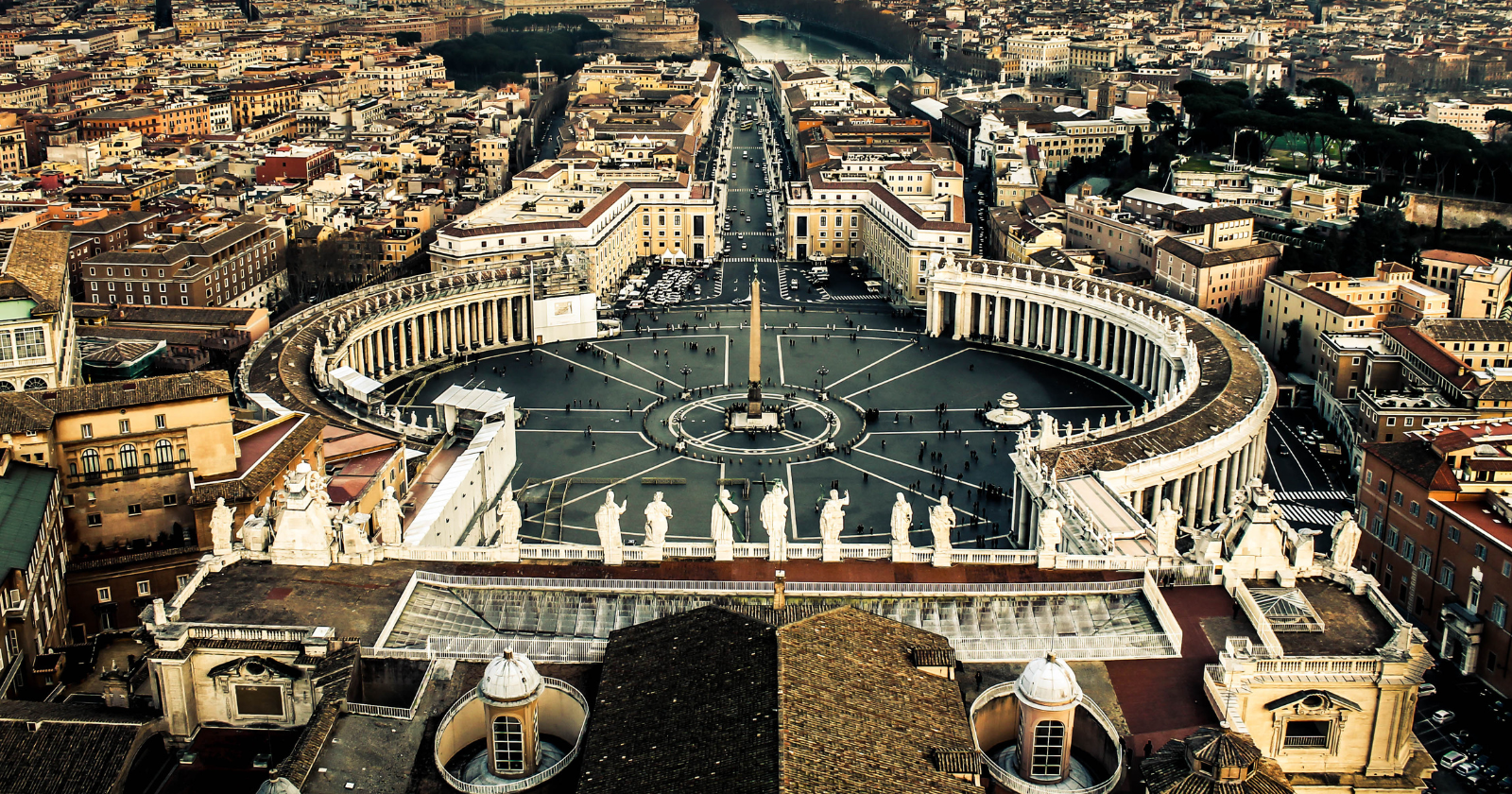
A country you can cross on foot in the time it takes to finish a coffee sounds like a joke. It isn’t.
Vatican City is a real, fully sovereign state. Its land area is 44 hectares, or roughly 0.44 square kilometres. That makes the entire nation much much smaller than New York’s 843-acre Central Park. It sits inside Rome, on the west bank of the Tiber, and you could walk from one side to the other in about fifteen minutes.
What strikes me isn’t the smallness itself. It’s how much statehood has been packed into it.
How a country this small came to exist
The Vatican is younger than you might guess. It was created by the Lateran Treaty, which settled a long dispute called the “Roman Question.” The trouble had festered since Italy took over the Papal States in 1870. For decades the popes refused to recognize the Italian state that had swallowed their old territory, and Italy had no tidy way to acknowledge the pope’s independence. The treaty, signed on February 11, 1929, closed that gap.
It was signed by Benito Mussolini for Italy and Cardinal Pietro Gasparri. The treaty recognized what it called “the full ownership, exclusive and absolute dominion and sovereign jurisdiction of the Holy See over that City.”
In plainer terms: the pope received a small patch of land under his sovereignty.
Mussolini framed it as a win for himself. He reportedly said of the deal, “We have not resurrected the temporal power of the popes; we have buried it.” The idea was that by shrinking the papacy to a walled compound, he had contained it for good. That prediction reads oddly now, given what the Vatican would go on to do with its tiny footprint.
The full apparatus of a state, packed into 0.44 km²
Vatican City is a half-square-kilometre enclave running almost everything a full-sized country runs. It issues its own coins and stamps, along with its own passports. Its postal service was launched on August 1, 1929. The stamps have a reputation among collectors far bigger than the country itself.
Then there’s the military guard: about 135 men in Renaissance-style uniforms. The Pontifical Swiss Guard was founded in 1506 by Pope Julius II, making it one of the oldest military units still serving anywhere. Its authorized strength was raised from 110 to 135 members in 2018. It is often described as the world’s smallest army, although its role is primarily to protect the pope and the Apostolic Palace.
At the top of it all sits the pope, who is head of state in the most literal sense. Vatican City is an absolute monarchy, and the pope holds full legislative, executive and judicial power. There is no other modern state quite like it: an absolute monarchy the size of a golf course, governed by an elected clergyman.
Why the size turns out to be beside the point
If you measured a nation’s importance by its acreage, the Vatican would be a rounding error. That’s the wrong measure, and arguably the whole point of the place.
The Vatican works on two tracks. There is the physical territory, Vatican City State. And there is the Holy See, the central governing body of the Catholic Church, which is what actually conducts diplomacy. Through the Holy See, the Vatican maintains full diplomatic relations with 184 states. It speaks, in a sense, for a church of more than 1.42 billion Catholics worldwide. Very few actual superpowers have a reach like that.
The political scientist Jodok Troy has described the Holy See as “one of the oldest participants in the international society of states,” which is a scholar’s way of saying it has been in the room a very long time. That longevity, more than any measure of land or military strength, is where its weight comes from.
The smallest country on Earth, and its borders are almost certainly the least relevant thing about it. You can walk across the whole sovereign state before your coffee goes cold, but none of that tells you how far its influence actually reaches.