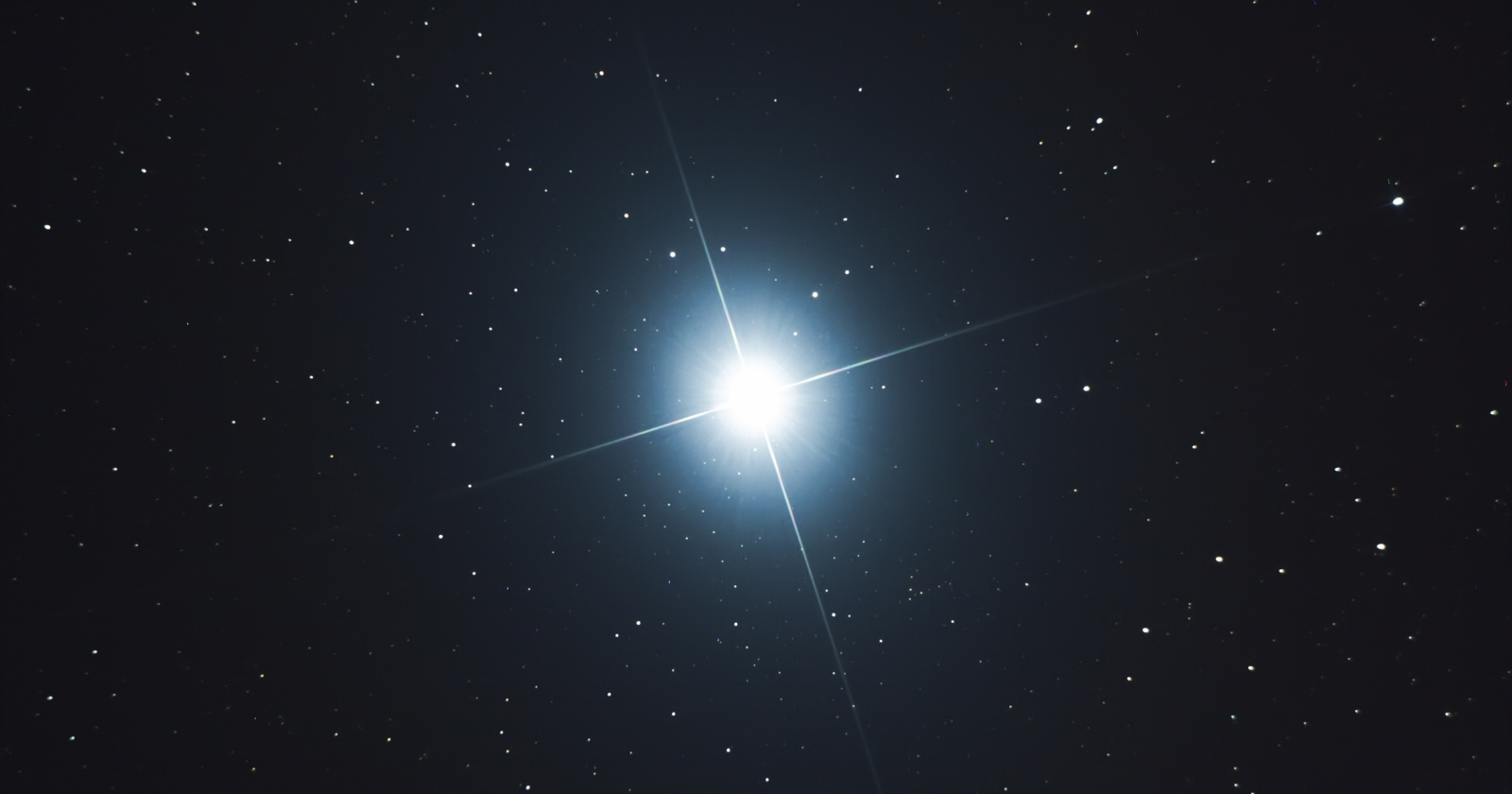
Ask most people to name the brightest star in the night sky and a lot of them will say the North Star. It’s the one they’ve heard of, the one tied to sailors and travellers, the one that supposedly sits at the top of everything. So it feels like it ought to be the brightest thing up there. It isn’t. Not even close. And the gap between the reputation and the reality tells you something about what we actually want from a star.
The mistake is easy to understand. Polaris (the North Star) carries a lot of cultural weight, and in our heads brightness and importance blur together. But the belief is simply wrong, and the correction is old and well established. As Space.com puts it, “The North Star is not the star closest to us, nor is it the brightest star in the night sky.”
What the numbers actually say
Astronomers rate stars on a brightness scale where lower numbers mean brighter objects. Polaris sits near magnitude 2, wobbling a little because its brightness varies over time. That’s respectable, but nowhere near the top. By EarthSky’s count, Polaris is around the 48th brightest star in the sky.
The real champion is Sirius, at magnitude −1.46, the brightest star in the night sky. The gap is bigger than the numbers make it look. By the standard math, Sirius appears roughly 25 times brighter to the eye than Polaris does. The exact figure depends on which magnitudes you use, but the scale is the point: to your eye, Sirius blazes where Polaris merely shows up.
Some of that is distance. Sirius sits about 8.6 light-years away, practically next door in space terms, which flatters how bright it looks. Polaris is much farther, roughly 430 light-years off. It’s actually a genuinely powerful star, putting out far more light than Sirius. It just loses the contest that matters to our eyes: not how bright a star is up close, but how bright it looks from here.
Why it barely moves
What Polaris does have is position. It sits almost directly over Earth’s north pole, only about 0.7 degree from the point in the sky straight above our planet’s spin axis. As Earth turns, every other star seems to swing in a slow circle through the night. Polaris barely moves. It hangs there, close to fixed, while the rest of the northern sky rotates around it.
It won’t hold the job forever, and it didn’t always have it. Earth’s axis wobbles slowly, like a spinning top, on a cycle of about 25,800 years. Over that span the pole drifts across the sky and points at different stars. Polaris is still creeping closer to true north and will reach its nearest point around March 24, 2100, then start to pull away again. The North Star holds the title only for now.
Brightness was never the point
What strikes me here is how neatly the misconception flips what actually matters. We assume Polaris must be brilliant because it’s important, when in fact its importance has nothing to do with how bright it is. Dozens of stars outshine it but not one of them is any use for finding your way, because they all move. Polaris is the one that stays put.
As one group puts it, “Polaris is a superstar in navigation, not in brightness.” My read is that this is the right frame for the whole thing. The sky is full of showier stars, and we could have latched onto any of them. Instead the one we built stories around, the one we taught children to find and sailors to trust, is a modest star that happened to sit in the right place. Usefulness, not spectacle, earned it the name. Once you know that, the brightest star losing to the plainest one stops feeling like a mistake and starts looking like good sense.