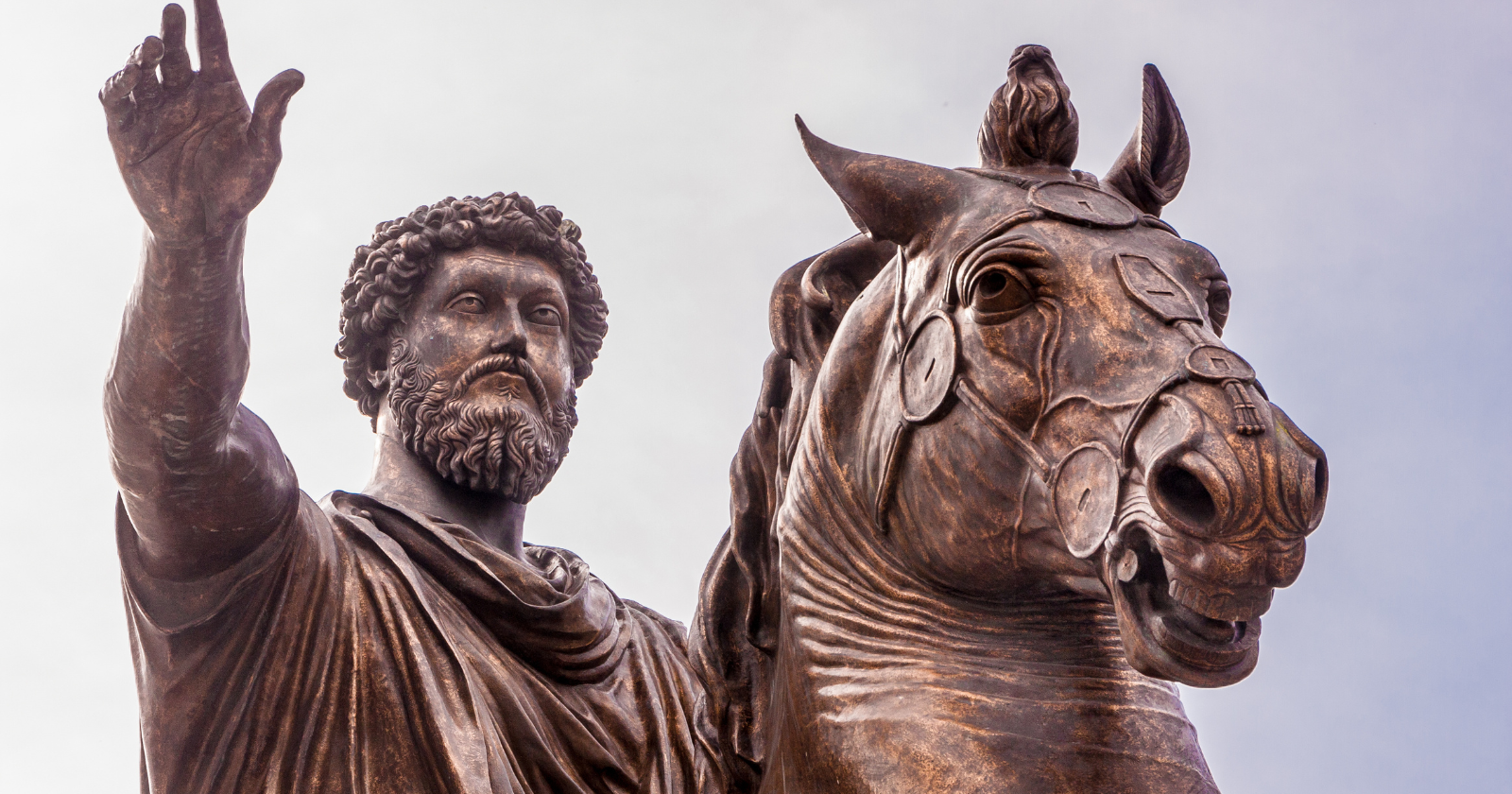
Most of the wisdom we treasure was written to be read. Sermons, essays, letters of advice, the great books on how to live: their authors wanted an audience, and shaped their words to reach one. However, one of the most quoted books of wisdom in the world belongs to none of that. It was written by a man talking to himself, for himself, with no sign that he ever expected anyone else to see a word of it.
That man was Marcus Aurelius, Roman emperor who ruled from 161 to 180 CE and a practicing Stoic. The book is the one we now call the Meditations. And the more you sit with how it came to exist, the harder it is to read it the way we usually read a classic.
Start with the title, because there isn’t an original one we know of. Marcus left the work no known name. The original title, if it had one, is unknown, so Meditations is just one of several labels later readers settled on. The Greek phrase often attached to it, Ta eis heauton, means roughly “to himself,” and even that may be a later addition, not a heading we know Marcus wrote at the top of the page.
The contents match the missing title. There’s no argument being built, no introduction, no reader being led anywhere. As the Stanford Encyclopedia of Philosophy puts it, the work was “written to and for himself”. Repetitions, half-thoughts, the same reminders returned to again and again. It reads like what it probably was: a working notebook.
The work survives in twelve books, written in Greek and probably composed largely while Marcus was on military campaign. The notes inside the text give it away. National Geographic notes that one section is marked as written among the Quadi near the River Gran, another at Carnuntum on the Danube. This was philosophy written in a war camp, by a man carrying an empire through years of battle.
So what was the writing for? The most likely answer is that it was a way of steadying himself under all that weight. The same Stanford entry reads the notes as an emperor trying to live a Stoic life in practice. Marcus never tells us why he wrote, so this is a reading of the text, not something he confessed. But it fits. The notes read like a man coaching himself to face the next day.
Once you accept the book as a private document, small things in it start to look different. Take the way Marcus so often addresses “you.” The psychiatrist and writer Neel Burton argues that the “you” is not a generic reader, but Marcus addressing himself. Read that way, the second person isn’t aimed at us at all. It’s a man giving himself instructions.
Burton is careful about the bigger claim, and rightly so. He writes that “it is unlikely that Marcus intended his thoughts for publication, or, even, for anyone’s eyes except his own.” Unlikely, not impossible.
That’s roughly where the scholarship sits: broad agreement that this was a private text, with an honest margin of doubt around a man dead for eighteen centuries.
What I take from this is a shift in how the book earns its authority. A lot of moral writing is performed. The author knows we’re watching, and there’s always a chance the wisdom is partly for show. Here there was probably no audience to perform for. If Marcus wrote to remind himself not to be angry, he wasn’t polishing a public image of a calm ruler. He was, as far as we can tell, just trying to be a little less angry the following morning. That missing audience is what makes the lines feel unguarded.
And now it is one of the best-known Stoic texts in the world. The book Marcus wrote for one reader has been read by generations he could not have imagined. There’s a quiet joke buried in that, and it’s the kind he might have appreciated: the words he set down only to steady himself have ended up steadying everyone but him.