

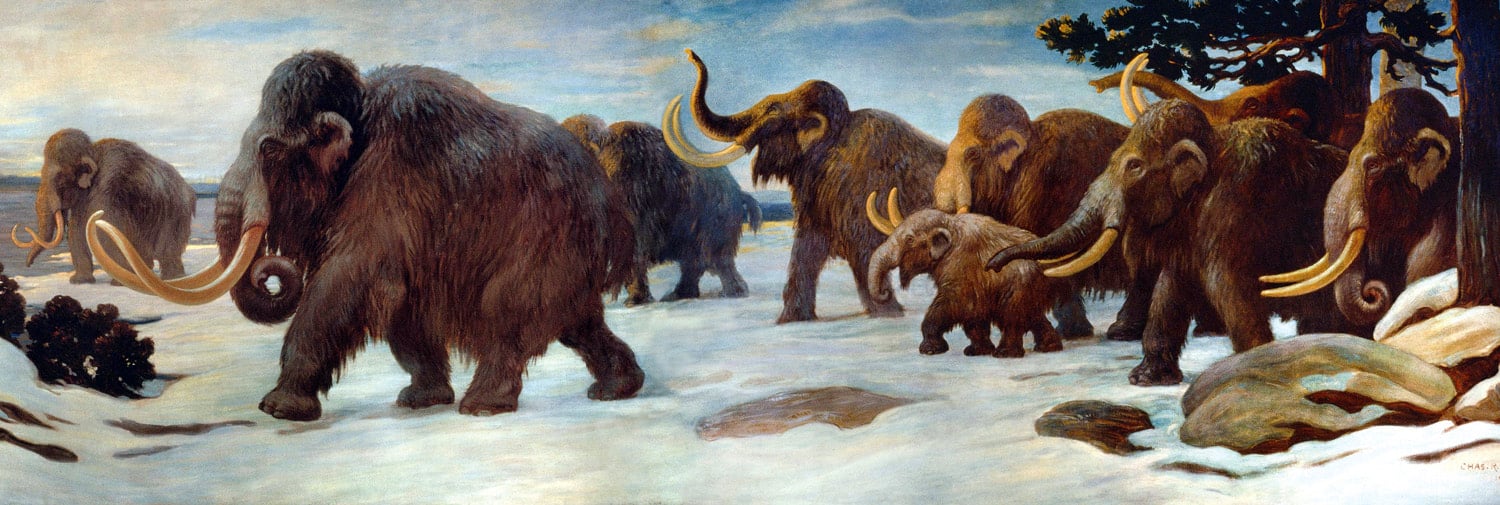
A small group of woolly mammoths clung to a scrap of land off the Siberian coast for roughly six thousand years after the rest of their kind had vanished.
Everything we assume about tiny, isolated, inbred populations says they should have faded out slowly, generation by generation, as genetic problems piled up. Instead they seem to have gone from a stable, healthy population to nothing at all.
Nobody can yet say what killed them.
We are not geneticists or paleontologists, and what follows is our reading of a single genomics paper rather than settled science. It is careful work, but it is one analysis of ancient DNA, and the patterns it describes are signals from long-dead animals, not a final verdict.
A population that should have limped on, but didn’t
Wrangel Island’s mammoths became the last of their species almost by accident of geography. Rising sea levels cut the island off from the mainland around ten thousand years ago, stranding a founding group there. They held on until roughly four thousand years ago, long after mainland mammoths were gone. That is late enough to overlap with the building of the Egyptian pyramids.
The start was brutal. The study team says the island was settled by at most eight individuals, a beginning so narrow it would make any conservation biologist wince. And yet the group didn’t collapse. It grew to 200 to 300 individuals within about twenty generations, then held roughly steady for the rest of its time on the island. A population that recovers and then stays level for thousands of years is not a population dying by inches.
What the 2024 study looked at
The work was published in Cell in June 2024 by Marianne Dehasque, Love Dalén and their colleagues at the Centre for Palaeogenetics.
Rather than guess what mammoth life on Wrangel was like, they read the genes directly. The team analysed 21 mammoth genomes, fourteen from the Wrangel population and seven from mainland mammoths that lived before the island was cut off. Together the samples covered about 50,000 years of the species’ history.
Reading genomes across that span lets researchers watch a population’s genetic health change over time, almost like time-lapse. They can see diversity shrink, count how many harmful mutations are carried, and estimate how large the breeding population was at each point. What they found on Wrangel wasn’t a slide toward collapse. The genetic signal stayed close to flat.
Why “inbreeding killed them” turned out to be wrong
The story many people assumed for years, was that a tiny inbred group slowly poisoned itself. Low diversity, harmful mutations building up, immune defences weakening, until it couldn’t sustain itself. The Wrangel mammoths were genuinely inbred, with low diversity and a gradual buildup of mildly harmful mutations. On the surface, the tidy story fit.
The genomes tell a more interesting version. The population shed its most dangerous mutations, the kind that kill or badly harm, even as it slowly picked up milder ones. The breeding population size didn’t drift downward over the millennia either. It held. That is the finding that breaks the slow-decline theory. As Dalén put it, the researchers can now “confidently reject the idea that the population was simply too small and that they were doomed to go extinct for genetic reasons.”
That is the study’s conclusion, not a universal law. Rejecting a theory is not the same as closing the case. But it is a strong result, and it flips the question. If genetics didn’t kill them, what did?
So what did happen?
Here honesty replaces certainty. The genomes clear inbreeding as the culprit but don’t name a replacement. Dehasque says the near-stable genetic picture “suggests that something else, and very sudden, caused the population to collapse.”
The likely causes are the kind of thing genes can’t record. A disease sweeping through a group with weakened immune defences. Or something environmental and abrupt. Dalén floats several possibilities: “something like a tundra fire, a volcanic ash layer or a really bad weather season could have caused a really bad growth year for the plants on Wrangel. Given how small the population was, it would have been vulnerable to such random events.” Each of those is a guess, not a finding, and he offers them as maybes.
One thing the team does rule out is us. Hunting doesn’t work as an explanation, because the archaeological evidence shows “humans only arrived 400 years after mammoths went extinct.” Whatever finished them off, it wasn’t a spear.
Dalén’s own framing is worth pausing on, precisely because he flags it as speculation. If the trigger really was some chance event, he said, “it was probably just some random event that killed them off, and if that random event hadn’t happened, then we would still have mammoths today.” That last part is a what-if no one can test. But it captures how much may have come down to luck.
Why the mystery matters now
There’s a practical reason to care about a population that vanished four thousand years ago. Conservation programs today spend enormous effort rebuilding the numbers of endangered species, on the reasonable assumption that a bigger population is a safer one. The Wrangel mammoths complicate that. Their numbers recovered, yet they still carried the genetic marks of that first tiny group for thousands of years afterward.
Dehasque draws the lesson out directly. She argues that “it’s important for present-day conservation programs to keep in mind that it’s not enough to get the population up to a decent size again; you also have to actively and genetically monitor it because these genomic effects can last for over 6,000 years.” That six-thousand-year figure comes from this one case, so treat it as what the mammoth data showed rather than a proven rule. The larger point stands: getting the headcount back up doesn’t automatically mean the genetic health has recovered too.
Genomes are extraordinary records, but they have blind spots. A disease outbreak, a bad winter, a freak fire — none of these leaves a clean genetic fingerprint, especially when it strikes fast. And the study has a literal gap: the final 300 years before extinction weren’t covered by the genomes analysed.
The mammoth story ends not with an answer but with a door left open. The genes have done what genes can do: cleared the old theory and left the harder question standing. Dalén isn’t ready to give up: “I would say there is still hope to figure out why they went extinct,” he said, “but no promises.” Those last fossils may be where the answer is hiding.