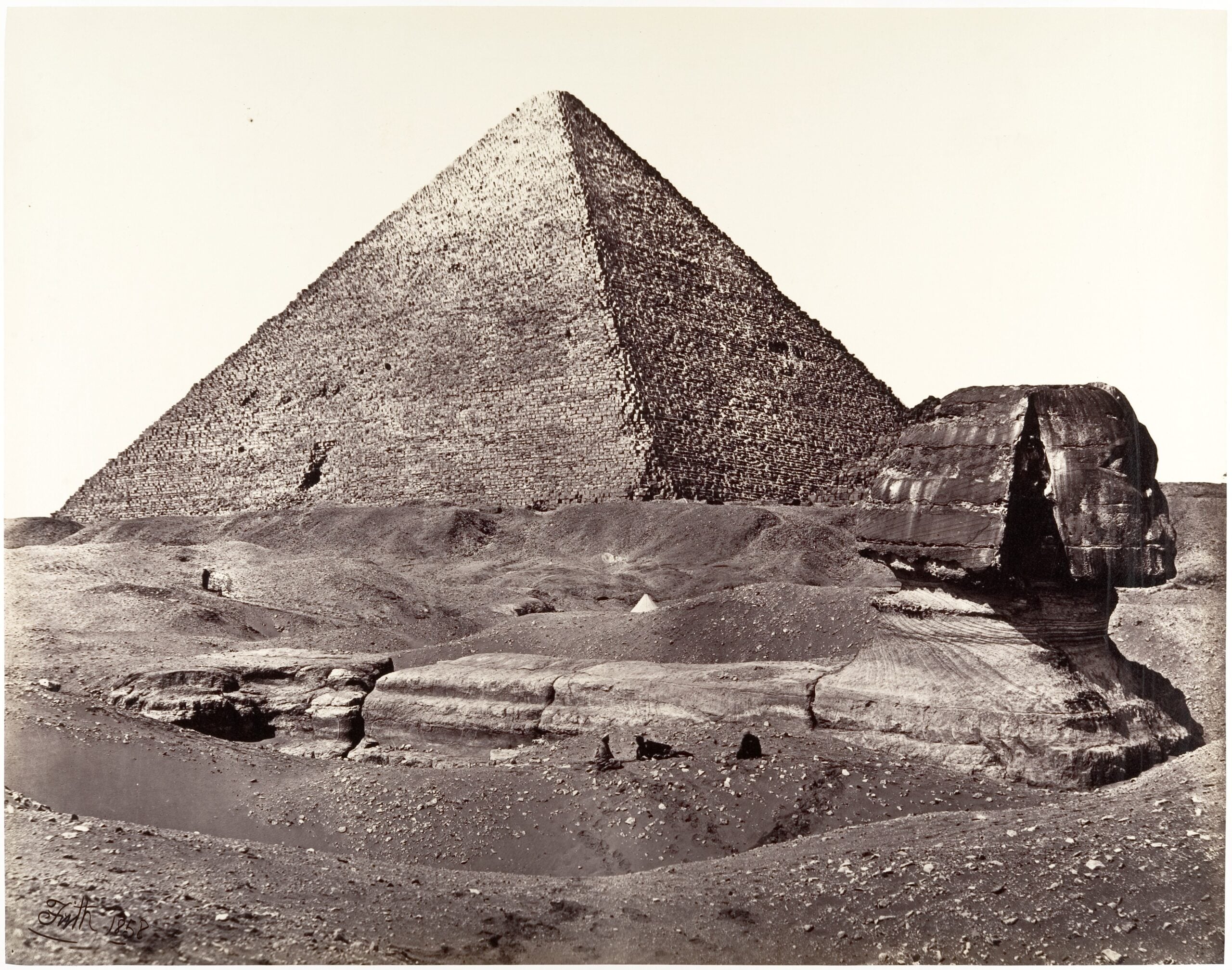
The Great Pyramid of Giza is built from something like 2.3 million stone blocks, averaging about 2.5 tons each, and it took roughly 20 years to build. Divide one number by the other and the pace reads like a typo. A block set, then the next, then the next, every few minutes, for two decades without stopping.
It isn’t a curiosity about one heavy rock. It’s a claim about a whole human system holding a steady tempo, day after day, for longer than most modern building projects, with no engine anywhere in the chain.
The math is almost embarrassingly simple, which is part of what makes it land. A 2025 paper in npj Heritage Science lays out the standard figures: about 2.3 million blocks of around 2.5 tons each, and a required pace of roughly one block every one to three minutes across a 20-year build of long working days. Squeeze the schedule and it gets worse. The same paper notes that a 10-year build would need a block set every 30 to 90 seconds.
The blocks weren’t uniform, either. The lowest rows carry stones reaching around 10 tons or more, so “some weighing several tonnes” isn’t rhetorical. All told, laborers moved into position six and a half million tons of stone.
What that pace really describes isn’t a single feat of strength. It’s a feat of scheduling, repeated a couple of million times.
A block every few minutes only works if you stop picturing one crew doing it all. Nobody was setting a stone, catching their breath, and setting the next. The pace is an average across a whole site working at once, with many teams quarrying, hauling, shaping, and placing in parallel, so the finished total climbs at that headline speed even though no single person is moving that fast.
That reframing is what modern Egyptology has spent decades building. The old image of whip-driven slaves has been replaced with evidence of an organized, housed, and fed workforce. Egyptologists Mark Lehner and Zahi Hawass estimate the peak labor force at 20,000 to 30,000 people. Not all of them were lifting stone. Vaclav Smil’s energy-based calculation for IEEE Spectrum puts the core stone-raising and placing crew at only about 3,300 workers, far from the 100,000 men the ancient historian Herodotus reported working in three-month shifts.
Perhaps the most intriguing evidence for how the tempo held came out of the ground fairly recently. In 2013, the French Egyptologist Pierre Tallet dug up a set of papyri at Wadi al-Jarf, the oldest known papyri in the world. Among them was the journal of an official named Merer, who led a crew of some 200 men and recorded ferrying fine limestone by boat to the Great Pyramid. It’s a logistics record, dated to the 27th year of Khufu’s reign, describing the movement of stone in plain administrative terms.
Where the workers slept has also come into focus. Lehner’s team dug up long stone galleries near the pyramids and reads them as living quarters. “We now see the enigmatic rows of long galleries…as barracks housing for a rotating labor force, perhaps as large as 1,600 to 2,000 workers,” he has said, careful to call it a working hypothesis rather than settled fact. Standing in one of them, he reportedly put it more bluntly: “This is a hell of a barn!” What interested him was less the stone than the society it required. His larger argument, and it’s his interpretation rather than consensus, is about “how the pyramids built Egypt”: that organizing the workforce may have done as much to shape the state as the state did to shape the pyramid.
The build itself was probably more clever than brute. Most modern scholars think the blocks were moved with ramps and sledges rather than any single heroic lift, and the recent npj Heritage Science paper argues the internal passages themselves may have doubled as sliding ramps for counterweights. Whatever the exact method, the common thread is doing many things at once so the average holds.
What we still don’t know
The rate calculation, honestly, is the easy part. You can do it on the back of an envelope, and every serious source lands in roughly the same range.
What none of the math answers is the harder question underneath it: how a single human organization, with no machinery and no written management theory we’d recognize, held that cadence for the better part of a generation.
Consider what the pace assumes. Quarries feeding the site without running dry. Boats arriving on schedule. Ramps maintained. Thousands of workers fed, housed, rotated, and replaced as they tired or died, all without the whole tempo collapsing when any one link failed for a season. Merer’s journal gives a single thread of that operation for a few months of one year. The rest is guesswork. I find it hard to believe we’ll ever fully reconstruct the day-to-day of it, and the papyri, for all they reveal, mostly sharpen the question rather than answer it.
So the number that stops you cold turns out to be the part we understand best. Set a block every few minutes for twenty years, and the strain isn’t on any one back. It’s on the organization that had to keep that rhythm going, on schedule, in the sun, for two decades, while the thing it was building slowly blotted out the horizon.