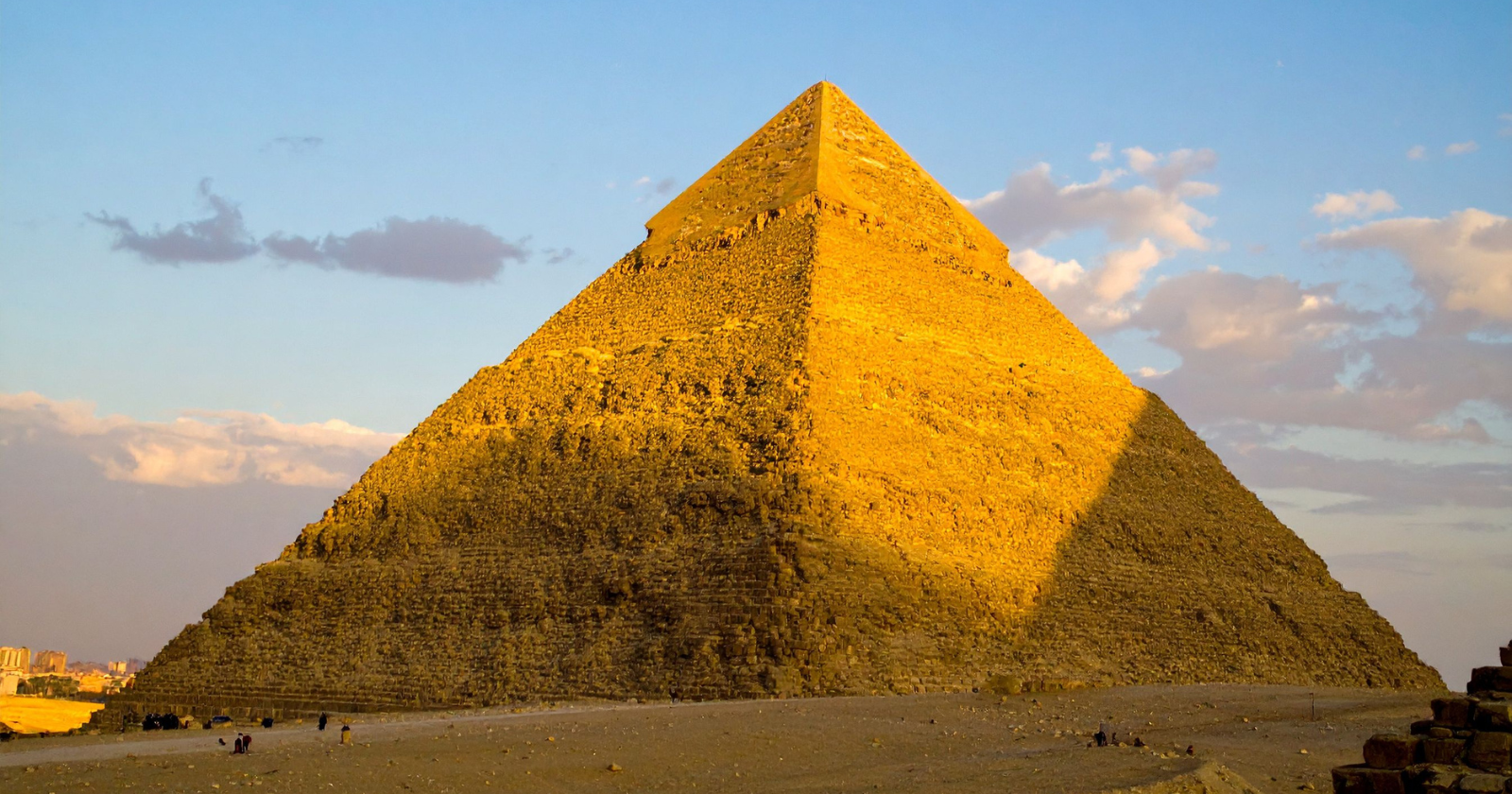
Ask anyone to describe the Great Pyramid of Giza and you get the same shape: four smooth triangular faces meeting at a point, a square base. And that was probably close to how the finished monument looked.
Its surviving surface, however, is more complicated.
The exposed stone core of each face has an irregular groove running down its centre, from near the summit to the base. In favourable light, that groove can make each triangular face appear divided into two, giving the pyramid the look of an eight-sided figure.
What everyone assumes, and why it holds up so well
The assumption of four flat faces is reasonable because the pyramid was originally covered in smooth limestone casing. A surviving row of casing stones at the base of the north face forms a straight line, evidence that the finished exterior was flat rather than deliberately folded into eight planes. Most of that casing was later removed, exposing the much rougher core masonry underneath.
From the ground, the central grooves are difficult to read as a single geometric feature. A face of the pyramid is more than 230 metres wide at the base, and the exposed blocks are heavily weathered and damaged. In grazing sunlight, however, one side of a groove can fall into shadow while the other remains bright, producing a striking line down the face.
What Flinders Petrie noticed from the ground
The archaeologist and surveyor W. M. Flinders Petrie described it in his 1883 survey of Giza. Looking at the exposed core, he wrote that the faces were “very distinctly hollowed” and that each side had “a sort of groove specially down the middle of the face.”
A 2022 review by Egyptologist Franck Monnier, drawing on laser scanning and 2018 photogrammetry, found that the profiles are far from uniform. Some courses are barely recessed, others are much deeper, and the maximum recession exceeds two metres in places.
That distinction matters. Petrie was examining the bare core, not the smooth outer casing that once covered the pyramid. He even suggested that the casing had become thicker along the midline to compensate for the hollowing underneath. The visible grooves therefore tell us about the exposed core and its later condition, not necessarily the intended outline of the completed monument.
The 1926 photograph that made the effect famous
The feature became widely known through an aerial photograph taken in 1926. Brigadier General P. R. C. Groves of the British Royal Air Force photographed the Giza pyramids at sunset around the autumnal equinox. The image, published in National Geographic that September, showed part of the Great Pyramid divided sharply into light and shadow. Akio Kato’s 2023 paper reproduces the photograph .
Why the grooves exist at all
Here the confident story runs out. The grooves are real, but whether they reflect an ancient construction method or later damage remains disputed.
Kato argues that the concavity could result from courses of stone sloping inward toward the centre of each layer. He proposes that such an arrangement helped the structure resist gravity, earthquakes and rain over long periods. In his interpretation, the exposed core can reasonably be described as a concave octagonal pyramid.
Monnier reaches a different conclusion. His photogrammetric analysis found a chaotic rather than systematic pattern, which he argues is inconsistent with a deliberate eight-faced design or a carefully repeated structural technique. He points instead to the removal of the fine Tura limestone casing from the Middle Ages onward. Quarrying, falling stones and weathering damaged the core most heavily near the centres of the faces, leaving the irregular furrows visible today.
What remains certain is narrower than the popular claim. Each exposed face has a central recessed zone that can split into light and shadow, creating a remarkable eight-sided appearance. What has not been demonstrated is that the Great Pyramid was originally designed as eight precise, flat faces. Its present shape records both ancient masonry and centuries of alteration — and the right light can make that complicated history look like perfect geometry.