

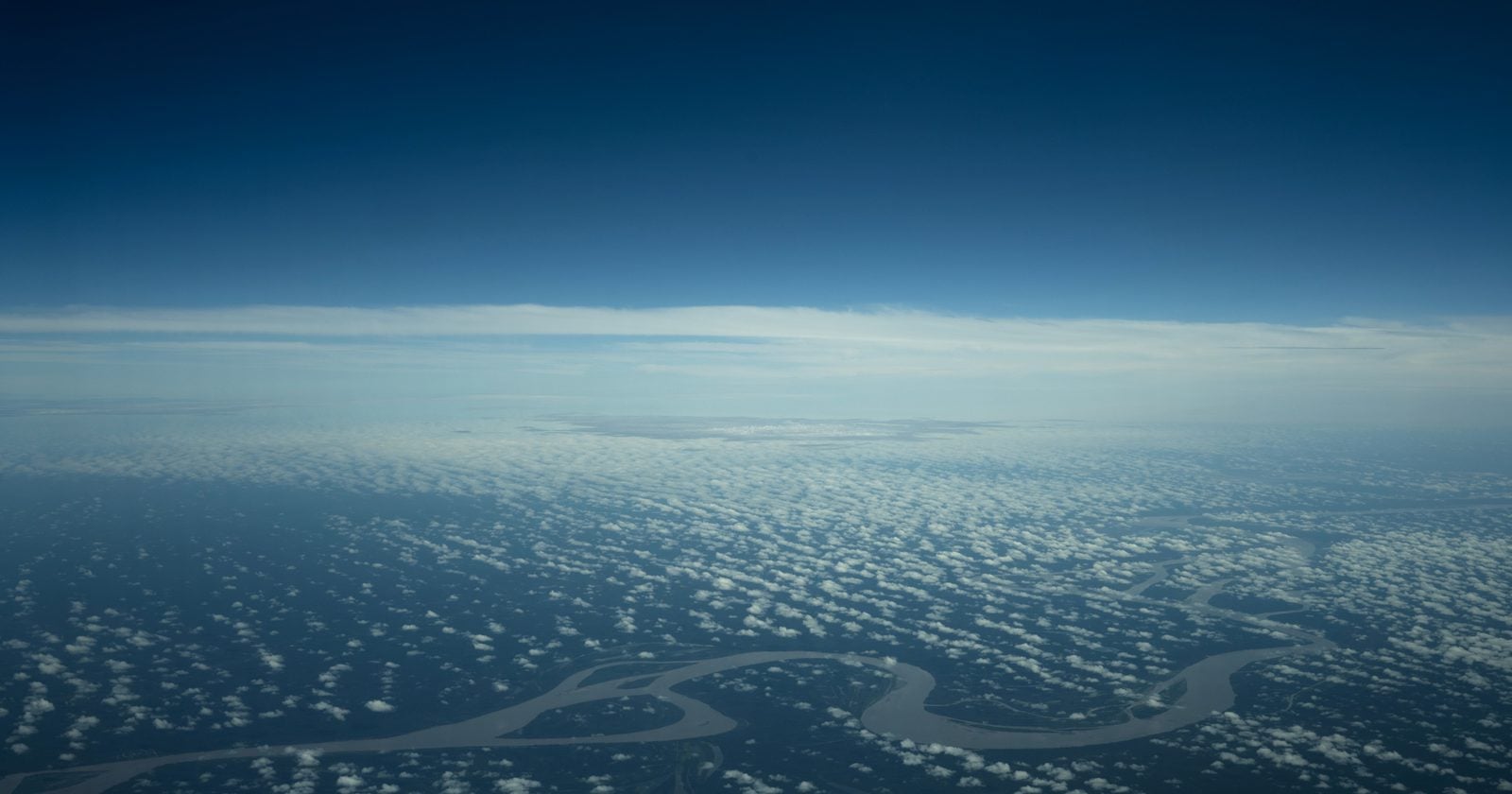
The commonly cited figure is an average of more than 200,000 cubic metres per second, and it holds a record no other river comes close to touching: the Amazon moves more water than the next seven largest rivers on Earth put together. The only way to feel how far ahead it sits is to line it up against the rest.
What 212,000 cubic metres a second looks like
Discharge is the amount of water passing a point in a given time. For the Amazon, the raw scale is hard to hold in your head, so comparison does the work. The river’s flow runs roughly five times that of the Congo and twelve times that of the Mississippi, according to the Amazon Conservation Team.
Where the channel narrows, the current speeds up and the figures climb. Natural Resources Canada puts the average at 212,000 cubic metres a second. Older United States Geological Survey surveys put the flood peaks far higher, with one 1953 flood at Óbidos reaching some 350,000 cubic metres a second.
The flow rises and falls with the seasons, so any single reading is best treated as a snapshot. But the picture holds: more than 200,000 cubic metres a second, moving through a channel that narrows to little more than a mile.
The Amazon against the next seven combined
The Congo, the world’s second-largest, averages about 39,600 cubic metres per second, per Natural Resources Canada. The Orinoco runs around 37,000 cubic metres per second, with the Yangtze near 31,900 and the Madeira near 31,200. The Mississippi, the largest river in North America, manages about 17,300.
Add all of those together, along with the other top-ranking rivers, and the combined total still falls short of the single flow leaving the Amazon’s mouth. The gap between first place and second is not small — it is a different order of magnitude, and that is what makes the Amazon unusual even among giant rivers.
Why the Amazon and not the Nile or the Mississippi
A river’s discharge comes down to two things: how much rain falls in its basin, and how big that basin is. The Amazon wins on both.
Its drainage basin covers roughly 7,050,000 square kilometres, the largest on Earth, and drains approximately 38 percent of continental South America. That is an enormous funnel, sitting in the wet tropics where rain is generous. In the central lowlands, yearly rainfall runs into the thousands of millimetres. The city of Iquitos in Peru gets an average of about 2,623 millimetres a year, per WWF, and on the Andean slopes it climbs far higher.
Geography also keeps the water in. The mountains along the western edge act as a wall. To the west, the Andes form a natural barrier that prevents most of the warm, moist air from leaving the Amazon Basin. What strikes us is how much of the rain the basin makes itself. Researchers have estimated that about one-third of Amazon rainfall originates within the basin, with much of that recycled moisture having passed through trees. Moist air arriving from the tropical Atlantic is repeatedly replenished as the forest returns water to the atmosphere through evapotranspiration; that moisture can then fall again farther downwind as rain. A PNAS study similarly notes that Amazon rainfall is maintained in part by forest evapotranspiration.
The Nile drains an enormous basin too, but its water balance is very different. NASA describes the Nile Basin as intensely evaporative, with most of the water falling there as rain leaving through evaporation rather than river flow. A global evapotranspiration analysis likewise estimated that about 82 percent of Nile Basin precipitation is lost through evapotranspiration, compared with about 48 percent in the Amazon Basin. That helps explain why two vast drainage basins can produce rivers of such dramatically different size.
What happens when it hits the Atlantic
All that fresh water does not simply vanish into the salt. Being lighter than seawater, the outflow spreads across the surface as a low-salt layer that scientists track from space. This plume can stretch hundreds of kilometres into the Western Tropical Atlantic, forming a barrier that marine animals struggle to cross.
The Amazon’s reach extends well beyond that plume. It delivers something like 15 to 16 percent of all the fresh water the world’s rivers pour into the ocean, and Natural Resources Canada puts it at more than one-sixth of the world’s total river discharge.
The standard 212,000 figure is also the conservative one. As more measurements have come in, the average estimate has been pushed up into the 215,000 to 230,000 cubic metres per second range. Which number you cite depends on the source and the years measured.
Either way, the river carries so much water that a ship’s crew hundreds of kilometres out to sea, well past any sight of land, could in places draw up water fresh enough to drink, delivered there by a river they cannot see.