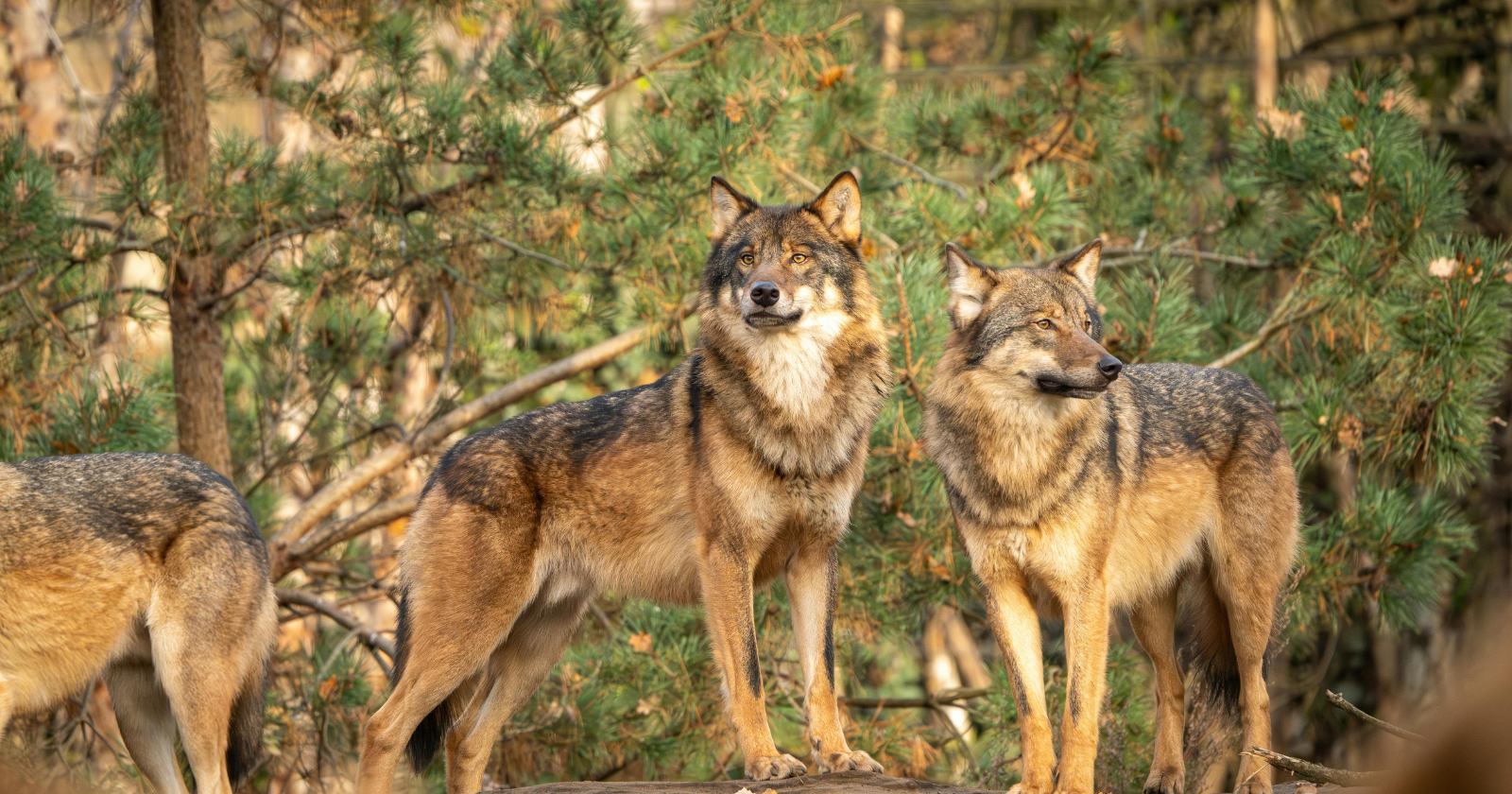
Scroll through social media for long enough and you’ll probably find some male influencer explain the world in terms of alphas and betas. The alpha leads, dominates and takes what he wants; the beta follows. The language sounds like hard biology, borrowed from the natural order of wolves.
The problem is that the “alpha wolf” as a permanent pack boss doesn’t really exist in a typical wild pack.
The idea comes largely from watching the wrong wolves. In the middle of the last century, researchers studied packs that had been assembled in captivity: unrelated adults, strangers to one another, penned together with nowhere to go. Those animals did jockey for rank, sometimes viciously. Scientists watched, called the animals on top alphas, and a whole theory of dominance was born. The flaw was the enclosure. It was less a wolf pack than a wolf prison, and the fighting said more about the cage than about wolves.
In the wild the picture is much more familial by comparison. A pack is usually a breeding pair and their offspring from the past two or three years, living and hunting together until the young ones are old enough to leave and start families of their own.
Packs can sometimes include unrelated wolves or more than one breeding pair, but the “alpha male” and “alpha female” that people picture squaring off for supremacy are generally simply the mother and father. The younger wolves follow them for the same unremarkable reason young children follow parents. They are the parents.
One of the people most responsible for spreading the alpha language later became its most determined critic. David Mech is a veteran wolf biologist, and his 1970 book helped fix the word “alpha” in the public mind. Then he went and watched wild wolves for a very long time. Starting in 1986 he spent time observing wolves on Ellesmere Island in the Canadian Arctic, and what he saw was a family raising its young, not a court of rivals plotting a coup.
By 1999 he had published a paper arguing that “alpha” was the wrong word for a typical natural pack, and he has been trying to walk it back ever since, including campaigning for his own older book to be taken out of print.
His way of putting it has stuck with me. What, he asked, would be the point of calling a human father the alpha male? He is just the father of the family. That, Mech says, is exactly how it usually works with wolves.
I find the shape of this more interesting than the wolf fact itself. A scientist popularizes an idea, discovers through patient work that it is wrong, and then spends decades of his career trying to undo it. That is science behaving well. The harder part is that the correction has not really landed where it matters most.
The “alpha” wolf did not stay in the woods. It walked straight into human life, where it now props up a small industry of advice about dominating the room or establishing your place at the top of the hierarchy. The whole frame borrows its authority from an animal that, in a typical wild pack, does no such thing.
None of this makes wolves soft. A pack is a formidable, coordinated hunting unit, and the parents guide it. But leading a family is a different thing. The word we borrowed to describe strength turns out, when you actually watch the animals, to be a word about looking after your kids.