

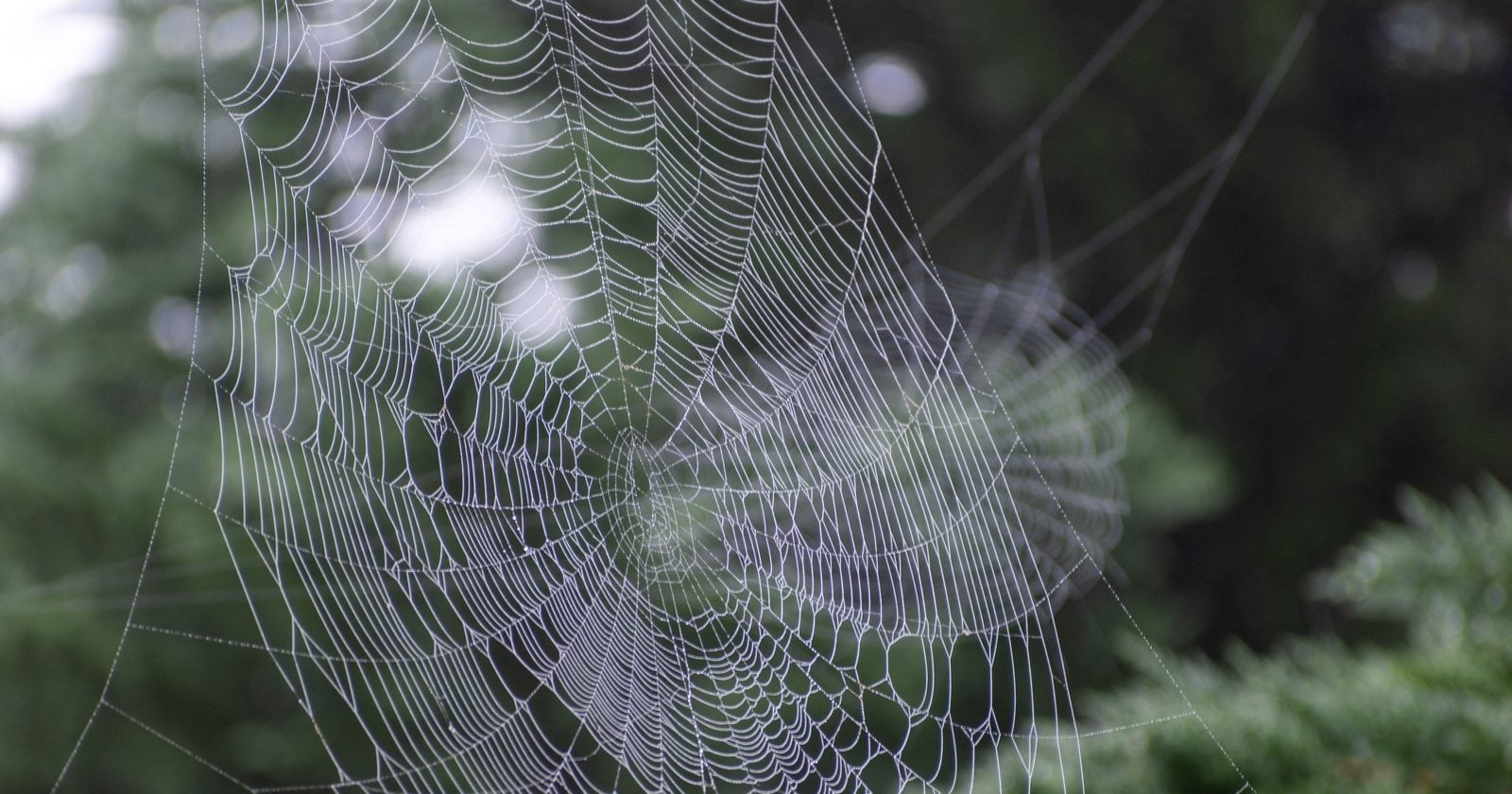
Most of us file spiders under one of two headings. Either they are pests to squash or usher out of the bathtub, or they are irrelevant, a bit of background wildlife that has nothing to do with anything.
Most of us miss the more interesting story. As a group, spiders are running one of the largest predation operations on the planet, and almost none of it happens where you can see it.
Every year, the world’s spiders kill somewhere between 400 and 800 million tonnes of prey. The low end matches everything the entire human species eats in meat and fish. The high end is about double it.
That figure comes from a single modeled estimate, so it is worth holding loosely rather than treating as a settled count. But the estimate is careful, peer-reviewed, and the scale it lands on is hard to ignore.
What the 2017 study estimated
The figure comes from a paper by Martin Nyffeler at the University of Basel and Klaus Birkhofer, then at Lund University, published in The Science of Nature in 2017. They did not go out and weigh dead insects. They built the number in two steps.
First, they used data from 65 earlier studies to estimate how much spider there is in the world. The answer: around 25 million tons of spider across seven major habitat types.
Then they worked out how much all that spider has to eat, using two separate methods. One started from what spiders need just to stay alive, given how densely they pack together. The other started from how much prey spiders are actually seen catching in the field. Both routes landed on the same broad answer: between 400 and 800 million metric tons of prey a year. There are more than 45,000 known spider species, and in some places they reach a thousand individuals per square metre, which is part of how the total climbs so high.
“Our calculations let us quantify for the first time on a global scale that spiders are major natural enemies of insects,” says Nyffeler. The “for the first time” reflects the study’s own framing of its novelty, but the ambition of the calculation is clear.
The comparison that reframes them
A number like 400 to 800 million tonnes floats without a yardstick. So the authors picked one. Humans eat roughly 400 million tons of meat and fish a year, the FAO figure the study uses for comparison. That is why the low end of what spiders kill matches everything the human species puts on its plate, and the high end roughly doubles it.
The authors line spiders up against other big eaters too. The world’s whales eat an estimated 280 to 500 million tons of prey a year, and seabirds around 70 million tons. Spiders, a group most people never think of as a heavyweight predator, sit at the top of that list, while weighing about 25 million tons all together, roughly a sixteenth of what they kill. These are efficient, hungry animals.
Why it’s a range, not a single number
The gap between 400 and 800 is wide, and that is the honest part of the study rather than a flaw in it. The press release explains that the range is broad because how much prey spiders catch varies considerably from one ecosystem to another. A patch of tropical forest and a wheat field are not doing the same job at the same rate, so any single global figure has to cover that spread.
This is one modeled estimate built from field data, not a headcount, and it is best read that way: a serious attempt to size something no one had sized before, not the final word.
What they’re actually eating
The prey is not what most people picture. More than 90 percent of what spiders catch is insects and springtails, tiny soil-dwelling creatures most of us have never knowingly seen. Most of that hunting happens far from us. Spiders in forests and grasslands account for more than 95 percent of the global kill, while spiders on crop fields contribute less than 2 percent.
That split matters. It means the huge scale of spider predation runs across wild and semi-wild land, holding down insect numbers in places no one is managing. Nyffeler argues that “in concert with other insectivorous animals such as ants and birds, they help to reduce the population densities of insects significantly,” and that “spiders thus make an essential contribution to maintaining the ecological balance of nature.” Those are his read of what the numbers imply rather than proven law, but the modeling behind them suggests spiders are doing a great deal of unpaid work.
The reason none of this registers is built into how spiders live. They are secretive, often active at night, tucked into leaf litter, bark, and soil. You see the web in the doorway and the one spider that spun it. You do not see the thousand per square metre elsewhere, or the hundreds of millions of tonnes of insects that never made it to your kitchen. The next time one turns up in a corner and you reach for a shoe, it is worth remembering that the animal you are about to evict belongs to one of the most productive teams of insect-hunters on Earth, and it has been working the whole time you weren’t looking.