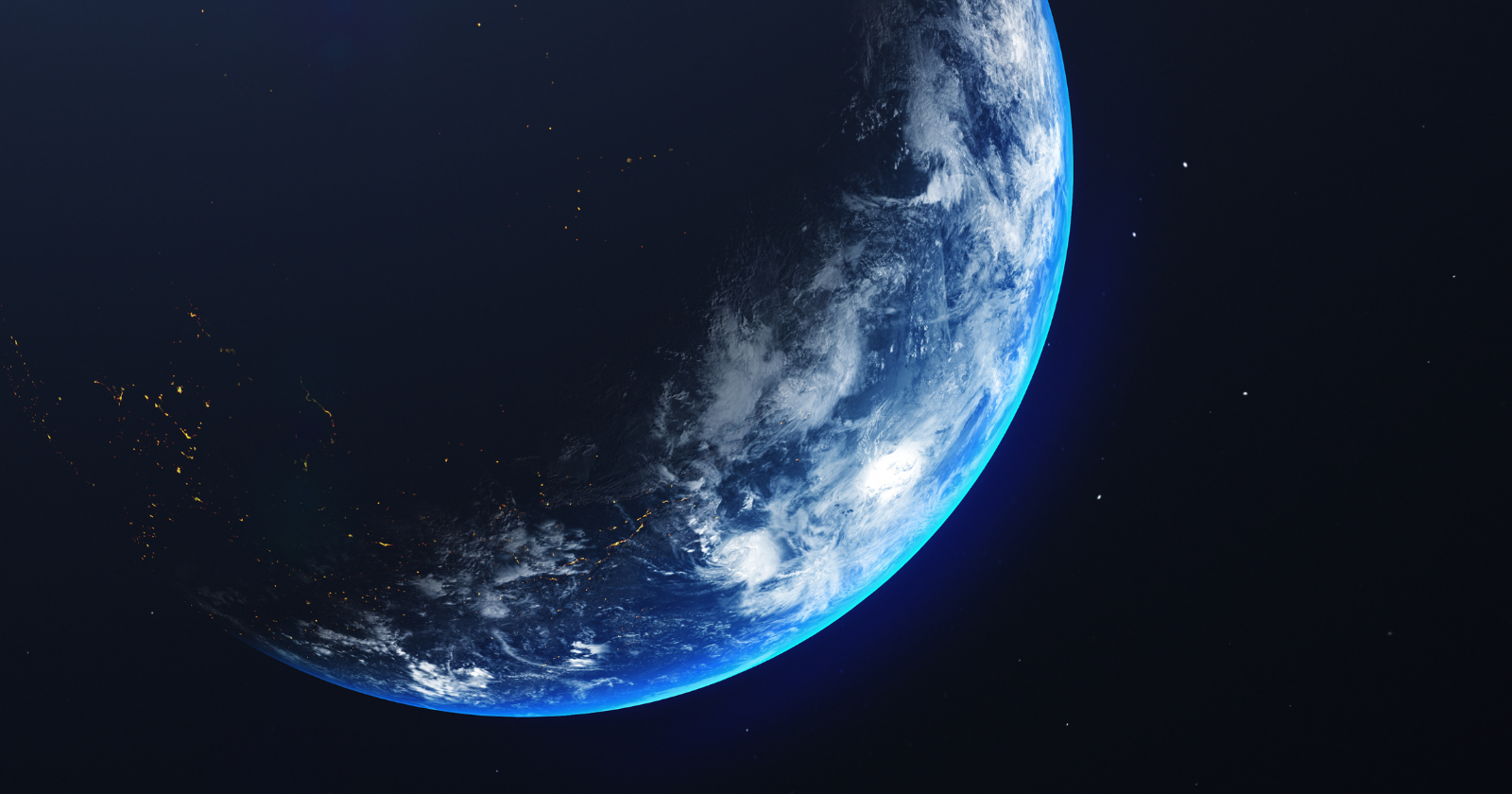
NASA astronaut Christina Koch, a NASA astronaut selected for the Artemis II crew, has perhaps the cleanest description of what she sees from the cupola of the International Space Station. “You don’t see borders, you don’t see religious lines, you don’t see political boundaries. All you see is Earth and you see that we are way more alike than we are different.” That is her line, on a NASA page from late 2025, and it is hard to read it without slowing down a little.
The phenomenon she is describing has a name. It is called the overview effect, a term coined in 1987 by the space philosopher and author Frank White. Many astronauts have described a version of it. Some come back ready to take up environmental work, some come back quieter, Some describe it in spiritual terms, some become more environmentally minded, and many talk about unity. You knew, intellectually, that the lines on the map were not drawn into the ground. From orbit you see that absence.
I have an extremely cheap version of this experience. Flying home to Ireland after a long stretch in Southeast Asia, I sometimes find myself looking out the window at the ground passing below — green and brown and gray — and noticing how completely unmarked it is. There is no line where one country ends and another begins. There are coastlines, rivers, mountains, fields. The countries are in my passport, not on the ground. It is a small reminder, not a transformation. The astronauts have the real version; I have the airline-window approximation. But the direction of the realization is the same.
Naming it that way is not a claim that borders don’t matter. They do. People die for them. People are kept out of countries by them. Armies are arranged along them. The point of the overview effect is not that the lines are unreal, but that they are drawn. They are something humans agreed to and could in principle agree to differently.
What I keep coming back to is that the country-on-a-map lines are only the most visible kind. There are smaller lines underneath them that get treated with the same permanence. The schedule we are supposed to be on by thirty. The score we keep about how the people we know are doing relative to us. The little groupings of who counts as our people and who does not. None of these would be visible from orbit either. None of them are in the picture above two hundred and fifty miles. They are also drawings.
I have felt this particularly with the by-thirty script. The career-and-house-and-marriage-and-kids progression I felt I was failing at in my late twenties was, in retrospect, a line. It was treated as a deadline. It was real in its consequences — I felt the pressure, my peers felt the pressure, our parents felt it on our behalf. It was also, if you stepped back, an arrangement. Koch’s line about being “way more alike than we are different” pulls in roughly that direction too — the strongest divisions you can name between people are usually drawings, and drawings can be redone.
It is also worth saying that the astronauts who report the overview effect come straight back to sea level. Koch’s Artemis crewmate, NASA astronaut Victor Glover, calls this the “sea level effect” — the return to the surface, where the lines are back in the picture and you have to decide what to do about that. He said “You come back to sea level, and then you have a choice…Are you going to try to live your life a little differently?”
I do not have a clean prescription for what to do with this on the ground. What we can do is small. Perhaps, notice when a line we are arguing about is something we drew. Notice when an in-group we are defending is one we joined for reasons we no longer remember. Notice when the by-thirty or by-forty or by-whenever clock is doing the thinking. None of that requires going to space. It just requires remembering, once in a while, that the picture from above does not have any of these in it.
That seems like a useful thing to hold onto. The big and the small lines we treat as permanent are mostly ours. The fact that we drew them is also, quietly, the fact that we could draw them again.